
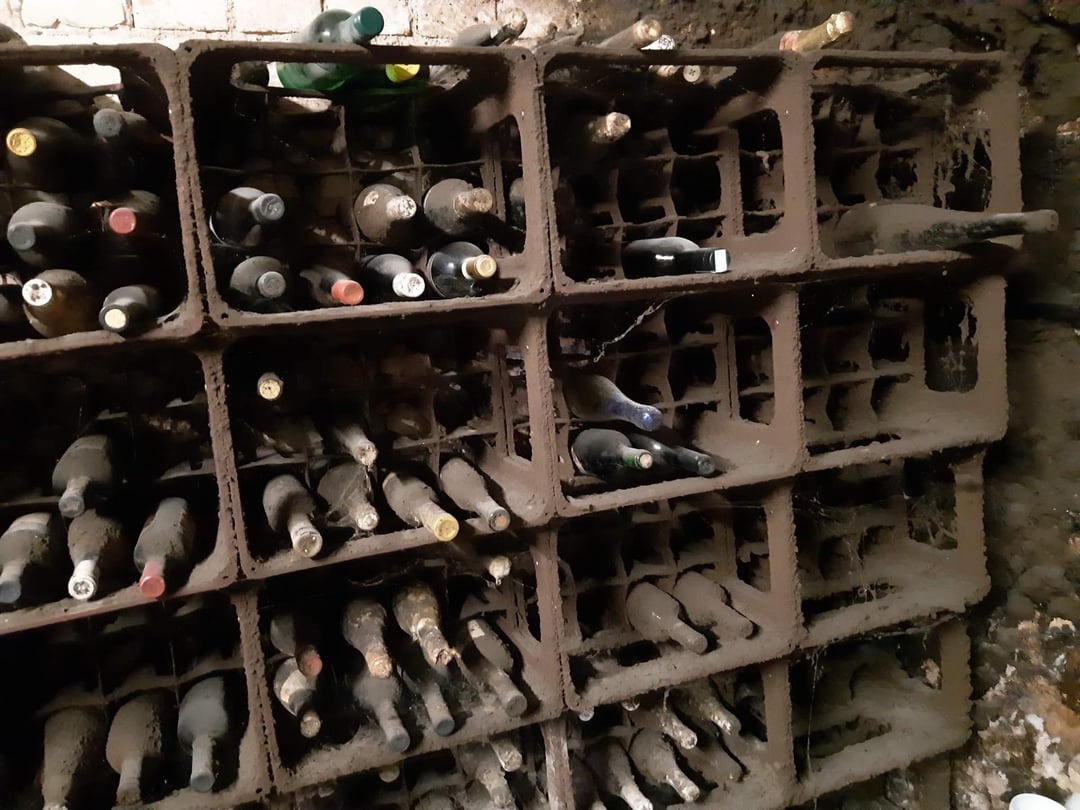
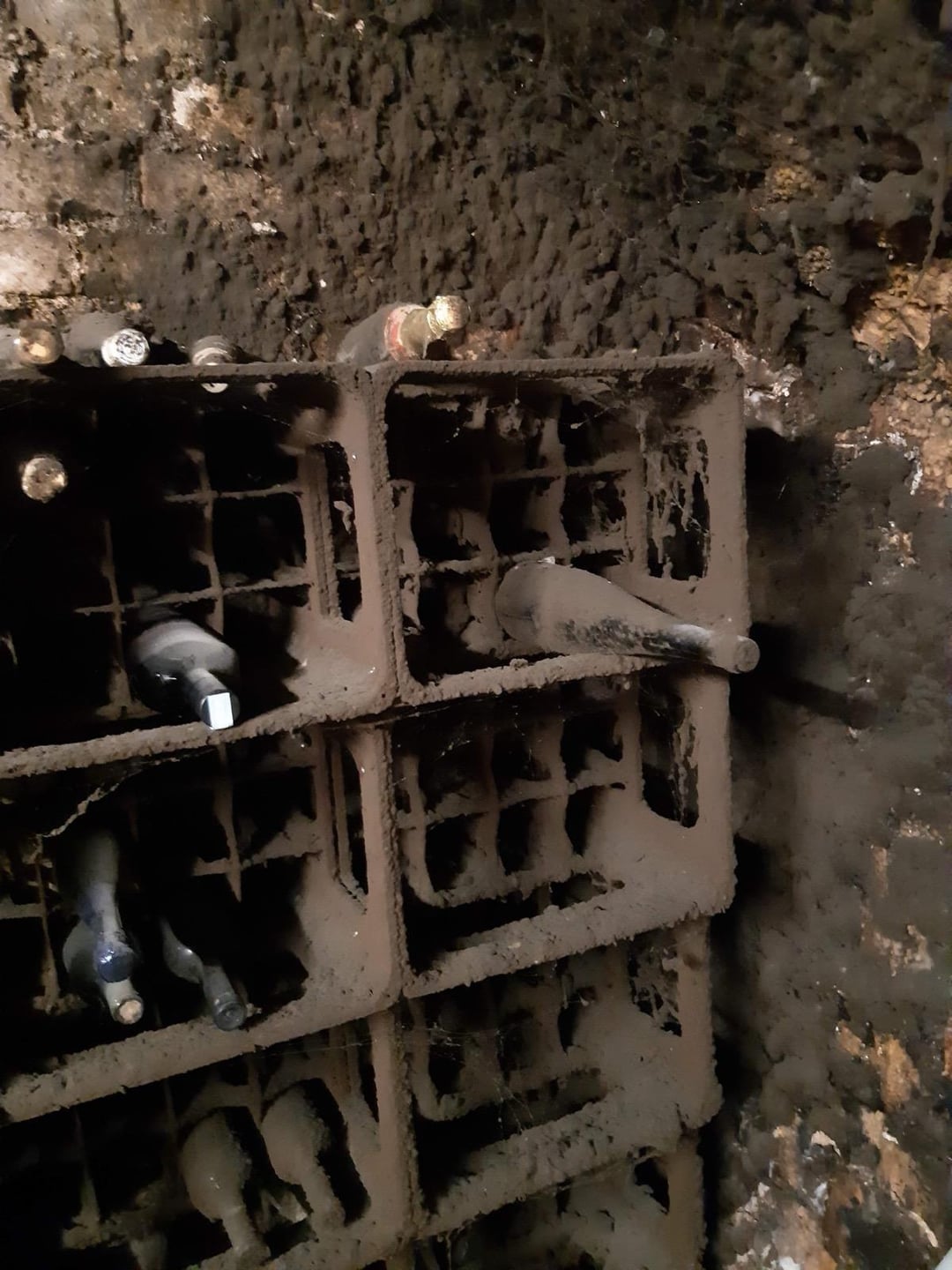
I recently discovered these bottles in a private wine cellar that appears to have been untouched for many years, possibly decades.
Known details:
• Private cellar, not commercial storage

• Bottles stored lying flat, directly on simple shelving

• Cool, dark environment, no light exposure

• Heavy dust buildup, some labels missing or illegible

• Exact origin and vintages unknown
I know that age alone means nothing and that most old wine doesn’t make it – but the horizontal storage and stable cellar conditions made me curious enough to ask here before touching anything.
Questions for the r/wine community:
• Based on storage conditions alone, is it reasonable to assume any survivability?

• What would you check first: fill levels, capsule seepage, cork integrity?

• Would you open a “sacrifice bottle” or leave everything untouched?
Not expecting hidden gems – genuinely interested in learning how experienced wine people would approach this situation.
Thanks in advance 🍷
by hmo-stone
20 Comments
very much depends on what wines.
if they’re all 15$ costco bottles, then that’s a lot of vinegar
It’ll just depend on the wines. Based on your description, if the wine was decent and intended for aging in the first instance it’ll probably be in good shape for its age now. Humidity levels are a question mark but if it’s been basically cool/dark/not particularly dry they’ll probably be fine IF they were wines that could go a couple decades in good conditions. Would love to see pics of some of the bottles if you get in there and blow the dust off a few.
It strongly depends on the bottles but theoretically yes! These were basically stored in ideal conditions. I’ve been lucky enough to have tasted a 60+ year old bottle of Dom and 40+ year old bottles of Barolo and Bordeaux and all were still very much alive and well!
In the immortal words of this sub – there’s only one way to find out!
If you’re in MA/CT I’ll buy em
They are most probably bad.
try to carefully clean them up and make an inventory.
look at the cork; it will be the first clue.
>Would you open a “sacrifice bottle” or leave everything untouched?
yes, open one, probably after making an inventory and looking at the overall condition of the cork and fill.
I would carefully dust off a few labels to see what you’re working with regarding what there is and a rough vintage range. There not much else to do until you know what’s there. If it’s a bunch of Madeira it’s drinking great. If it’s a bunch of Bordeaux from 1945 it’s worth money. If it’s a bunch of white zin from the 90s you can toss it all.
Depending on the veriatal you could have something good. If they started as value driven wines you’ve probably got a lot of vinegar. I’d check out that bottle of sparkling on top and to the right to get a baseline of when the rest are.
Somethings to keep an eye on :
Pushed out corks
Leaking from capsules
Lead capsules – depending on how old they are they may be capsules of lead. You might need to be extra cautious when cleaning and opening.
Post some pics of the labels, if they are at least partly legible, then people will tell you.
Looks like a lot of fun. Enjoy the quality control process.
Those are either really old or in a bad place for storage. Hopefully you don’t Bad Luck Brian it and find all 1960 and 1963 Bordeaux.
What does the house look like? Did the people have money? There are a lot of clues to tell you more about the wine. Are you in an area with historic access to great wine? Come on, spill the wine, taste that pearl.
Thanks, that’s actually very helpful.
Yes, a few of the bottles appear to be from a small private winery in Baden-Württemberg, Germany. Unfortunately, most labels are either heavily damaged or completely gone, so I don’t have vintage or producer details yet.
Storage-wise, the cellar was consistently cool and dark, and the bottles were stored horizontally the entire time. That said, I’m fully aware that small producers + unknown vintages + long storage is very much a gamble.
My next step will likely be to check fill levels and capsule condition more closely before deciding whether to open a sacrificial bottle.
If helpful, I’m happy to share close-up photos of necks, corks, or any remaining label fragments.
Appreciate the input.
I have tasted quite a few 30-50 years old reds that had been stored properly. My general experience is that their enjoyability greatly depends on the wines. Pinots from Bourgogne and Alsace aged beautifully, so did the majority of the Bordeaux ones. The ones that didn’t age well at all were for example the Moulin-à-Vent(unsurprisingly) or southern france Syrahs. So I suggest you to check the varieties and of course you can always look at the bottles with some light behind to look for the sediments that are the most obvious signs of degradation.
Looks like the place to store wine
We’ve had some old Rieslings with big ullage and they were still fine. I wouldn’t toss anything!
Are you looking for wines to drink or wines to sell?
Those are highly hazardous let me know where they are and I will safely dispose of them for you!
I’m going to predict there are some bottles worth drinking in there. Cellared by someone who liked wine enough to stash several bottles with apparent good storage conditions. And doesn’t look like any corks are pushed out (good sign).
Sweet german Riesling can be stored for 20-30 years without any problems, so probably a few good experiences will be in between. Hope to get photos and tasting comments 😋
WOW! What an amazing score! I wonder how many of them may be corked, or good enough to recork!