
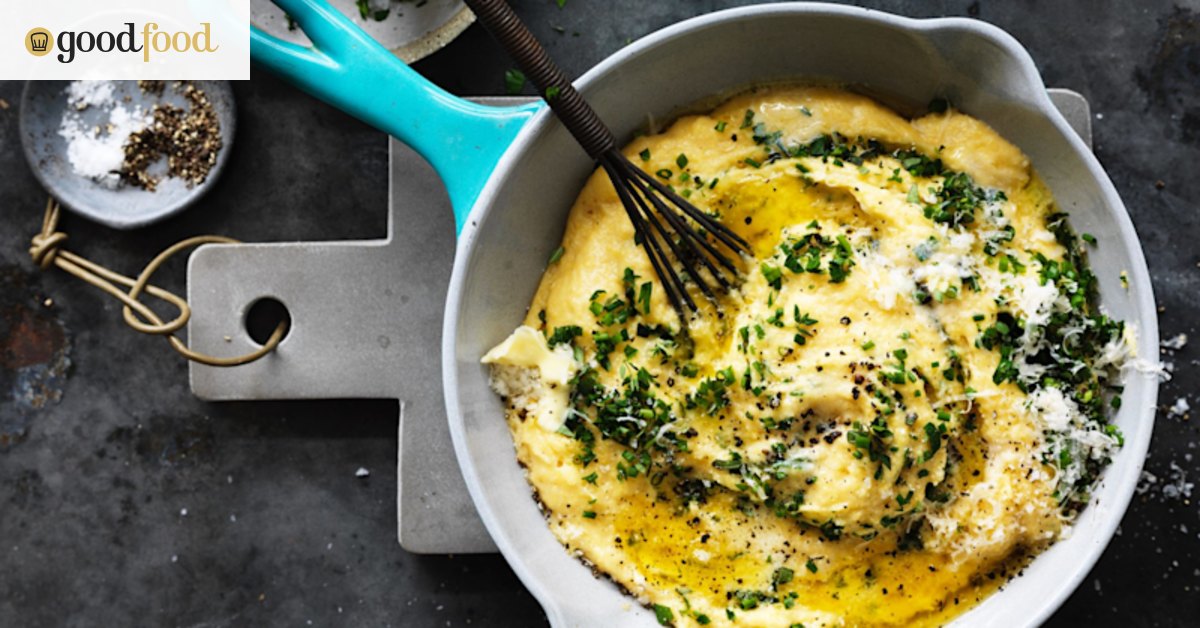
As one of the signature dishes of the Milan and Cortina d’Ampezzo region, polenta is finally having its golden moment. Plus: how to cook it at home.
Save
You have reached your maximum number of saved items.
Remove items from your saved list to add more.
Save this article for later
Add articles to your saved list and come back to them anytime.
Got it
AAA
Once dismissed as the humble sustenance of the rural poor, polenta is having a moment, courtesy of the Milano Cortina 2026 Winter Olympics, kicking off on February 6, where it will be proudly prepared and served to athletes and spectators.
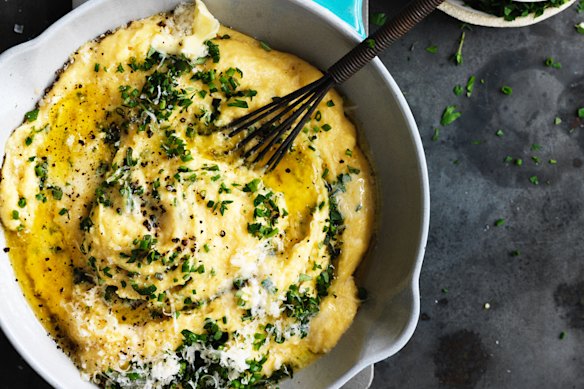 Ultimate comfort food: Adam Liaw’s winter herb polenta.William Meppem
Leading the Olympic hospitality strategy are Michelin-starred chef Carlo Cracco and Olympic Games Food and Beverage Director Tommaso Cavallari, who likes his polenta with sweet, nutty twist.
“I’m from Trento [in a glacial valley south of the Dolomites], so polenta is really a part of my childhood and part of my gastronomic culture,” says Cavallari. When he stayed at his grandmother’s as young boy, he’d eat slabs of fried polenta loaded with Nutella for breakfast. “Honestly, it’s insanely good,” he says.
To help inspire Australian home cooks watching the luge, bobsleigh or ice hockey into the wee hours, Cavallari shares his tips for creating Olympic-inspired TV snacks, and explains why polenta is such an important part of Italy’s cultural identity.
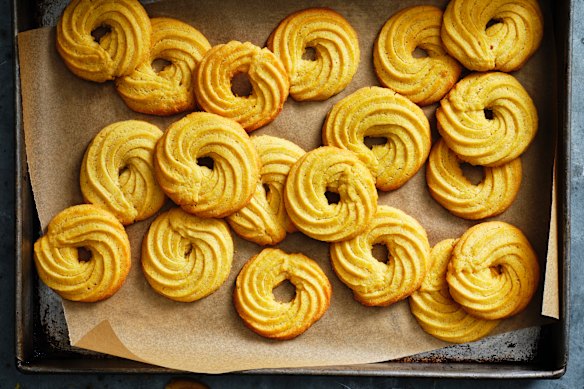 Polenta is great in sweet bakes too, Julia Busuttil Nishimura’s Piemontese polenta biscuits.William Meppem
The best recipes from Australia’s leading chefs straight to your inbox.
Sign upWhat is polenta?
Polenta is a versatile pantry staple made from coarsely ground yellow or white cornmeal or buckwheat. It can be simmered and stirred into a creamy porridge, baked in a cake, or allowed to set into a solid slab and fried as chips or grilled as “toast” for eggs (or Nutella).
Related Article
In the south and middle of the country, Italians eat mainly pasta and bread, but in the north, they prefer rice and polenta. Historically, southerners were called mangiamaccheroni (macaroni-eaters), while northerners were dubbed polentoni (polenta-eaters).
In 2025, UNESCO acknowledged Italian cuisine as an Intangible Cultural Heritage of Humanity, and Cavallari describes polenta as a “universal language” across northern Italy, where every region has its own version.
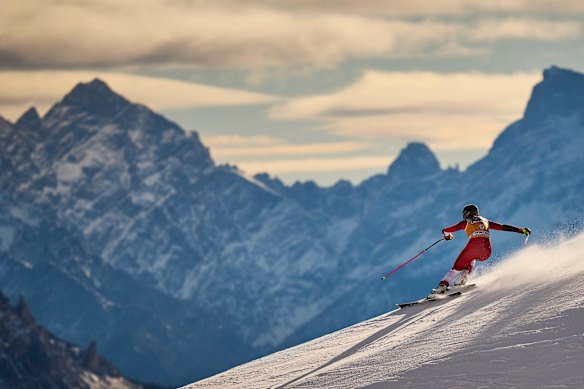 The Olympia delle Tofana run in Cortina d’Ampezzo is the spectacular setting for some upcoming Winter Olympics slope action.Julian Finney/Getty ImagesRegional variations of polenta
The 2026 Winter Olympics are the most geographically widespread Games ever staged, a sprawling 22,000 square kilometres, traversing the volcanic thermal valleys and rugged limestone peaks of northern Italy.
Cavallari says in Veneto, locals eat polenta with fish caught from the nearby lakes, while the higher elevations favour pairings of porcini mushrooms and meaty ragus, such as venison.
“No northern Italian would ever put butter in their polenta.”
Tommaso Cavallari, Olympic Games Food and Beverage Director
In Livigno, at altitudes where temperatures hit minus 15°C, polenta is enriched with aged Alpine cheese. At altitude, polenta is comfort food with cultural heft, fuelling athletes and spectators in cold weather.
“Polenta has evolved in the Italian gastronomy,” says Cavallari. “It’s not only a poor dish any more. It can be done still the old ways, but you’ll find it basically everywhere in the northern gastronomy.”
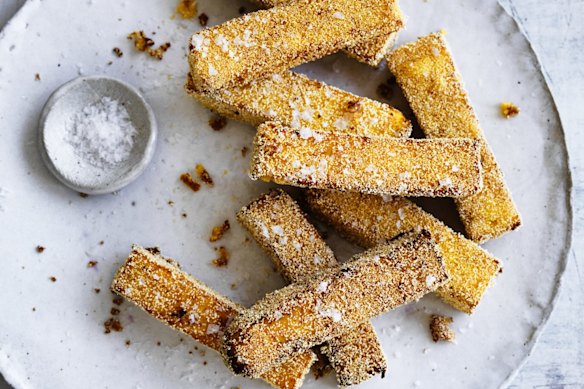 Neil Perry’s polenta chips.William MeppemHow to cook and store polenta
Traditionally polenta is cooked in a copper pot on an open fire, and this is how it will be prepared and served for athletes and spectators during the Winter Olympics.
For the home cook, a saucepan and stovetop work just as well, but the sticking point for many is the idea that polenta must be stirred continuously for 50 minutes. Cavallari says the length of time relates more to the rough, hand-ground grains of traditional times and swears supermarket polenta, such as the brand il Molino, cooks easily within 15 minutes.
Related Article
To cook polenta, Serious Eats suggests a five-to-one ratio of liquid to cornmeal, yielding polenta that’s fully hydrated and creamy, with no raw or gritty bits. Italian chef Stefano Manfredi recommends frequent stirring over a low flame to avoid lumps.
For the liquid, use milk for a rich, velvety texture, or water for a milder flavour. Either way, salt is a must, and Cavallari is quick to point out that, “no northern Italian would ever put butter in their polenta”. His favourite pairing is gorgonzola.
The polenta is ready when it begins to “talk”, a burbling sound made by thick bubbles that pop on the surface showing the starch has fully gelatinised.
Turn off the heat and fold in gorgonzola or your choice of topping and dive in. If there’s any leftovers, Manfredi suggests wrapping polenta in a tea-towel (rather than clingfilm which cause it to “sweat”) and keeping it in the fridge to be eaten the next day.
Related
Milano Cortina 2026 Winter Olympics runs February 6-22, followed by the Paralympics from March 6-15. Catch the action on 9Now and Stan Sport.
Save
You have reached your maximum number of saved items.
Remove items from your saved list to add more.
From our partners
Dining and Cooking