
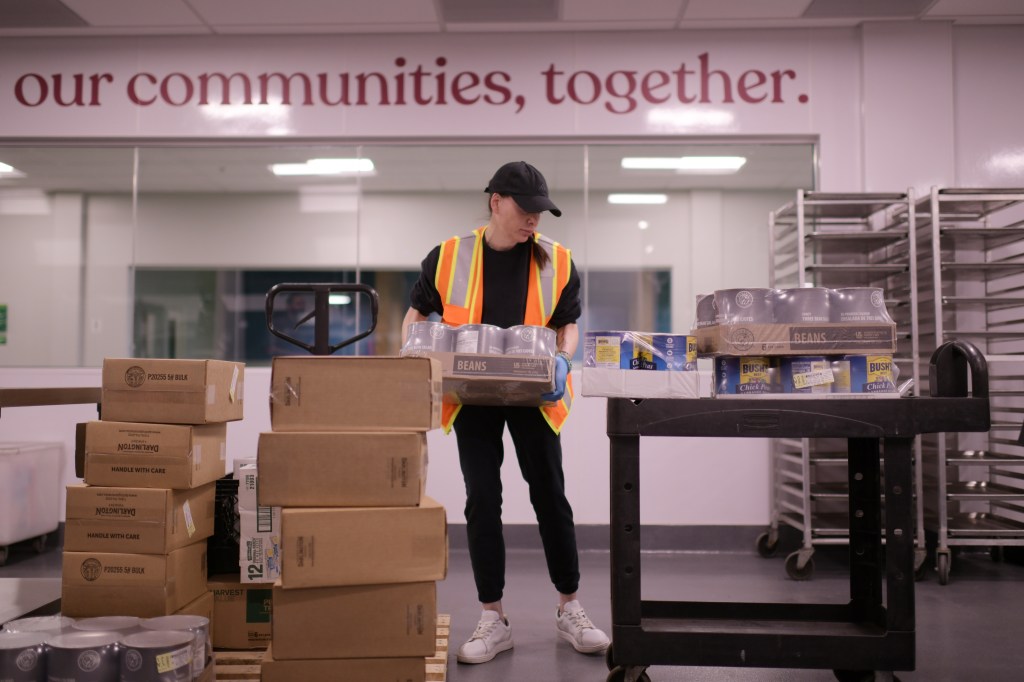
Food Bank of the Rockies is expanding its job training programs to help clients find culinary jobs that hopefully will keep them from needing the hunger-relief organization’s services in the future.
Generally, there are two ways into the restaurant world: attending a culinary school or getting an entry-level job in a kitchen and gradually working up, said Jon Knight, executive chef and director of culinary operations at Food Bank of the Rockies.
The food bank’s new Community Culinary Pathways Program will give people with barriers to employment who want to work in the industry but can’t afford culinary school a chance to move up the ladder faster, he said.
Currently, the food bank has two interns who attend the Auguste Escoffier School of Culinary Arts in Boulder and started off working in the packing area of the food bank’s new Aurora facility before moving into the kitchen, Knight said. The community pathways participants will begin with learning safe food handling, then progress to the preparation and cooking skills that the interns mastered in culinary school as they help make meals for after-school programs, he said.
Ultimately, the goal is for each graduate to learn not only cooking techniques, but also the basics of ordering and financial management for a kitchen, Knight said.
“It puts them in a position to really grow,” he said.
The additional labor will also benefit the food bank, allowing it to expand its after-school program and to offer more scratch-cooked items in the meals.
Currently, the kitchen in the new facility produces 2,400 to 2,700 meals each school day for kids in metro Denver, and about 40% of the items are cooked from scratch, Knight said. He’d like to expand that capacity to 10,000 meals per day to reach more after-school programs, with 80% scratch cooking.
Daria Mirgorodskaia, one of the current interns, said working in a food-bank kitchen requires a different skill set than she’d used before.
In culinary school, students have to prepare one meal at a time and are encouraged to experiment. At the food bank, following the recipe exactly is vital because they have to churn out 2,500 nearly identical meals, she said. Unlike the students who will start in the community culinary program, Mirgorodskaia and other interns are enrolled in a traditional culinary program while also learning at the food bank.
On Wednesday morning, Mirgorodskaia was hefting industrial-sized cans of beans so she could drain and combine them to make a salad. Everything was larger than in the culinary school kitchen or the farm-to-table restaurant where she also interns part-time, from ovens the size of most people’s refrigerators to a stand mixer with a bowl large enough to bathe a toddler.
Most Escoffier interns only get to experience one setting, but working in the food bank and a restaurant that serves maybe 30 people a night allowed her to get a sense of both extremes of the industry, she said.
“It’s a much bigger scale, so the prep is a lot more intense,” she said.
Erin Pulling, president and CEO of Food Bank of the Rockies, said workforce training is a major part of the group’s mission. About 10% of the food bank’s 175 employees in Denver started through an employment partnership with Stout Street Foundation, working in the food bank’s warehouse as part of their addiction recovery, she said. Some are now supervisors.
The food bank’s recently opened facility in Aurora will allow it to train more people because of the additional kitchen and warehouse space, Pulling said. The facility has gradually come online over the last few weeks, though the warehouse isn’t yet full. Most likely, the food bank wil hire more Stout Street clients, though they could also begin partnering with other organizations working with people who have barriers to employment, she said.
The 270,000-square-foot facility, which cost about $75 million, allowed Food Bank of the Rockies to move out of two smaller spaces, saving money on operations in the long term. The increased space will allow it to accept some donations it previously had to turn away, such as large amounts of frozen produce that it didn’t have the space to break into smaller packages that families could use.
Helping people to get jobs that provide food security will be particularly important in the coming years, with demand for help through food banks projected to double nationwide, Pulling said. States will have to shoulder a larger share of the costs of the Supplemental Nutrition Assistance Program, possibly forcing cuts, and the federal government is sending less commodity food than it did before the pandemic, she said.
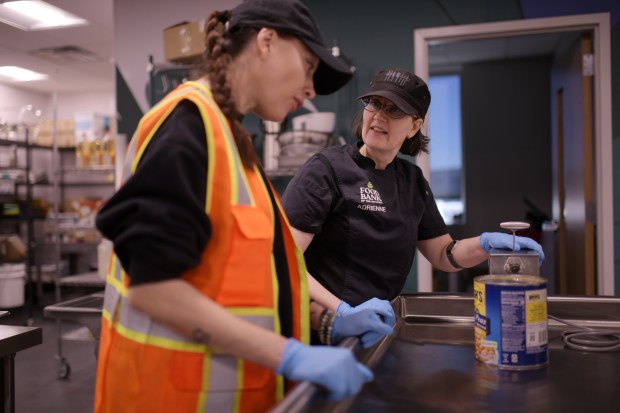 Sous chef Adrienne Flowers, right, talks to Intern Daria Mirgorodskaia at Food Bank of the Rockies in Aurora on Wednesday, Feb. 4, 2026. (Photo by Hyoung Chang/The Denver Post)
In 2024, the food bank had a roughly $173 million budget and assisted about 417,000 people in Colorado and Wyoming, mostly via local organizations that operate their own food pantries. While their contribution is significant, it pales in comparison to the Supplemental Nutrition Assistance Program, which pays for about eight meals for every one funded by food banks, Pulling said.
“We’re continuing to see this reduction (in federal assistance) while we’re seeing a big increase in need,” she said.
If all goes as planned, the first cohort of six community culinary students will start mid-year and finish about six months later. Over time, the number of students will increase as they bring in new partners who commit to hiring graduates, Knight said.
He estimated the program will cost about $150,000 per year once it reaches the full capacity of 24 students per year, with the money coming from workforce training grants and community donations.
“In the grand scheme, it doesn’t feel like a lot to change the lives of 24 people a year,” he said.
Sign up for our weekly newsletter to get health news sent straight to your inbox.
Dining and Cooking