
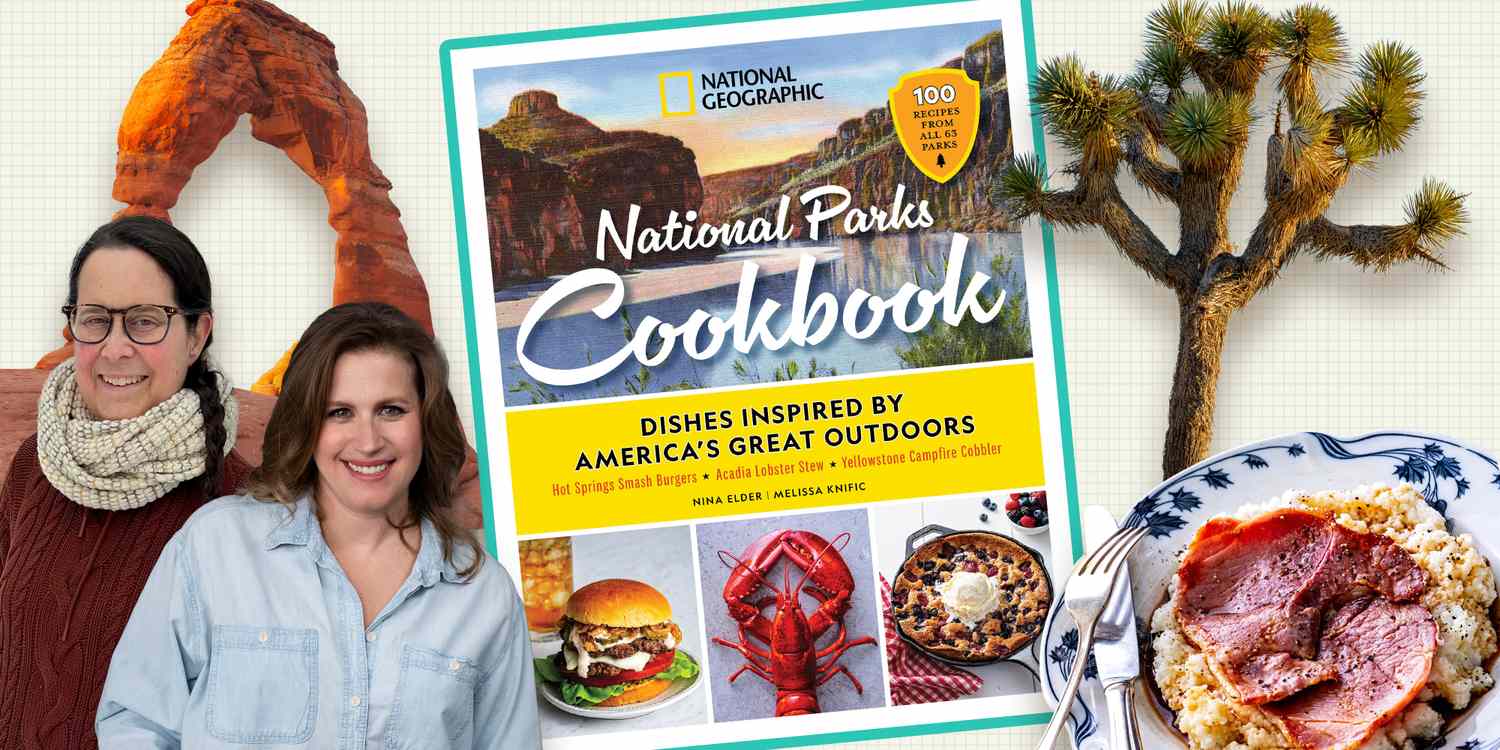
The best way to conceptualize National Parks Cookbook by Nina Elder and Melissa Knific, released Feb. 3, is to think of it as a three-in-one. It’s a cookbook, of course, but also a guide and history book, and ultimately a wishlist in the making. As I went through the book the first time, I found myself devising a system of “make this!” “been there!” “go here!”
Given the project’s multifaceted nature, it makes sense to have two authors who grew up in different parts of the country (Missouri and Ohio, respectively) and currently reside in different places (Rhode Island and New Jersey). The two met years ago in the Meredith test kitchen while Elder was working for Everyday with Rachael Ray and Knific was working for Family Circle. Over the years, they kept in touch and hoped to work together someday. Then, in March 2023, this project came to light, and the stars aligned. Although Elder and Knific haven’t yet been to all 63 national parks, they dug deep to find meaningful information about each area, including studying history, interviewing people on the ground, and tapping local chefs.
National Parks is structured as a cookbook, but know that this isn’t a gather-round-the-campfire-and-cook-by-live-fire kind of tome. Yes, there are 100 recipes, and while some could be made while camping (like the Arches’ No-Bake Apricot-Almond Granola Bars, page 34), the vast majority are designed to be enjoyed in the comfort of your home or backyard. The focus of the book is to tell the story of place—be it through a specific ingredient (wild hearts of palm in the Florida Keys), a restaurant recipe (a tri-tip sandwich near Joshua Tree), or a tradition (Teddy Roosevelt’s beloved biscuits in North Dakota) reflective of the respective park.
Allrecipes: Tell me a bit about how the idea for this book came together.
Nina Elder: The idea originated with National Geographic, but it was just the concept. It was just the broad strokes, like at least one recipe from each park. When I first accepted, I was freelancing, but I got a full-time job during the process. I was working on this on the weekends. At a certain point, I realized I needed some help. I went back to [my editor] and said, “This is an immense project, and I want to make sure we do the best we can. Can I bring on a co-author?”
Melissa Knific: It was a couple-year project. We would have calls every Thursday where we would get on Zoom and ideate and work on spreadsheets. We made sure we were covering at least one recipe from every park, and some have two. We wanted to make sure we had diverse recipes. We wanted to represent different cultures, different regions, and also wanted to make sure there wasn’t a lot of crossover. On top of that, we were making sure that we were thoroughly researching each park. Between Nina and me, we’ve been to a lot of parks, but not all of them.
I love the history in the book. Of course it includes details like that Yellowstone was the first designated park, but I also mean the history of food in and near the parks. It really makes you think about the range of climates and regional influences on culture and food.
MK: We hope the book brings positive attention to this amazing system that’s in place. We hope it brings back memories, too. Not everyone can or will be able to get to these parks, but we can bring the dishes to them. I have two younger kids…and I was thinking about how this has been a history lesson for them. They taste all the dishes, and it’s been fun to share with them. How fun would it be if this book were in schools to learn history in a different way? We can learn so much through food.
It’s funny, I didn’t realize the Gateway Arch in St. Louis was a national park. I’ve always thought of it as a designated landmark. Were there many surprises for you when researching the book?
NE: So many surprises. The breadth and depth of the national parks, and the distinction between what really are national parks, lent the opportunity to dig a little deeper into these places. The challenge for me was how to represent these places. How do you distill something that’s as small as the footprint of the Arch or as expansive as the parks in Alaska? California and Alaska have so many parks! It makes sense because there’s so much land, and it’s heartening to realize that it has some protection.
MK: There’s a recipe that I think about often. I developed Country Ham with Red-Eye Gravy & Grits (page 210) for the Shenandoah National Park in Virginia. I knew that country ham is very popular, but I didn’t know about the Ham Belt, which is a certain strip around the globe where the conditions are ideal for curing ham.
I’ve always wanted to go to Joshua Tree National Park, but now with that photo of Pappy & Harriet’s tri-tip sandwich, it’s rocketed even higher on the list.
NE: During the process of the book (this was Feb 2025), my husband, son, and I went out to Landers, California, to visit one of our friends. After working on the book, I wanted to go to Joshua Tree, and I went to Pappy & Harriet’s for their sandwich (Pappy & Harriet’s Tri-Tip Sandwich, page 144). We had gotten the recipe from them, and I made it in Rhode Island on our grill. Then I went to Joshua Tree, hiked in the park, and went and had that sandwich. It was delicious and full circle. I was sitting there in the restaurant, and it was such a delightful kind of thing.
When it’s all said and done, do you have a favorite recipe?
MK: The most remote national park is Gates of the Arctic in Alaska, and the recipe [Wild Blueberry Sourdough Waffles, page 96] ended up being one of my favorites. There was a two-part thought process. Access to food is super tricky there because it’s so deserted, so cold, you have a short window of when vegetation [like wild blueberries] grows. Also, sourdough is a big thing in Alaska, so combining those two things made sense. Also, the recipe for Pulled Pork With Mustard Barbecue Sauce [for Congaree National Park, page 68] is close to my heart. I grew up going to South Carolina every summer, and Southern food really speaks to me. I made the pulled pork accessible by using a slow cooker [instead of cooking it in a pit]. And I served it with collard greens (Smoky Collard Greens, page 69).
NE: There’s the Mile-High Blackberry Ice Cream Pie [inspired by Shenandoah National Park’s Skyland resort, page 208]. It’s not difficult, and there are these little tips and tricks. It looks very impressive, but you start with a store-bought crust, and you toast it a bit so there’s a little flavor and more structure, so it’s not going to sog out and will cut more cleanly. Then you use softened blackberry ice cream (or use vanilla and berries or just use your favorite ice cream), then you make a simple meringue. It takes time, but it’s very doable. Other recipe highlights were Diana of the Dunes lavender latte (Indiana Dunes National Park, page 140). Melissa found that one, and the backstory to that was so nice—how the local coffee shop owner has brought the person of the park into present day.
Do you have a favorite park?
MK: They’re all so diff. The Florida Keys are so amazing, and the Grand Canyon—there’s nothing else like it. But then there’s Zion. I don’t know if I can pick a favorite. Beauty is relative to different landscapes.
NE: As someone who grew up in Missouri (way down by the Arkansas border), I’m going to have to go with the Gateway Arch National Park. Although I haven’t been there since I was a kid, and long before it received its national park designation, the experience still feels fresh in my mind. I remember looking out from the observation deck and being in awe of the view. It’s such an iconic structure, and it’s a reminder that a national park doesn’t have to be huge and vast.
Dining and Cooking