
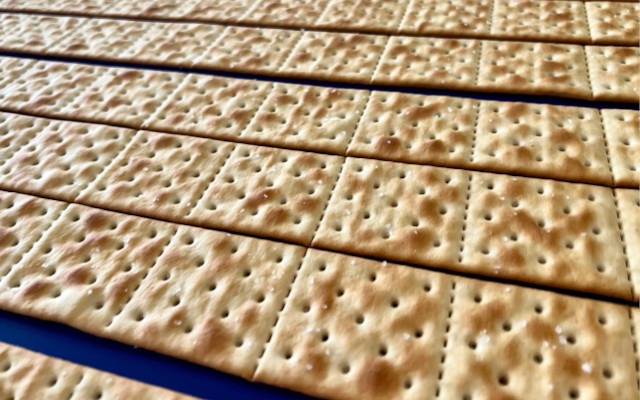
I Italian crackers represent one of the most consolidated categories of the industrial dry bread making, appreciated both on the domestic market and in export channels. Born as a simple and versatile product, crackers have gradually evolved by integrating technological innovation, nutritional attention, and a growing range of variants. premium, biological and functional, in line with current consumer expectations and with the international positioning of the Made in Italy agri-food.
Sector numbers: exports and performance 2024-2025
According to the most recent sector analyses, the Italian sector of bakery products – which includes biscuits, crackers, breadsticks, rusks, and leavened products – remains among the most dynamic in the national food industry. In 2024, overall production stood at 1.463.994 tons (-0,6% compared to 2023), while the value reached 7.937 million euro (+0,4%), confirming the sector’s ability to enhance its offering through differentiation and specialization (Unione Italiana Food, 2024).
THE export of baked goods has recorded significant growth, reaching 886.086 tons (+11,2%) for a value of 4.304,2 million euro (+13,3% compared to 2023), representing the most dynamic segment after pasta within the sectors represented by Unione Italiana Food (Unione Italiana Food, 2024; ISTAT, 2024).
Major target markets include Germany, France, United States, UK, Spain e Poland, where Italian crackers are appreciated for their quality standards, food safety, and product diversification. Emerging markets such as Middle East, East Asia e northern Europe represent new opportunities, particularly for the lines biological, ‘clean label ‘, gluten free and functional products, consistent with global trends in conscious consumption.
From the sailor’s biscuit to the modern cracker: an Italian story
The term cracker comes from English to crack, referring to the dry noise produced during breaking. However, contrary to the Anglo-Saxon name, The invention of the modern cracker has its roots in Mediterranean tradition and in the long Italian history of dry bread making, from the sailor’s biscuit to today.
In Italy, products similar to modern crackers appear among late nineteenth and early twentieth centuries, as an industrial evolution of the unleavened bread, dry biscuits intended for long-term storage and Turin breadsticks already documented in the 18th century. The first Italian industrial production of crackers dates back to the 20s, when some companies in the Po Valley began to produce thin and crunchy biscuits on a large scale, intended for both civilian consumption and military supplies (Capatti & Montanari, 2005).
In the post-war period, with the spread of industrial baking and modern distributionCrackers established themselves as an everyday staple, an alternative to fresh bread, thanks to their convenience, shelf life, and quality standards. From the 80s onward, the Italian industry gradually diversified its offerings, introducing whole-grain, multigrain, and organic varieties that anticipated many international trends.
La Italian legislation defines crackers precisely through the Presidential Decree 283/93, reserving this denomination for products obtained according to a specific production process, with a humidity content not exceeding 7% of the weight of the finished product (average tolerance of 2%).
Production areas, agronomic practices and sustainability
The production of crackers is widespread throughout the country, with a greater concentration of factories in Northern Italy – in particular in Emilia Romagna and Lombardy, Lombardia e Piedmont – in the vicinity of the cereal supply chains, logistics hubs and main consumer markets.
Agronomic practices depend on the supply chain Wheat, the main raw material. The growing interest in organic products has stimulated attention towards:
crop rotations and integrated weed management,
reduction of chemical inputs and optimization of fertilization,
traceability of supply chains from the field to the shelf,
supply from certified organic agriculture (CREA, 2023; EU Reg. 2018/848).
On the industrial level, many companies adopt environmental management systems certified (ISO 14001), waste reduction, energy recovery and water optimization programs, in line with the ESG objectives of the food sector and with the circular economy strategies promoted by the European Commission.
The legal framework: the requirements of Presidential Decree 283/1993
In Italy, the Presidential Decree 283/1993 – ‘Regulation on the legal names of certain bakery products’ – introduced the legal requirements that a series of ‘bakery’ category foods must meet, in order to be marketed under their respective names.
‘The name ‘Crackers’ is reserved for
bakery products obtained from
rapid cooking of one or more doughs, even leavened ones, of one or more cereal flours, even wholemeal, with water e
with the possible addition of salt, sugars, oils and fats, malt, malted products, bran and other ingredients, as well as permitted flavourings and additives.
Crackers are obtained by stamping and their standard of humidity cannot exceed 7% by weight of the finished product, with an average tolerance of 2% in absolute value'(DPR 283/1993, article 1).
Production technology: from fermentation to lamination
The basic ingredients of the traditional crackers include:
wheat flour (type 0, type 1 or integral),
vegetable fats (sunflower oil, corn oil or extra virgin olive oil in the premium lines),
yeast or leavening agents,
Il productive process It involves several controlled phases:
Dough: mixing of ingredients with calibrated hydration (35-45% of the flour).
Fermentation: chemical (with leavening agents) or biological (with brewer’s yeast or mother yeast), which can last from 30 minutes up to 16-24 hours for the artisanal variants.
Lamination: successive passes of the dough between cylinders to obtain the desired thickness (1,5-3 mm).
Forming and drilling: cutting into standardized formats and creating micro-perforations that facilitate uniform cooking and prevent swelling.
cooking: at temperatures between 200°C and 280°C for 4-8 minutes in continuous tunnel ovens.
Cooling and packaging in protective atmosphere (MAP) to preserve crispiness and shelf-life (Lagoudaki et al., 2023).
The variants with mother yeast involve longer times and a more complex aromatic profile, with the development of volatile compounds that confer characteristic notes (De Vuyst & Neysens, 2005).
Innovation, clean label, and organic: the new face of premium crackers
The Italian food industry offers a wide variety of crackers, including:
classic crackers (with leavening agents);
multigrain and ancient grains (spelt, Senatore Cappelli);
integrals and semi-wholemeal, a rapidly growing segment;
biological certified pursuant to Regulation (EU) 2018/848;
to extra virgin olive oil (EVOO);
to mother yeast and long fermentations;
gluten free (based on rice, corn, buckwheat, legumes);
a low fat content, in accordance with Regulation (EC) No. 1924/2006, Article 9, i.e. with a minimum reduction of 30% compared to the average of the best-selling products in the same category on the Italian market;
enriched with semi (sesame, flax, chia, sunflower) or natural flavors.
This diversification allows for a positioning that goes from the classic product to the gourmet crackers, responding to the needs of consumers attentive to well-being, biodiversity and the most refined flavours, as well as people with gluten intolerances.
Nutritional analysis: fiber, lipids, and the role of sourdough starter
According to the Food composition tables of CREA (2023), 100 grams of crackers provide on average:
carbohydrates: 67,5 g (of which starch 61,4 g),
fats: 10 g (variable depending on the recipe),
protein: 9,4 g of cereal origin,
dietary fiber: 2,8 g in classic versions, up to 6-10 g in the integrals and multigrain,
salt: 1-2 g (to be monitored, as part of a balanced diet).
La medium portion It is indicated as 30 g, as these are light products in relation to their volume and packaged in small containers. The versions integrals have, on average, a more favorable nutritional profile in terms of fiber, B vitamins, minerals (magnesium, iron, zinc) and bioactive compounds (Jonnalagadda et al., 2011). dietary fiber from whole grains is associated with cardiovascular benefits, glycemic control, and gut health (Reynolds et al., 2019; Aune et al., 2016).
Crackers formulated with extra virgin olive oil They have a better lipid profile, with a greater presence of monounsaturated fatty acids and polyphenols with antioxidant action, although cooking at high temperatures can partially reduce their content (Servili et al., 2009).
The use of mother yeast It can improve digestibility and reduce the glycemic index, thanks to the partial hydrolysis of starches and the production of organic acids during fermentation (Gobbetti et al., 2014).
Uses in cooking and food service
I Italian crackers are consumed:
including alternative to bread during meals,
negli snacks daily newspapers, at home and away from home,
in combination with cheese, cold cuts, preserves, jams and vegetable creams,
as a basis for finger food, aperitifs and high-end catering,
of collective catering (school, company, hospital canteens) and commercial,
in creative preparations (breadcrumbs, bases for savory cheesecakes).
Advice for buyers
For conscious consumers, it is advisable to favor crackers:
certified organic (EU reg. 2018/848),
to extra virgin olive oil as the only fat,
a natural leavening (mother yeast),
with ingredient lists simple (‘clean label’),
with moderate content of salt.
For the international buyers, it is essential to evaluate:
supplier reliability and production capacity,
certifications process and product (BIO, IFS, BRC, FSSC 22000, gluten-free),
continuity of supplies and commercial flexibility,
compliance with the regulations of the destination markets (FDA, CFIA, SFDA),
full traceability of the supply chain and compliance documentation.
The Eurobursar GIFT – Great Italian Food Trade offers specialized expertise in selecting reliable Italian manufacturers, supporting international buyers in supply chain analysis, document verification, and strategic product positioning on international markets.
Conclusions
Today, the Italian cracker represents the perfect blend of technical rigor and gastronomic versatility. The ability to innovate without compromising the simplicity of the original recipe—supported by national regulations that protect its identity—gives this product an unstoppable competitive advantage in international markets. GIFT continues to monitor and support the excellence of this supply chain, a cornerstone of the Italian agri-food system.
Cover credit: Crich 1870
References
Aune, D., Keum, N., Giovannucci, E., Fadnes, L.T., Boffetta, P., Greenwood, D.C., … & Norat, T. (2016). Whole grain consumption and risk of cardiovascular disease, cancer, and all causes and cause specific mortality: Systematic review and dose-response meta-analysis of prospective studies. BMJ, 353, i2716. https://doi.org/10.1136/bmj.i2716
Capatti, A., & Montanari, M. (2005). Italian Cuisine: History of a CultureISBN-13: 978-8842076759. Rome-Bari: Laterza.
Gobbetti, M., Rizzello, C. G., Di Cagno, R., & De Angelis, M. (2014). How the sourdough may affect the functional characteristics of leavened baked goods. Food Microbiology, 37, 30-40. https://doi.org/10.1016/j.fm.2013.04.012
Jonnalagadda, S.S., Harnack, L., Liu, R.H., McKeown, N., Seal, C., Liu, S., & Fahey, G.C. (2011). Putting the whole grain puzzle together: Health benefits associated with whole grains—Summary of American Society for Nutrition 2010 Satellite Symposium. The Journal of Nutrition, 141(5), 1011S-1022S. https://doi.org/10.3945/jn.110.132944
Lagoudaki, V., Nouska, C., Grigorakis, S., & Makris, D. P. (2011). Optimization of microwave-assisted extraction of phenolic antioxidants from cracker waste using response surface methodology. Foods, 12(3), 527. https://doi.org/10.3390/foods12030527
Reynolds, A., Mann, J., Cummings, J., Winter, N., Mete, E., & Te Morenga, L. (2019). Carbohydrate quality and human health: A series of systematic reviews and meta-analyses. The Lancet, 393 https://doi.org/10.1016/S0140-6736(18)31809-9
Servili, M., Esposto, S., Fabiani, R., Urbani, S., Taticchi, A., Mariucci, F., … & Montedoro, G.F. (2009). Phenolic compounds in olive oil: Antioxidant, health and organoleptic activities according to their chemical structure. Inflammopharmacology, 17 https://doi.org/10.1007/s10787-008-8014-y

Dario Dongo, lawyer and journalist, PhD in international food law, founder of WIISE (FARE – GIFT – Food Times) and Égalité.
Dining and Cooking