
Eating in France changes by the geography, with a pride of place reflected in ingredients and techniques used to create an area’s favorite foods.
Craving the onion soup so common in Paris, I was disappointed to discover it nonexistent at restaurants in Nantes, the first city on my autumn visit to France. (See bit.ly/nh-france-nantes.)
Once I reached Paris, its well-known French onion soup was at the top of my “to eat” list. Meanwhile, my daughter Sascha and I discovered a few other restaurants and dishes that tell their own stories of Paris. We agreed that discovering a place through its foods is a delightful way to explore.
Because our French is sorely lacking, we asked the front desk at our hotel, the Hôtel L de Lutèce in Paris, to make the required reservation for La Chope des Puces. A fixture for more than 50 years in the tangled streets of the Puces de Paris Saint-Ouen flea market on the north side of Paris, the bar still has only a few dozen seats.
There, Manouche jazz, in the style of Django Reinhardt, is played Saturday and Sunday afternoons. Reinhardt, a member of the Manouche tribe of the Romani, lost the use of three fingers in a tragic caravan fire when he was a teen. When he adapted his guitar music to play without those digits, he originated Manouche jazz music, based in the lively string rhythms of guitar and violin. It dates from the 1930s, but Reinhardt’s distinct music is often heard in my home and in Sascha’s, so a pilgrimage to the place of its roots interested us.
La Chope des Puces is said to be close to the place where Reinhardt’s family’s caravan was parked. It’s a neighborhood for thrifting that boasts antique shops and secondhand stores.
It was once called “gypsy jazz,” but that term is now considered derogatory, and Manouche is preferred. It’s characterized by emotional depth, ranging from frenzied hot jazz to elegant ballads. Reinhardt’s ability to blend his Romani heritage with the swing-era sound created a unique, instantly recognizable and highly influential musical genre.
We arrived at La Chope des Puces around noon, just when the music was getting underway, and respected the signs prohibiting photographs. Hearing the music, passersby stepped inside, hoping for a musical escape from a rainy day. Those without reservations were turned away. But tables outside were covered by a canopy, so those folks had a place to eat — but without the music.
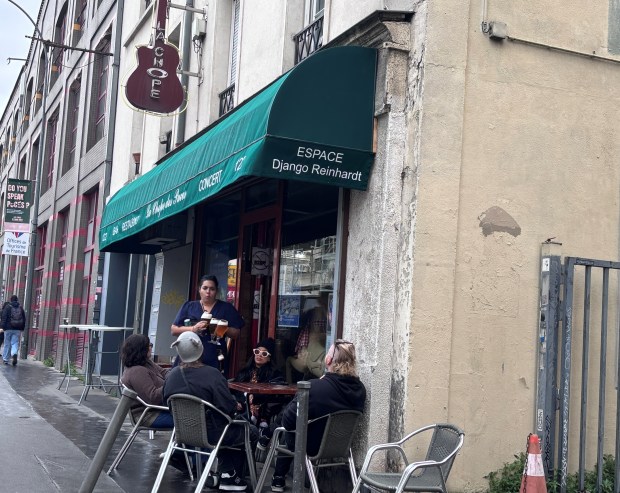 A guitar-shaped neon sign resides over the entry of La Chope des Puces, a temple of the Manouche jazz created by Django Reinhardt in the 1930s. Jazz aficionados from throughout the world make pilgrimages to this north Paris neighborhood devoted to flea markets. (Janet Podolak – For The News-Herald)
A hat is passed to collect contributions for the musicians.
I could have just hung out for hours, but it’s not polite to take up space without paying for it, so we ordered lunch from the blackboard menu without great expectations. Back at home, La Chope des Puces would be considered more dive bar than restaurant. The food surprised us with its wholesome deliciousness.
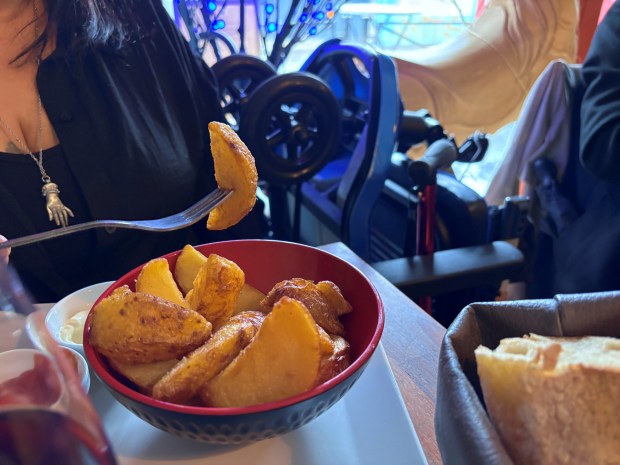 The modest french fries Parisians call frites were declared “potato nirvana” at La Chope des Puces, where the food is as good as the live music. (Janet Podolak – For The News-Herald)
Sascha declared her frites to be “life-changing” and “glorious potatoes from the gods.” Describing the thick-cut wedges of thin-skinned potatoes, she said they were crispy on the outside and delicately flavored like potato clouds on the inside.
“I will never forget them,” she said, proclaiming them “potato nirvana.”
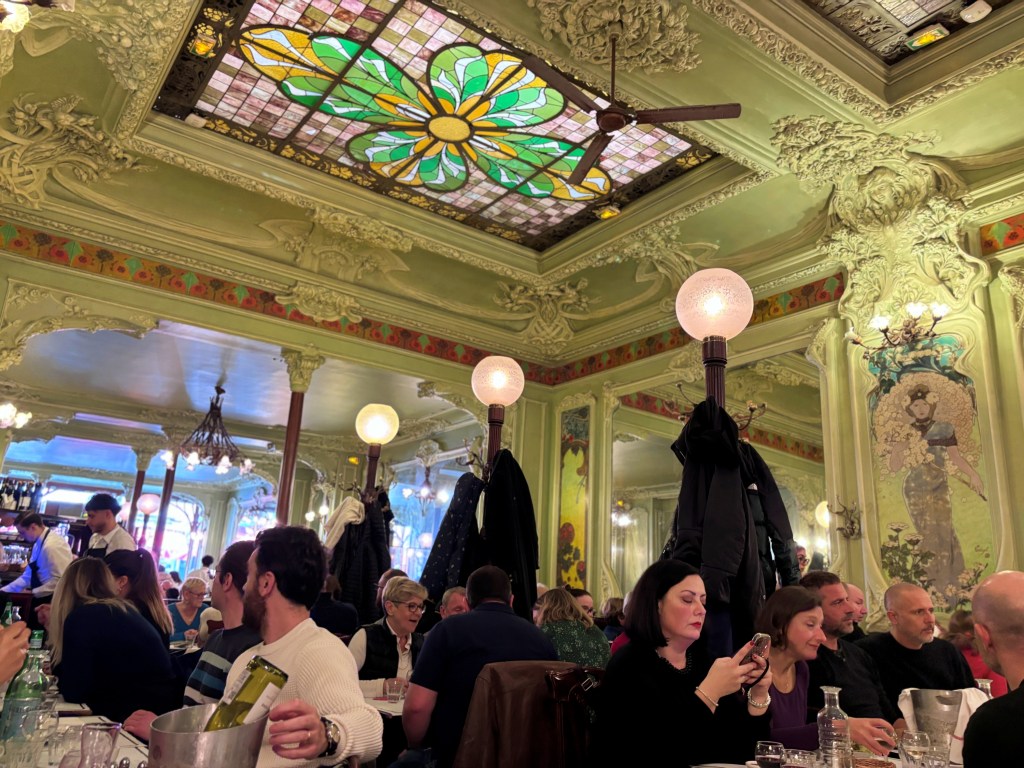
Another day, we stood in line outside Bouillon Julien, in the rue du Faubourg Saint-Denis neighborhood, to wait for a table, later learning it was one of the few Bouillon restaurants to accept reservations. Bouillons became the chain restaurants of Paris in the mid-1800s when a butcher, seeking a use for lesser cuts of meat, added vegetables and boiled the meat into a hearty soup (bouillon) to serve to workers at a price they could afford. As other dishes were added to the menus, more of the working-class eateries were opened. Many had stunning Art Nouveau decor, with intricate hand-carved woodwork, mosaics, and mirrors. By 1900, more than 250 bouillons were scattered around Paris. Singer Edith Piaf became a regular at Bouillon Julien.
As brasseries began to take their places, Bouillons closed during the next half-century, but now they’re making a comeback.
Artisans employed when Bouillon Julien was built in 1908 were master craftsmen. The master glassmaker Louis Trezel created four magnificent nymphs symbolizing the four seasons, placing them on the walls in four facing glass panels. Louis Majorelle, one of the most celebrated cabinetmakers of the era, was commissioned to create the spectacular Cuban mahogany bar clad in pewter — still in use.
Restoration began in 2018, and Bouillon Julien opened to acclaim two years later.
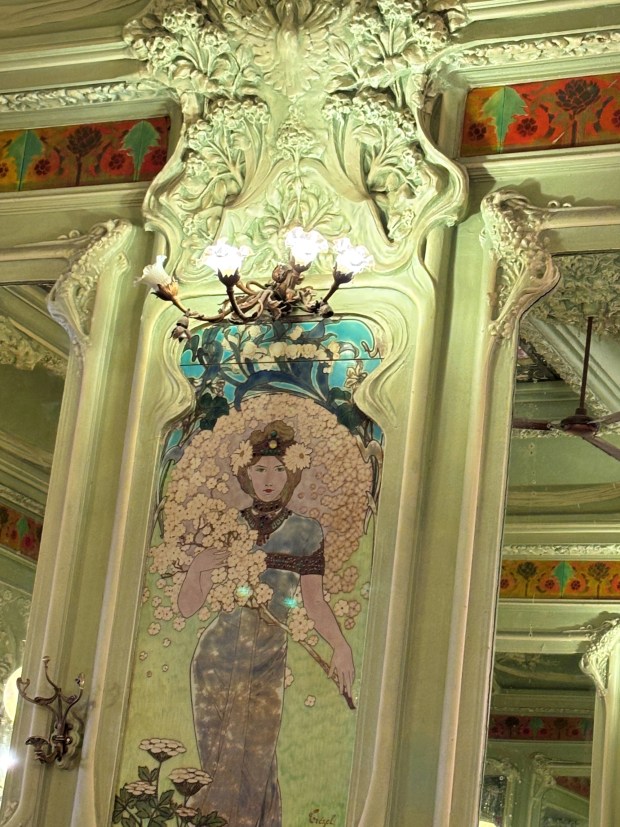 A glass artisan created four nymphs portraying summer, fall, winter and spring for the walls of Bouillon Julien. (Janet Podolak – For The News-Herald)
It’s in the working-class rue du Faubourg Saint-Denis neighborhood — easy walking distance from much of Paris.
I feasted on cream of pumpkin soup with squash oil and endives au gratin with Emmental cheese and béchamel sauce, accompanied by a glass of Rhône wine. Sascha ordered smoked pork loin and potatoes, pronouncing them delicious. I shared her dessert of chocolate cream with roasted hazelnut pieces.
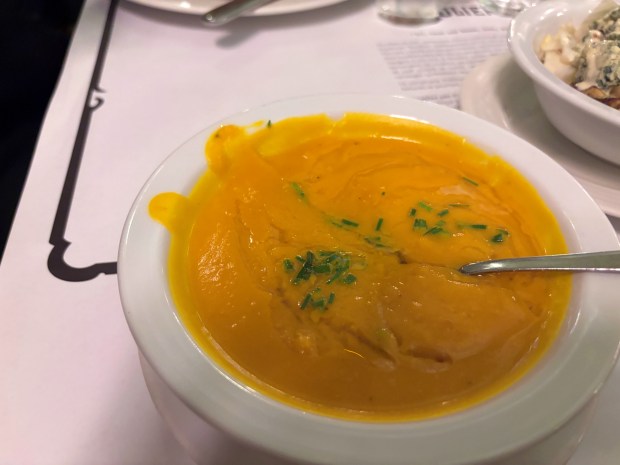 Cream of pumpkin soup with squash oil is one of the dishes at Bouillon Julien. (Janet Podolak – For The News-Herald)
Our lunch check was 35.70 euros — about $43 U.S.
We’d chosen the Île Saint-Louis as headquarters for this trip. An island in the middle of the Seine River next door to Notre Dame, the village-like neighborhood proved central to everything but was very quiet at night. Its narrow cobbled streets have several charming small hotels, restaurants and shops, including the famous Berthillon ice cream shop. Begun in the 1950s, Berthillon still is owned by the same family and draws ice cream lovers from near and far. Its 70 flavors are made with premium natural ingredients.
I fell in love with the Hôtel L de Lutèce, a small hotel with spaces dating to the 1700s, including its original wooden overhead beams. I’ll definitely return for a longer stay.
Just steps away is the Aux Anysetiers du Roy, a tiny restaurant that’s a dining favorite for locals. The 400-year-old building oozes charm with its medieval touches.
With cozy seating close to your neighbor, you’ll likely strike up conversations about the food, which is that of a traditional French grandmother. Cassoulet is one of my favorite dishes, and this place does it very well. The husband-wife owners are delightfully hospitable and speak English.
Travelers’ checks
Information and assistance about travel in France is available from Atout France, the French national tourist office, at france.fr/en.
The Puces de Paris Saint-Ouen flea market: pucesdeparissaintouen.com/en/les-puces
La Chope des Puces: facebook.com/lachopedespuces
Bouillon Julien: bouillon-julien.com
Berthillon ice cream: berthillon.fr
Hôtel L de Lutèce: paris-hotel-lutece.com
Aux Anysetiers du Roy: anysetiersduroy.com
Dining and Cooking