
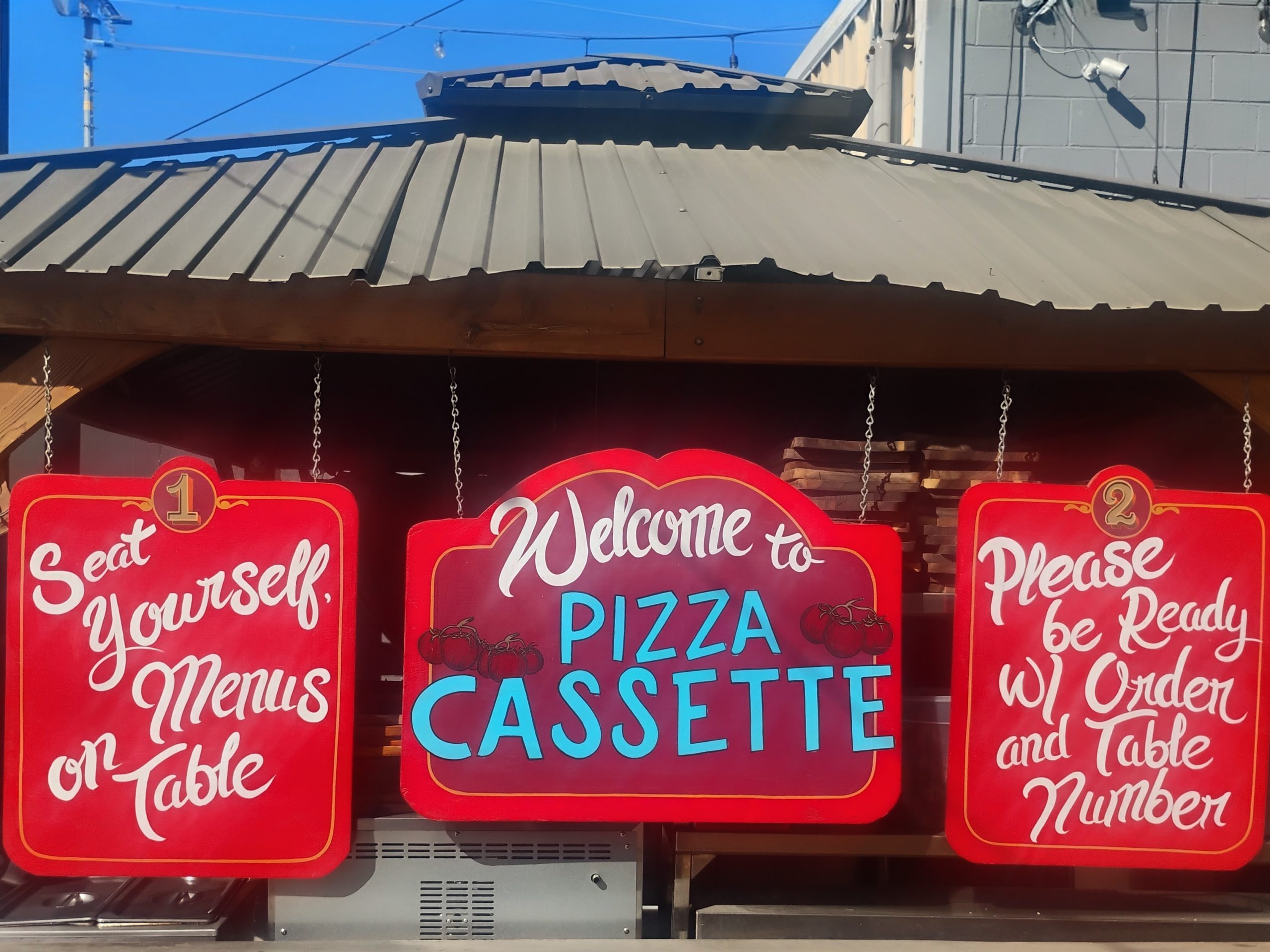
PACIFIC BEACH – Pizza Cassette founder Jimmy Terwilliger didn’t start as a master pizzaiolo.
His first job in pizza was delivering pies for a small chain in upstate New York called Pudgie’s — and he wasn’t very good at it. A pile-up of parking and speeding tickets eventually got his license suspended, forcing him off the road. He tried to quit.
Pudgie’s had other ideas.
“I was like, ‘Look, I have to find another job. I lost my license. I can’t deliver anymore,’” Terwilliger recalled. “They’re like, ‘Well, you’re not fired. You have to go make pizza in the kitchen.’”
Terwilliger, then a student at Broome Community College studying information technology, remembered being teased at age 12 for wanting to stay home to watch “Iron Chef.” He had hoped to attend culinary school, and in college, the only classes that truly resonated were the cooking electives he was taking.
“Only three days into making pizza, I liked it more,” he said. “It’s repetitive, but it’s also creative.”
And with that, the start of a pizza journey that took him through some of San Diego’s top kitchens —Catania, Biga, Wheat and Water, and Buona Forchetta.
“Definitely a lot of [trial and] error,” Terwilliger said. “As a head chef, I was young, and I made a lot of mistakes — trying sourdough starters and not realizing how hard it would be to maintain a consistent product without a crew who really understood what we were going for.”
After a stint of pop-ups, Terwilliger opened Pizza Cassette in 2023, a Neapolitan, wood-fired pizza operation nestled in The Gärten, a communal outdoor dining and drinking venue at 5322 Banks St., which also features Deft Brewing, Oddish Wine, and Lost Cause Meadery.
In March, Pizza Cassette will open a new location at 1459 Garnet Ave. in Pacific Beach, taking over the space formerly occupied by Hoboken Pizza.
“[Neapolitan has a] soft flour, short fermentation, and the pizza is cooked quickly in a wood-fired oven,” Terwilliger said. “It’s more artisanal. It comes out more floppy. For me, the digestibility of it and the flavor… Once I stepped away from the pizzeria style and into the fine dining world, my palate expanded, and my interest in trying to showcase flavors grew.”
Every element of the menu — aside from cheese and salami — is made in-house. Dough is pressed by hand, meats are cured and roasted on site, and sauces are prepared from scratch, giving each pizza a fresh, bold flavor.
The menu’s red and white pies offer unique flavor profiles. Terwilliger’s favorite, the white Lemon Song, is layered with sausage, lemon, ricotta, mozzarella, parmesan, and spinach.
Other standouts include the red ROSSI (V), a simple combination of basil, garlic, and oregano without cheese, and the white Pork Soda, featuring bacon, onion jam, mozzarella, parmesan, cherry tomatoes, arugula, and balsamic. A recent weekly special showcased house-made pastrami with pickles.
“We’re definitely one of the few restaurants in San Diego making pastrami from scratch in-house, and we make our own pickles here,” Terwilliger said. “We do everything that we can, right down to the bacon. We get whole pork bellies, dry-rub them, cure them, and roast them in the wood-fired oven.
“The sausage is ground, seasoned, and roasted on site. Our meatballs, too — we grind the beef and sausage ourselves and hand-roll them. When I tried that pastrami on a pizza, I thought, ‘This is a really interesting combination of flavors.’”
According to Terwilliger, Pizza Cassette generated roughly $1.5 million in food sales in 2025, placing it among the top 10 percent of pizza operations in San Diego. A typical week sees 1,200 to 1,800 pizzas sold, with peak months like August reaching as many as 2,000.
A self-described “Dead Head,” Terwilliger named Pizza Cassette in homage to his collection of thousands of Grateful Dead cassette tapes, combined with a phrase he heard every day while working in the Buona Forchetta kitchen.
“All the cooks there were from Italy,” Terwilliger recalled. “Nobody spoke English. I didn’t speak Italian, and they would constantly be saying ‘quando cassette’ — which means ‘how many cassettes,’ referring to the pizza boxes.”
READ NEXT
Dining and Cooking