
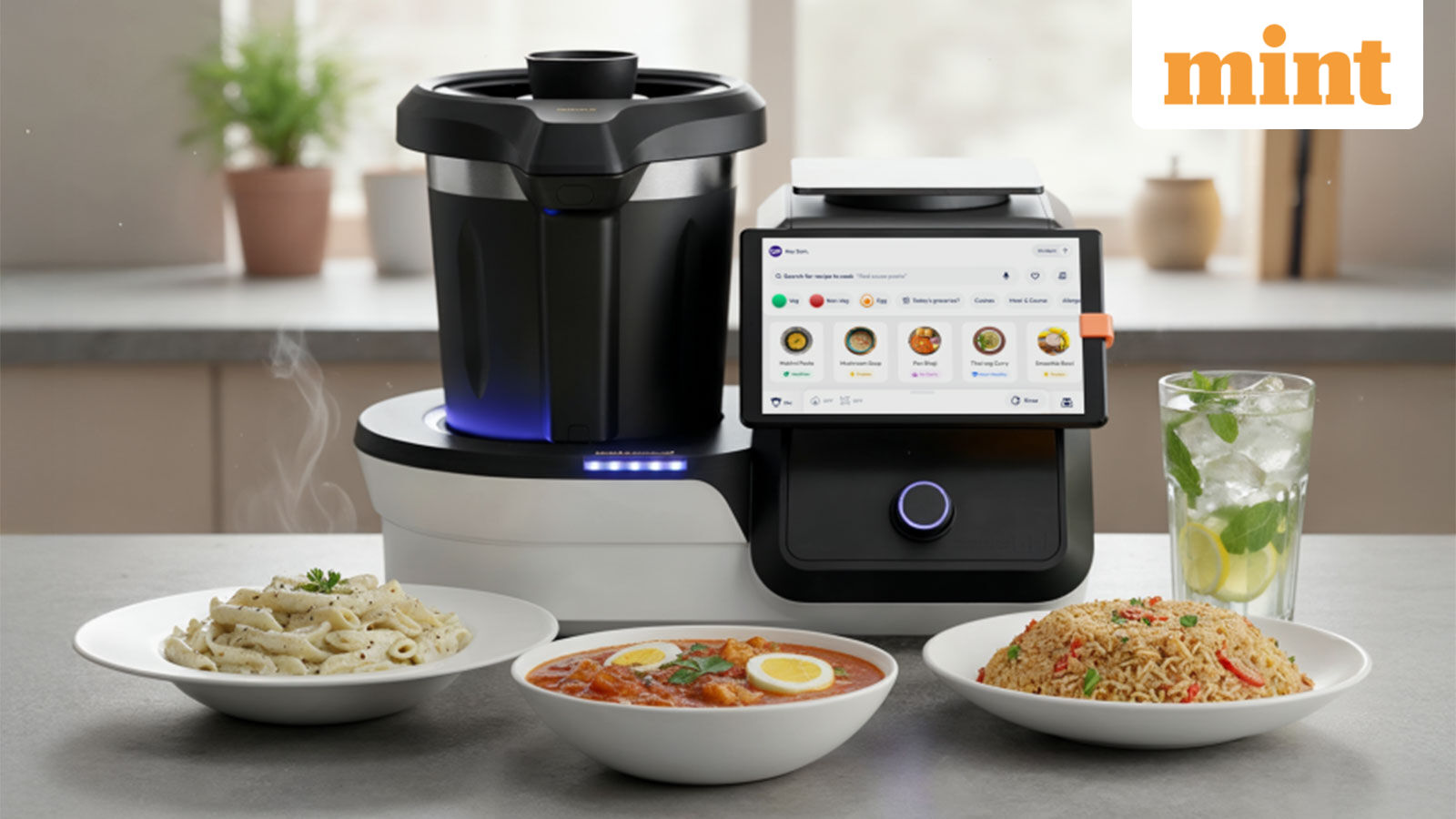
With full working days and the convenience of food delivery apps, cooking at home often takes a back seat. That’s where the Upliance 2.0 comes in. It’s a one-stop device that claims to do it all, from chopping and sautéing to everything in between. Does it deliver? After using the Upliance 2.0 for a week—as someone who rarely cooks—this is what I found out.
Unboxing and Day One
The Upliance 2.0 will stand out among all your other kitchen gadgets in size. That said, it is sleek, well-built, and will fit snugly on your countertop. On the right-hand side is the 10-inch touchscreen with a slightly sluggish yet intuitive UI that’ll put you at ease once you start using it daily. When you start out, you’re greeted by a menu full of dishes, or you can search specifically for what you want to make. There are over 750 recipes loaded onto the device, and you can even use the on-board AI assistant to port recipes from YouTube or similar websites.
Also Read | Fitness tracking: When your wrist quietly judges you
I made a diary of everything I cooked over the course of a week. On Day One, as I hadn’t had pasta in a while, I decided to make a simple ‘white sauce pasta’, one of the most cooked dishes on the device. Just select the dish and it’ll give you options for how many people (up to 4) you want to cook for. Then it’ll adjust the quantities and lay out a step-by-step guide for you to follow. On the right-hand side, above the touchscreen, is a weighing scale. It’s very easy to weigh the ingredients. Once done, just throw them into the jar, on the left-hand side, as per instructions (which are minimal), and you’re good to go.
The pasta recipe was easy to follow. While chopping ingredients (for a mere 10 seconds), you’ll hear a violent purr from the machine as it shakes side to side, but it gets the job done with aplomb. The dish took almost as long to cook as it said it would, and, in the end, we were quite surprised by the taste. Yes, it had too much black pepper and oregano, but take that out and it got an 8/10 from my mother. Then we proceeded to make kadhai paneer. Easy peasy. Just get the ingredients ready, and the steps are easy to follow. The taste, again, surpassed expectations.
When things took a turn
The kicker came on Day Three when we tried to make chicken curry. My mother, who has cooked for years, told me to buy a whole chicken for the four of us. We ended up putting in around 750-800 grams, more than the 600g that the “Dhaba Style Chicken Curry” recipe had asked for. The kicker was that it took longer than it said to cook, and even then, some pieces still didn’t seem fully cooked, so we finished it off on the stove before serving.
Day Four was easy, as it was just some rasam. We had most of the ingredients at home and just had to source rasam powder and tamarind paste. It ended up being a little thicker than we’d have liked, even after adding more water and running the cycle once again. I must say that the taste was top-notch.
On Day Five, when we tried to make mutton keema, we fully realized the one limitation that the device has. Since it lets you select the number of people but doesn’t let you enter the “amount” you’d like to make, you sometimes end up with the wrong proportions. Basically, there should be more flexibility for tweaking recipes for quantity and entering amounts manually. In the end, we ended up with a way more watery gravy than we wanted, and we had to thicken it on the stove. But it is almost always about the taste, isn’t it? Well, this one got two thumbs up from everyone at the table.
We ended up making mint hummus for the next two days, then chhole masala. The device nailed the mint hummus recipe, while the chhole masala was on the sweeter side. This might have more to do with the recipe than with the machine, which cooks quite efficiently.
After a week with the device
The way the Upliance 2.0 chops and sautes in minutes was impressive, and definitely a boon for people like me who have hardly ever chopped vegetables. It works best if you stick to the recipes on the device. A little bit of experimenting works okay, especially if you know your way around the kitchen, but anything beyond that and the device can produce a dish that isn’t to your liking. It also isn’t a full kitchen replacement. For example, the device can knead dough, but can’t actually make rotis. You’ll also still need a gas stove or microwave for reheating food.
The downsides are minimal but need to be mentioned. The UI is sluggish, and even after a full rinse, you need to scrape off some of the leftover food that sticks to the bottom of the jar. While cooking, especially during the chopping phase, the device can get extra loud. It lacks any mid-cooking adjustments, spontaneity, and the like. The intuition that goes into cooking is almost negligible here.
At a price tag of ₹39,998, I really had to think about who the target audience is. You don’t actually cut down on the cooking time with this device, you just cut down on your time in the kitchen. In the mornings, you’ll still need to wake up at the same time, get the ingredients ready, and be present whenever you have to move to the next step.
If you’re one who enjoys the “theatre” of cooking, then this is definitely not for you. While Thermomix is doing well in the western world, a device like Upliance 2.0 makes less sense in India. Your help/cook can get the job done just fine without any extra machines. There is, I believe, a market for Upliance 2.0, but it is limited—it’s for those who don’t have time to supervise in the kitchen, want a stress-free meal without the heavy lifting of chopping and sautéing, or folks who don’t know how to cook or simply dislike doing it.
Also Read | Haier M80F vs LG G5: Which TV reigns supreme?
Dining and Cooking