
French canals are working thoroughfares. This is proved on our first day piloting a motorboat through France’s Camargue region when a 1,000-ton cargo barge honks us into a riverbank. I receive a raised fist from a bargee, a one-fingered salute from a fisherman and a stern telling-off from my wife. If your marriage is already on the rocks, a French canal holiday could sink the ship.
The following morning is a placid epiphany for my young family, however. We slip our moorings in a rosé-tinted dawn and meander down the Canal du Rhône à Sète, an extension of the Canal du Midi, which we selected because it has zero locks — amateur territory. Snow-white Camargue horses nuzzle on the towpath. Kingfishers zing past like iridescent darts. The canal, and our first full day of adventure, stretches ahead like a watery boulevard lined with swaying oaks and nesting herons.
Silence brings nature to life. We hear guttural shrieks from white egrets, which wing above the boat like brides in a flap. The going is tranquille because we’re piloting a new Sixto Fly C, a 15m-long boat named Gallician, which runs on hydrotreated vegetable oil, a biofuel made from waste fats such as cooking oil. This makes cruising quieter compared with a diesel engine, as well as fume-free.
We picked up Gallician in the wine town of Bellegarde and it has three bedrooms, three loos, three sundecks and a cushioned area where our three kids log bird species in the sun as we head east. It’s chartered by Riverly, one of France’s largest boat-rental companies, which also operates in Germany, Portugal, the Netherlands and Hungary. You don’t need any sort of licence to hire it, but you will get a thorough briefing before setting off.
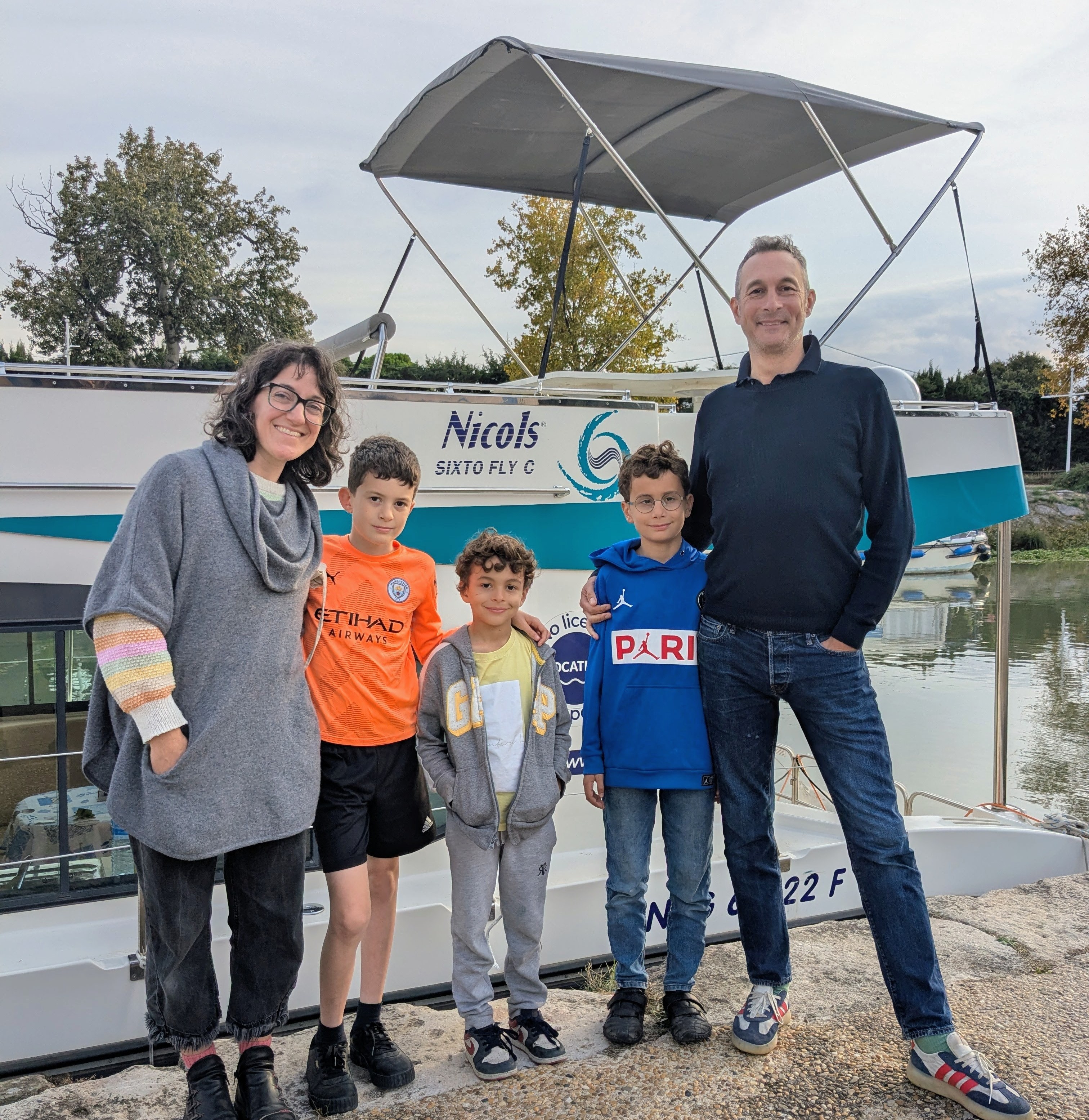
Tristan Rutherford with his family
The canal mirrors the surrounding Midi canvas during the ten miles we cruise each morning from place to place. Oak forests become ripening vineyards, as the Canal du Rhône à Sète abuts multiple AOC regions on its passage to the Mediterranean. On day three grapevines become salt marsh as we putter further south. We spy our first semi-wild bulls. With curving horns they look like honking devils with four cloven feet. I’m sad to say we ate their cousin — steaks grilled on Gallician’s top-deck electric griddle, paired with an excellent Côtes du Rhône.
The pilot book we were given on embarkation noted that our route was conceived as an extension of the Canal du Midi in the 18th century. When complete it would allow barges to be loaded up with bottles of burgundy in Lyon, before spilling a few glasses near Marseille, then popping out at Bordeaux a few weeks later. Salt could travel in either direction.
The grand projet was mired in politics. Work on the canal halted in 1789 when French revolutionaries formed sans-culottes clubs, smashing churches instead of digging ditches. Construction resumed in 1801. Only during the 1820s did the canal become fully operational. It had cost 16 million francs rather than the original estimate of 2.5 million. Wine and salt have floated up and down it ever since.
What you need to knowHow much does it cost? Six nights in a boat sleeping six is from £2,326Who will love it? Captains-in-waiting, low-key adventurers, families and eco-minded explorersInsider tip Travel there on Brittany Ferries’ Saint-Malo eco-vessel and you can enjoy a buffet of oysters and seared salmon on board before being rocked to sleep across the English Channel. Then take a TGV train to Arles, stopping for crêpes in St Malo and saucisson brioché in Lyon
• Discover our guide to family travel
French cowboys and wild horses
By day four we’re deep in cowboy country. The colour palette is muted by the mistral wind’s saline whipcrack: dusty roads, dun rivulets, salt-licked tamarisk trees. Early French Western movies were filmed against this backdrop. Gardians — cowboys — in straw hats still corral the indigenous Camargue horses through knee-deep water and sleep by campfires under the stars at night. The breed itself is similarly resilient and nimble and has evolved wide hooves to navigate the marshy habitat.
Keen to explore, we tie up at one of the canal’s many free public mooring spots and stroll into the briny landscape. Wild rice sways like a green carpet on the sun-dazzled horizon. The kids scoop a generous pinch of salt from a quicksilver salt pan for a risotto we cook on Gallician’s gas stove later. These are holiday colours we could never witness by car.

The wild white horses of the Camargue
GETTY IMAGES
However, our supplies purchased in the Carrefour supermarket in Bellegarde are running low. So in the calm dusk of day four we moor Gallician in Gallician — the Riverly rental boats are named after canal villages and towns.
It’s another baptism of fire. We use our bow thrusters to rotate Gallician on a centime before reversing into a poky berth between two sparkling new yachts. Know-it-alls yell baffling advice in French; one makes a throat-slitting sign. The five mooring attempts of les amateurs Anglais become a riparian spectator sport. We need a drink.
Fortunately Gallician’s economy has moved on from the days of harvesting reeds to make cowboy hats. When irrigation canals were dug above the Canal du Rhône à Sète in the 1950s, winemaking became the biggest player in town. Gallician’s ivy-clad wine co-operative offers free tastings. I sample a £6 bottle of Terre des Launes — land of the moons — a bullish, leathery red that distils the sunbaked intensity of the Camargue. Stuff that. For £1 I fill up an empty one-litre Evian bottle from the co-op’s spigot. Hopefully my wife will never know the difference.
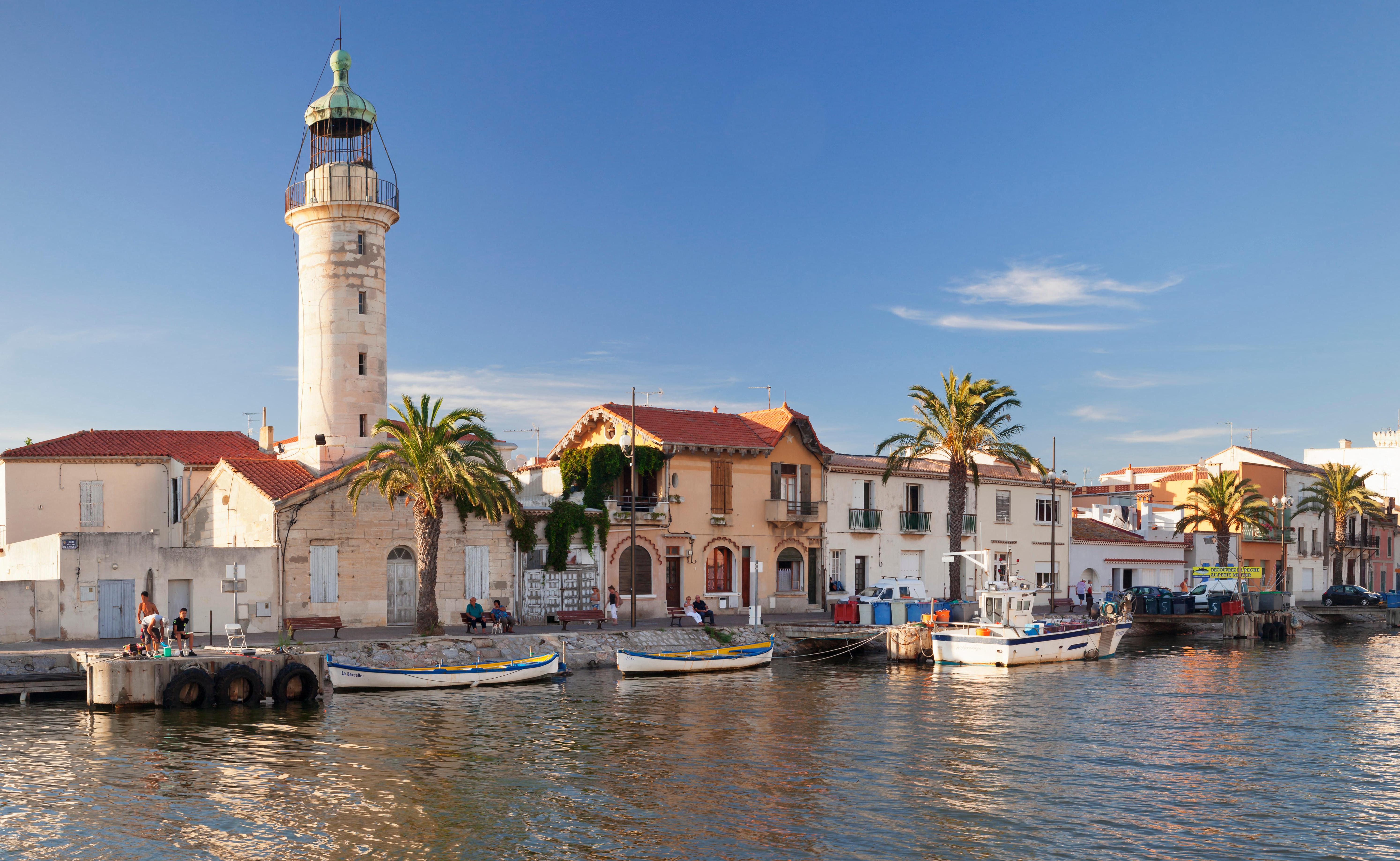
The port at Petit Camargue, Le-Grau-du-Roi
ALAMY
• 10 of the most beautiful places in France (and how to see them)
Child-friendly birding in a nature reserve
Gallician’s biggest draw is the adjoining Scamandre Nature Reserve, one of the Camargue’s most biodiverse birding regions. At dawn we follow the children on wetland paths armed with the Merlin Bird app with its birdsong identifier. They log 15 species in 15 minutes, including the Nokia tweet of a common firecrest, the discordant techno of a Sardinian warbler and the car-alarm song of a green sandpiper. Beats chasing virtual animals in Minecraft.
The Canal du Rhône à Sète becomes a true working waterway as it nears the ancient salt capital of Aigues-Mortes and the wine port of Sète. Where salt and wine once floated along the canal, today gargantuan barges transport animal feed and aggregates. Like caravanning or yachting, a boater is granted admission to a riverine corps. Cargo pilots greet us with bugling toots as they shoulder past. Eel fishers give us a stiff wave. The happiest workers are the barge lookouts who soak up the sun during their meditative cruise. A dream job in hi-vis.

The Canal du Rhône à Sète is an extension of the Canal du Midi
GETTY IMAGES
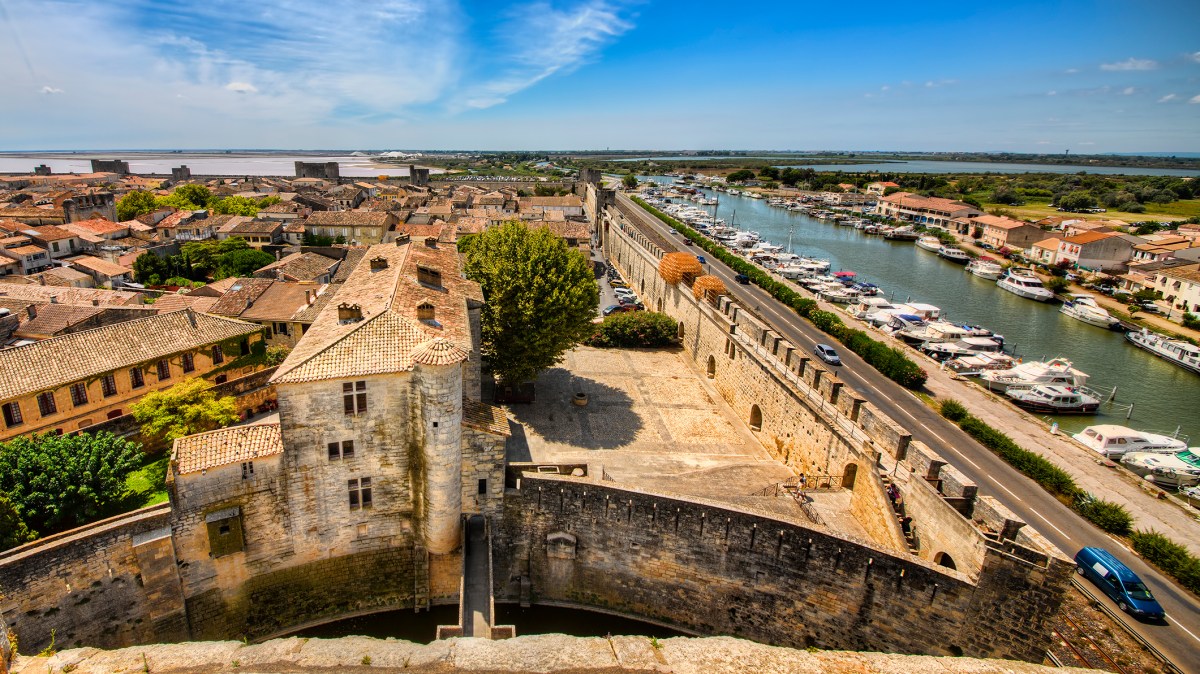
Salt still sustains Aigues-Mortes, our furthest stop on day five. The medieval city rises from the flatlands like a Disney castle. When seen from above, the surrounding salt pans resemble a Mark Rothko canvas, as salt-loving algae tint the pools every shade from rosé to claret. Using the Tour du Sel, Aigues-Mortes’s original salt depot, as a landmark, we ease Gallician into a tight berth beside the castle walls. Advertisement hoardings showcase river cruises to see wild Camargue horses. Already done it, mate.
• Read our full guide to river cruises
A gourmet picnic on the boat
Living on a houseboat in a vibrant town centre is an alluring prospect. It’s like lodging in a moveable Airbnb, with no pesky unpacking or checking in. We pay £28 to the Aigues-Mortes tourist office for the mooring with an electricity hook-up, then hit the Wednesday market. For our top-deck picnic we purchase roast rabbit, bull sausage, cod roe and fougasse bread made with orange blossom. At a British outdoor market we’d probably end up with a box of broken biscuits.
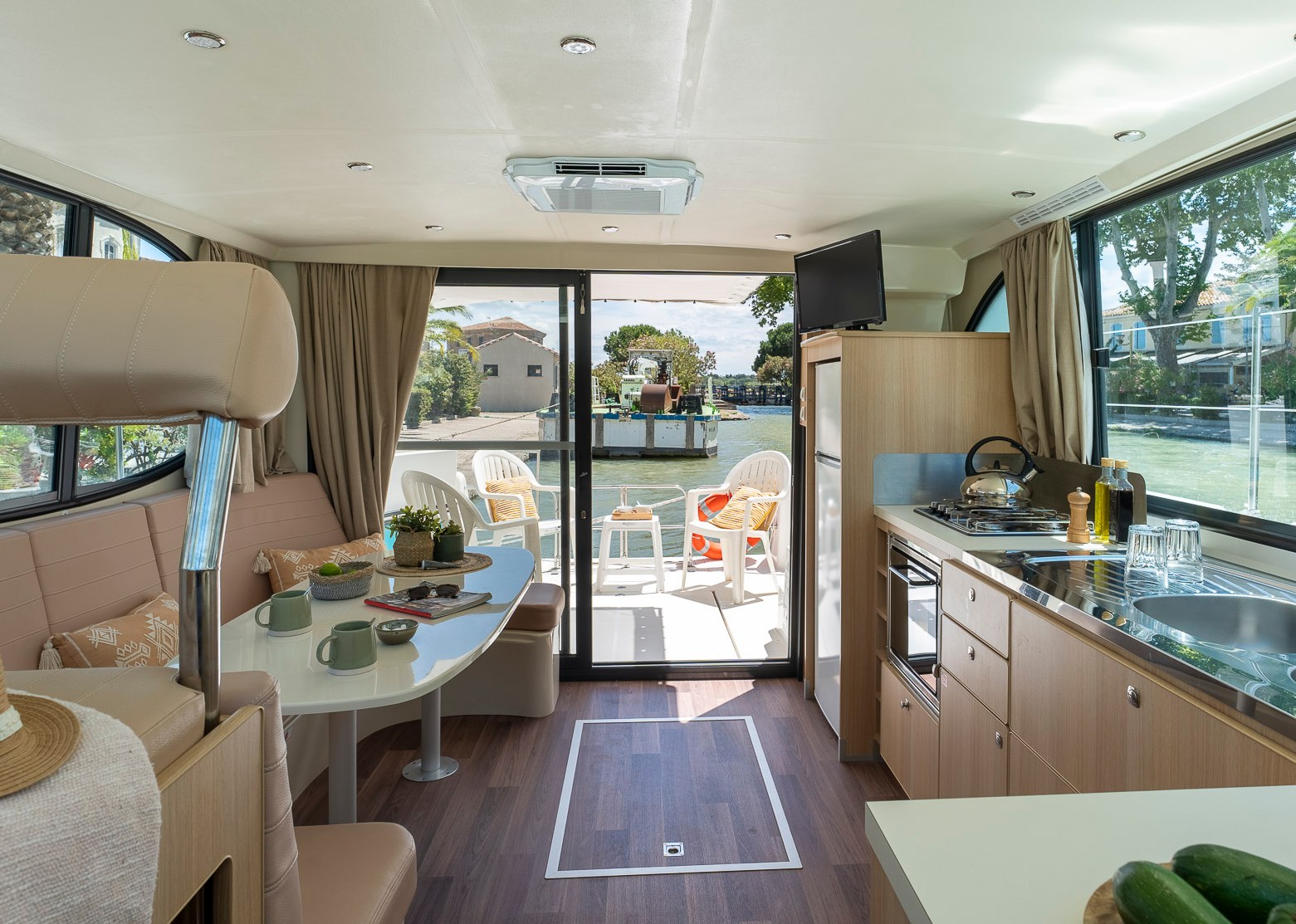
The boat feels like a moveable Airbnb, says Tristan Rutherford
To stave off cabin fever we’ve promised the kids an afternoon on the beach. The three-mile railway line from Aigues-Mortes to the port at Le Grau-du-Roi was built in the 19th century to transport salt to waiting ships. Today the seven-minute train ride, past ruby-red salt pans and flamingos turned shocking pink from beaking too many prawns, is like journeying through a rose-hued kaleidoscope, for just 85p a trip.
Le Grau-du-Roi charms like a holiday resort from a 1950s murder-mystery. One apartment block is shaped like the SS Normandie ocean liner, another like a Moorish palace. It’s the sort of plage where bichon frisé dogs snooze under bistro tables, while Sobranie-smoking grand-mères lick foie gras from dessert forks. Out at sea, kitesurfers scream like multicoloured eagles across a cobalt sky.
After the beach, go wine tasting
I leave the beach early to look for more wine. Midway between Le Grau-du-Roi and Aigues-Mortes sits the most unlikely vineyard in France. The Domaine Royal de Jarras is perched on a salt-licked sandbar. Tours can be made on horseback with the winery’s resident gardian, Cédric — a rather conservative name for a cowboy. I enjoy a tasting walk with the host Marianne Barbier (tours from £14; domainedejarras.com). As the domaine’s vines have their toes in the sand, no pesticides are required, giving each organic vintage a mineral zing. In winter 5,000 sheep nibble any weeds while fertilising next year’s grapes.
It’s time for Gallician to putter home. In a single day we retrace the timeless waterway, photographing horses and bulls from the deck. The only monument to modernity is the ViaRhôna bike path, a Lycra superhighway that runs adjacent to the canal. We shimmy into our berth back at Bellegarde like bargees of old. If anyone says that sailing the Canal du Rhône à Sète isn’t spectacular, take that with a pinch of salt.
This article contains affiliate links that will earn us revenue
Tristan Rutherford was a guest of Riverly, which has six nights’ boat hire for six in a three-cabin Sixto Fly C from £2,326 (riverly-boats.com), and Brittany Ferries, which has Portsmouth to St Malo crossings for a family of four from £336, including cabin (brittany-ferries.co.uk)
Dining and Cooking