
We analyse the EU–Mercosur agreement and its consequences for the Spanish olive sector together with Cooperativas Agro-alimentarias de Andalucía: a deal presented as an opportunity, yet perceived as a threat.
By Marga López Polo, agri-food journalist
The trade agreement between the European Union and Mercosur, negotiated for more than two decades, is currently on hold, though far from absent in sector debates and mobilisations. The European Commission has described the situation as a “technical pause”, and both Brussels and the Spanish Government have reiterated that the pact remains strategic and will be reactivated once the review phase is completed. During Spain’s presidency of the EU Council, the Ministry of Agriculture argued that the agreement would open opportunities for export-oriented sectors such as olive oil, insisting that Spain would be “one of the major beneficiaries”.

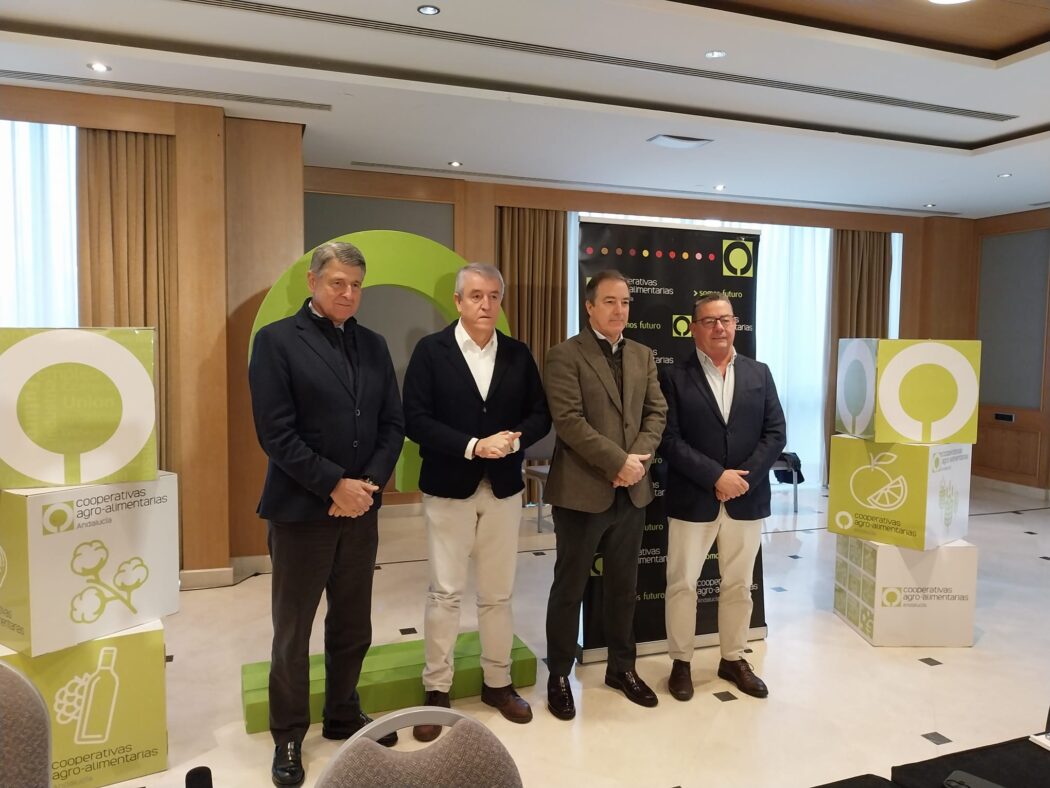
However, this institutional narrative sharply contrasts with the perception of the Andalusian olive sector, which believes that the agreement, as currently drafted, not only fails to benefit Spanish olive growers but also jeopardises their future competitiveness. This was made clear during a recent briefing organised by Cooperativas Agro-alimentarias de Andalucía, attended by eComercio Agrario.
A deal negotiated without the sector and under asymmetric conditions
For Cooperativas Agro-alimentarias de Andalucía, the criticism is unanimous: the sector has not been heard. Rafael Sánchez de Puerta, president of the national olive oil division of Cooperativas, summarises it clearly: “The sector has not been taken into account in the negotiation.” This exclusion is even more serious, he explains, because the agreement is built on a profoundly unequal basis: while Europe imposes increasingly strict social, labour and environmental requirements, Mercosur countries operate under far more lenient regulatory frameworks.
The result is a direct loss of competitiveness. Sánchez de Puerta puts it bluntly: “Social and environmental conditions make us lose competitiveness compared to Mercosur countries.”
Despite this, some administrations have presented the agreement as an opportunity for olive oil. The sector sees this as a diagnosis disconnected from productive reality. “They say the olive oil sector is a major beneficiary, but we don’t see it that way. We find this agreement disrespectful, because it does not establish equal conditions.”
An open European market versus countries with no land or water constraints
One of the sector’s most repeated arguments is the productive asymmetry. While Spain faces water shortages, environmental restrictions and difficulties in expanding irrigation, countries like Brazil and Argentina have land, water and room for growth.
Sánchez de Puerta warns that if Europe opens its market without correcting these differences, other countries will increase their production while Spain is forced to limit its own. He summarises it as follows: “We are concerned about production limits here while other countries will find an open market. Those countries have no land or water constraints.”
The risk is not theoretical. Cristóbal Gallego, president of the olive oil division of Cooperativas de Andalucía, recalls that the agreement includes a 10% tariff for European imports over 15 years, which will gradually decrease, while Argentina will be able to export oil to Europe tariff-free from day one. And although Argentina does not currently have significant production, the incentive is clear: “They can activate production as soon as they find a free, tariff-free market. And an olive plantation produces oil in just 3–4 years.”
The combination of preferential access, abundant resources and lower production costs opens the door to rapid expansion of olive groves in Mercosur countries. “They have no land or water limitations,” Cristóbal insists.
The suspension of the agreement: a temporary relief, not a solution
The recent suspension of the agreement has been welcomed as good news, but the sector remains cautious. Jaime Martínez-Conradi, director general of Cooperativas Agro-alimentarias de Andalucía, puts it plainly: “It is good news that the agreement is now on hold, but we know it will be reactivated in two years.”
For the sector, this period is merely a grace interval before the pact is approved in its current form. And the impact, they warn, would be severe: “It will be very damaging for our sector.”
The sector does not reject trade: it demands policies to compete
A key point the sector wants to emphasise is that it is not opposed to international trade. On the contrary, Spanish olive production is highly export-oriented. As Sánchez de Puerta reminds us: “As cooperatives, we defend an open market because we defend exports.”
The problem is not trade itself, but the lack of policies that allow competition on equal terms. And here, the diagnosis is unanimous:
Increase irrigated land to convert dryland into irrigated olive groves.
Water policies focused on competitiveness, not only restriction.
Modernisation and reduction of administrative burdens.
Stronger defence in Brussels against agreements that generate unfair competition.
Martínez-Conradi summarises the sector’s concern in one sentence: “Only then can we have a competitive olive sector.”
A deal that requires deep revision
The EU–Mercosur agreement is presented by administrations as a strategic opportunity, but the Spanish olive sector sees it as a structural threat. The combination of regulatory asymmetries, productive advantages in Mercosur countries, internal limitations on water and land, and preferential access to the European market for emerging competitors creates a scenario that could undermine Spain’s global leadership in olive oil.
The current suspension offers a window to correct imbalances, but time is limited. As the sector warns, if Spain does not adopt competitiveness policies now, it could lose ground in just a few years.

Dining and Cooking