
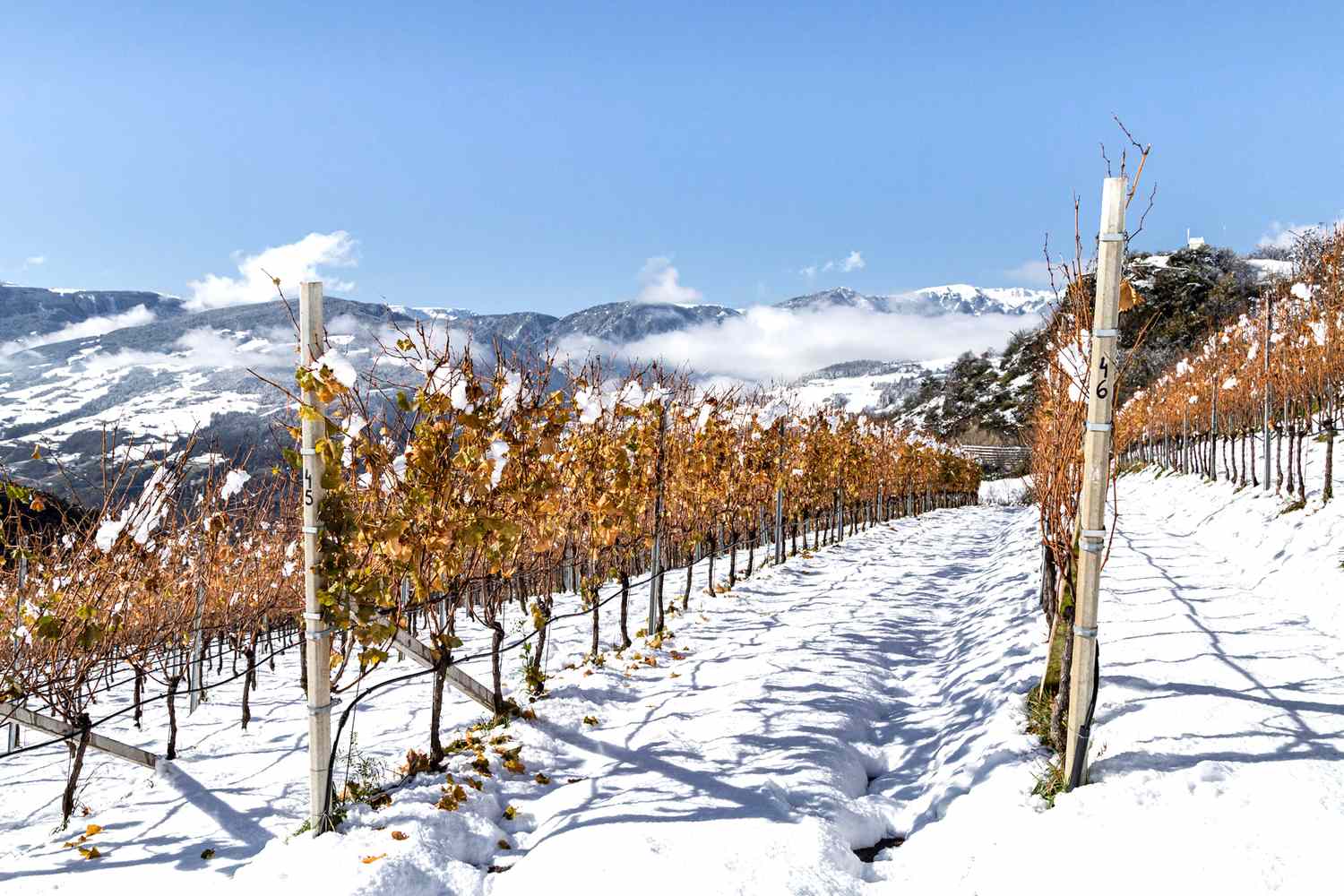
In the Italian Dolomites, it snowed four times over the last two weeks of January after barely a flake fell since November. It was good news for the Milano Cortina Olympic Games, as the resort town of Cortina d’Ampezzo, the “Queen of the Dolomites,” prepared to host the bobsled events, women’s Alpine skiing, luge, and more.
Around 40 miles west of the Games, in the village of Cortina sulla Strada del Vino (or SSDV), Claus Drescher, export sales manager of Peter Zemmer winery, was also happy.
“Snow for us is also essential as winemakers because then in the summer we have some water left,” says Drescher.
Located in the Alto Adige wine region of Italy, producers like Peter Zemmer rely on melted glacier snow to fill the local natural springs, which ensures a water supply to drip-irrigate the vines during the warmer months. Snow can also help insulate the vines against frigid temperatures further up the vineyard slopes, which can drop down to 5°F in winter.
With high altitude and a cool climate, Alto Adige is a study in the variety, extremity, and exceptionalism of remarkable mountain terroir.
Courtesy of Alto Adige Wine / Tiberio Sorvillo
A taste of Alpine wine
Also called Südtirol, Alto Adige is an autonomous province in the Dolomite mountains named after the Adige River that cuts through northeast Italy. It was once part of Austria before it was annexed by Italy, and its Tyrolean heritage lives on in the local character.
German remains one of the region’s official languages, the cuisine is hearty and comforting, and the residents still don dirndls and Tyrolean jackets for special occasions.
The wines of Alto Adige can be called “Alpine,” and for reasons that go beyond skiing and the poached or boiled dumplings known as knödel. While there’s no official definition, the term is a broad framework for common traits in wines made across the European Alpine mountain range.
The concept is being honed by wine professionals like Swiss grape geneticist Dr. José Vouillamoz. He says that “high-altitude vineyards often planted on steep slopes, influenced by a cool climate” as shared factors across national borders. In the wines, this translates typically to a greater sense of freshness, with higher acidity and lower alcohol.
If Alpine wines were ever considered lightweights, then warming global temperatures have provided more heft in recent years.
But among the Alpine regions, Alto Adige stands out for the depth and intensity that its wines can yield. In the 1800s, under Archduke Johann of Austria, Alto Adige expanded its wine production to improve technical ability and include more international grape varieties. As a result, powerhouse varieties such as Merlot and Cabernet Sauvignon, usually better known for Bordeaux blends and Super Tuscans, have grown near the snow-capped peaks for centuries.
Courtesy of Alto Adige Wine / Florian Andergassen
Part of the success of these wines is owed to Alto Adige’s unique climate, which functions in extremes.
“Summer days can rival southern Italy in warmth,” says Eduard Bernhart, director of Consorzio Vini Alto Adige.
Open to the south, the region is exposed to Mediterranean air that flows eastward, as well as a warm midday breeze called the Ora that originates from nearby Lake Garda.
But true to the Alps, the nights are cold. It creates literal night-and-day differences in temperature that allow the grapes to ripen fully, yet retain their acidity.
The mountains also form dramatically varied vineyard sites, which allows producers to pursue what Josef Seebacher of Tenuta Kornell calls “the right vineyards for the right grapes.” Winegrowing areas extend from the valley floor to summits of nearly 4,000 feet, with all sorts of altitudes, exposures, gradients, and soils in between.
Courtesy of IDM Südtirol-Alto Adige / Andreas Mierswa
A variety of wines — red and while, light or bold
Seebacher’s family grows Merlot and Cabernet Sauvignon on quartz porphyry in the valley, where the grapes take advantage of the relative warmth and the minerality of the volcanic soil. These nuances allow the big reds to thrive just as well as Schiava, Alto Adige’s signature light red grape.
For white wines, now 65% of Alto Adige’s production, the effect can beef up grapes with otherwise lackluster reputations. Peter Zemmer’s potent Pinot Grigio wine named Giatl will put any watery, by-the-glass version to shame with its sheer complexity. The Tiefenbrunner estate makes its commanding Feldmarschall von Fenner wine from Müller-Thurgau grown on a high plateau, both taut and intensely flavored. In the Isarco Valley, Kuenhof takes often-underloved Sylvaner and imbues it with both rich plumpness and acidic lift.
As for the reds, the cooler climate can impose discipline, as evidenced by Kornell’s Kressfeld Merlot.
“We prefer smoke and spice, as opposed to fruit and jam,” says Seebacher.
Such restraint is also apparent in Cantina Bozen’s reserve Taber from the full-bodied local Lagrein grape, where a cool stoniness offsets the suave, dark-fruited flavors. At the Aldein-Eich Vigna Kofl site, Peter Zemmer’s Pinot Noir, grown at 3,400 feet, shows the kind of earthiness that feels increasingly rare.
With such powerful wines, it’s natural to contemplate their aging potential. For Seebacher, there’s more faith placed in high acidity over alcohol and ripeness.
“For longevity, we prefer the fresher vintages,” he says.
As every Olympic athlete knows: with power comes strength, and then there’s endurance.
Dining and Cooking