
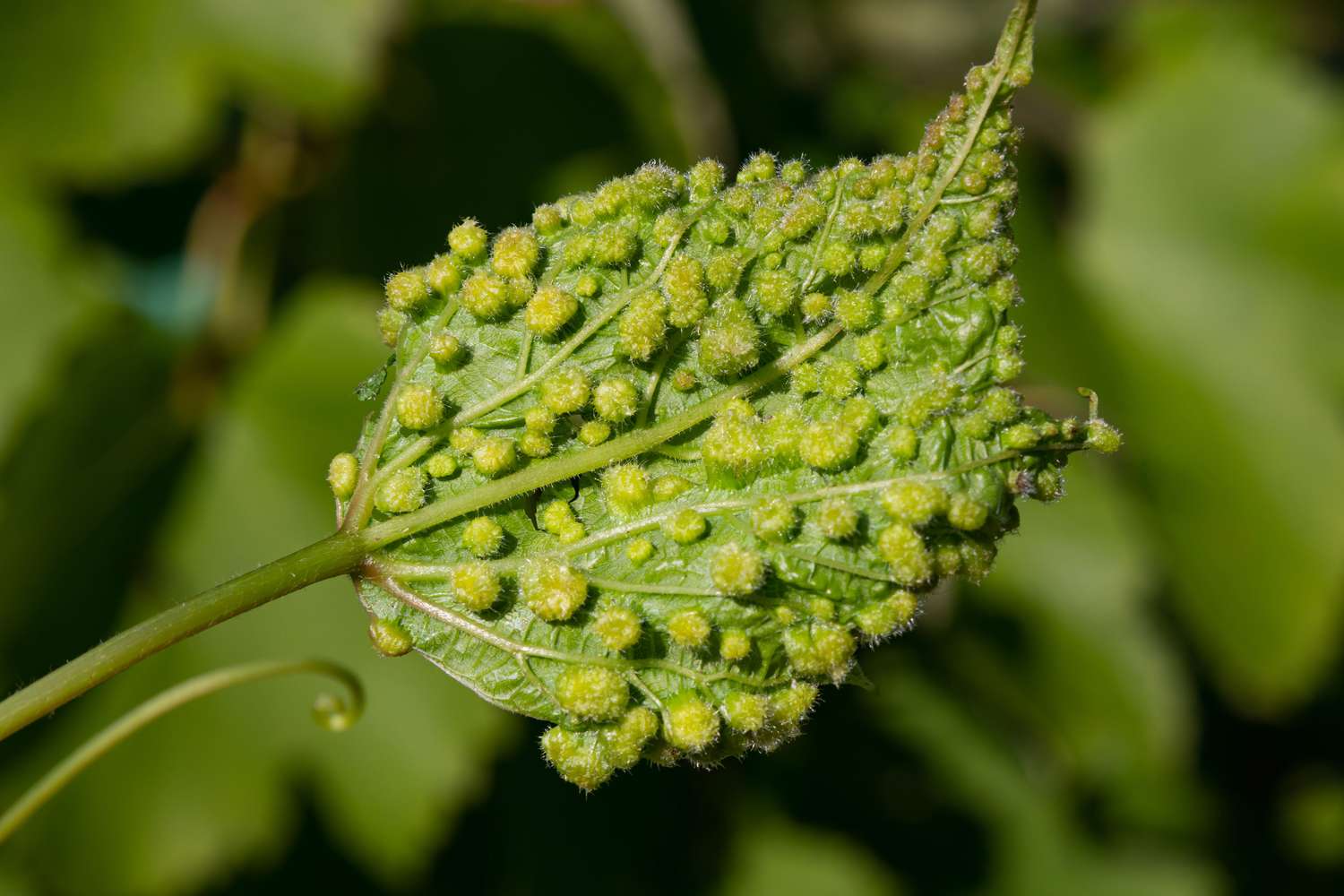
Phylloxera is a microscopic, aphid-like insect that attacks grapevine roots.The tiny insect infestation nearly wiped out Europe’s vineyards in the late 19th century.The crisis was solved by grafting European Vitis vinifera vines onto resistant American rootstocks — a practice that remains standard in vineyards around the world today.
When it comes to wine history, phylloxera is public enemy number one. In the late 19th century, it devastated an estimated 40% of France’s vineyards before spreading across Spain, Italy, Germany, Austria, and Portugal. By the time it tore through Europe, roughly two-thirds of the continent’s vineyards had been wiped out. The pest eventually reached California, South Africa, Australia, and beyond. It’s a term often thrown around in the wine world, but what exactly is phylloxera, and how did it permanently reshape vineyards?
What is phylloxera?
Phylloxera is a tiny, yellow, aphid-like insect, similar to plant lice, that kills vines by attacking their roots. When it was first identified, scientists debated what to call the insect, now formally known as Dactylasphaera vitifoliae. The name phylloxera comes from Jules-Émile Planchon’s Phylloxera vastatrix — a fitting moniker that means “the devastator.”
Phylloxera spreads rapidly because females lay hundreds of eggs, producing four to seven generations per growing season. As populations explode, insects crawl to neighboring vines, are carried by wind, or hitch rides on soil and equipment. Infected vines can take years to show visible symptoms, giving the pest time to multiply undetected. But the single biggest driver of its spread is humans.
The insect is native to North American vines, where species such as Vitis labrusca and Vitis riparia evolved alongside it and developed natural resistance. European grapevines — Vitis vinifera, the species used for most fine wine — did not. In the mid-19th century, American vines were imported into Europe for experimentation and research, unknowingly bringing phylloxera hitchhikers with them.
The first documented outbreak in France was in 1867 from a vineyard planted in 1863 at St-Martin-de-Crau in the Southern Rhône. Other reports followed in southern France’s Languedoc and Vaucluse, then in Bordeaux by 1869. Ultimately, an estimated 6.2 million acres of French vineyards were destroyed.
The solution
By 1873, the French government was officially alarmed. It offered a prize of 300,000 francs to anyone who could find a remedy and prove its effectiveness at the School of Agriculture in Montpellier. More than 1,000 proposals were submitted, ranging from burying a live toad beneath vines to draw out poison, to irrigating vineyards with white wine.
An early leading theory involved injecting liquid carbon bisulfide into soil to kill the pest, but this soon proved harmful to the vines. Advocates of the method began recommending diluting it with water as a gentler approach, which became common practice despite little evidence to support it.
Yevhenii Orlov / Getty Images
But it was Americans who found a true solution. C.V. Riley, the state entomologist of Missouri, identified the French insect as the same species found in America, and was among the first to suggest grafting European varieties onto American rootstocks. Vitis riparia and Vitis rupestris proved most effective.
While this was forward progress, those species of vines struggled in France’s calcareous soils. In 1878, Texas-based ampelographer T.V. Munson guided French scientists to Vitis berlandieri, Vitis cordifolia, and Vitis cinerea, which tolerated limestone-rich soils. Munson was rewarded for his efforts with the French Legion of Honor medal and a commemorative statue in Montpellier.
Converting vineyards to new rootstocks required specialized expertise, and some regions resisted, fearing the taste and structure of their wines would suffer. Burgundy prohibited American rootstocks until 1887, when mounting vineyard losses forced a repeal. By 1990, about 85% of the world’s vineyards were grafted onto resistant rootstock.
Phylloxera-free zones — does it matter?
During the scramble to find a solution, one key discovery emerged: phylloxera cannot survive in sandy soils. It needs cohesive soil to move between roots and maintain moisture; loose sand collapses its tunnels and dries it out, breaking its life cycle. As a result, a handful of sandy enclaves — such as Portugal’s Colares and Sardinia’s Carignano del Sulcis — still cultivate vines on their own roots, rare living relics of pre-phylloxera viticulture.
Other regions avoided the louse through geographic isolation rather than soil type. Entire countries like Chile were shielded by natural barriers — the Andes to the east, the Pacific Ocean to the west, the Atacama Desert to the north, and Antarctica’s cold currents to the south — while regions such as Western Australia and Tasmania benefited from strict quarantine and physical separation. Even within heavily affected regions, tiny pockets of pre-phylloxera vines survived. In Champagne, Bollinger maintains two walled Pinot Noir parcels never touched by phylloxera, bottled as Vieilles Vignes Françaises and sold at a premium.
There’s a long-running, and often heated, debate over whether grafting affects wine quality. Advocates of ungrafted vines argue that grafting introduces an interface, the junction where rootstock and scion meet, that can subtly alter water uptake, nutrient flow, and vine metabolism, potentially muting site expression. Wines from ungrafted vines are often praised for greater aromatic delicacy, saline minerality, and finer tannins. In some cases, own-rooted vines can live for centuries, developing deep roots that some growers believe enhance drought resilience and complexity.
On the other side, grafting onto American rootstocks is essential: without it, most of the world’s vineyards simply could not exist. Modern rootstocks are selected not only for phylloxera resistance, but also for soil compatibility, vigor control, drought tolerance, and disease resistance, allowing growers to fine-tune vine behavior and fruit quality. Controlled tastings have found no consistent evidence that grafted vines produce inferior wine, and many of the world’s most celebrated wines — from Burgundy to Rioja to Napa Cabernet — come from grafted vines.
The next time you hear the word phylloxera mentioned, you’ll have a deeper understanding of its impact. Or, when you pick up your favorite bottle of Bordeaux, silently thank American scientists Riley and Munson for making the experience possible.
Dining and Cooking