
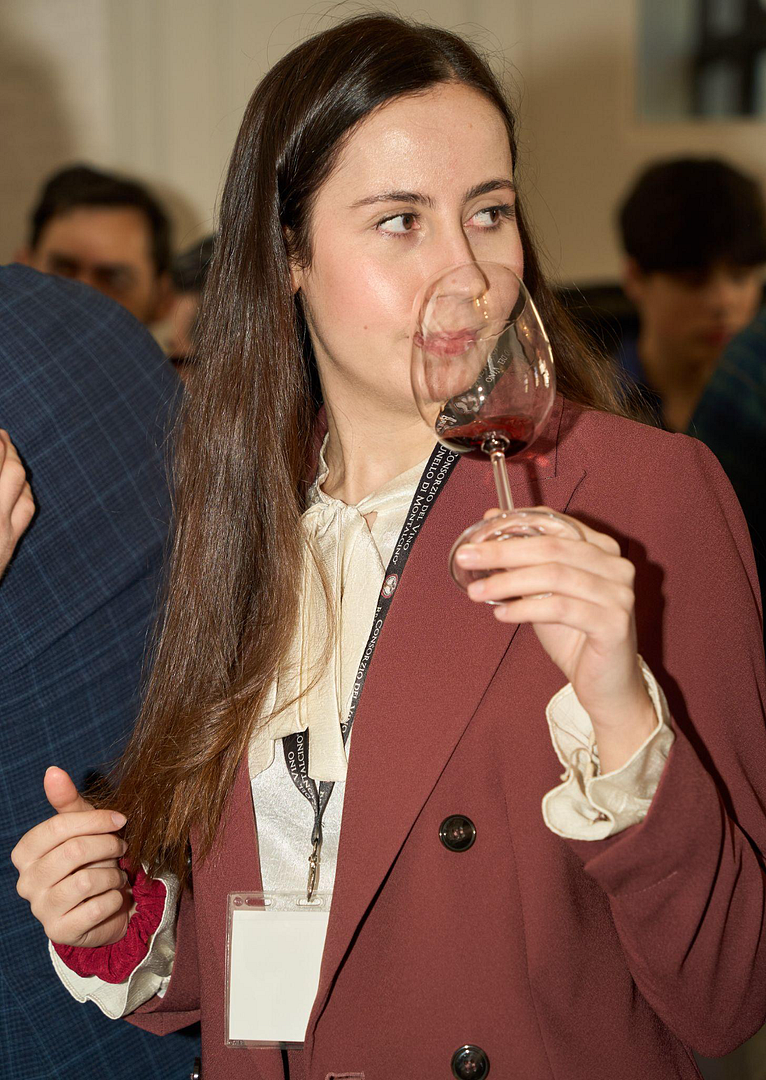
In the complex and competitive world of Italian wine, a category defined by its historical roots, bridging that gap requires more than just a good story—it requires a translator, a strategist, and a diplomat. Bianca Panichi, a Tuscany-born communications strategist based in New York City, has emerged as one of the key figures fulfilling this role.
“Bridging Italian wine with the US market begins with dual fluency,” Panichi explains. “Being Italian allows me to understand wine from within, not only its technical structure, but its cultural logic and institutional framework.”
Working at Colangelo & Partners, the leading wine communications agency in the U.S., Panichi has carved out a niche as a vital cultural conduit between Italy’s most prestigious wine regions and the American trade, press, and consumers. Her approach is not merely about translation, but about a precise alignment of cultural integrity and market relevance.
In fact, Panichi’s work stands out for its depth and precision. By bridging the cultural and structural divide between Italian wine and the U.S. market, she ensures that the narrative remains authentic, the quality is understood, and the dialogue continues. As the wine industry evolves, her role as a cultural bridge becomes not just valuable, but essential.
This dual fluency is the cornerstone of her strategy. While many in the industry focus solely on varietals and tasting notes, Panichi operates on a deeper level, navigating the intricate systems of Italian denominations and the specific expectations of the American consumer. Her role involves working closely with wineries and consortia to ensure that what they represent domestically is communicated with accuracy and integrity in the U.S.
“I understand how the American market evaluates quality, narrative, and positioning,” she says. “My role is to align Italian cultural depth with structured messaging that resonates in a competitive environment.”
The Challenge of Context
One of the most significant hurdles in marketing Italian wine in the United States is the fundamental difference in how wine is perceived culturally. In Italy, wine is often an intrinsic part of daily life, woven into family structure, regional identity, and generational continuity. In the US, wine is frequently a conscious, curated choice—a luxury product or a hobby.
“The challenge is not to make Italian wine more ‘marketable,’” Panichi explains. “It is to ensure it is understood correctly.” This requires a delicate balance of attraction and education. Panichi’s tactics include contextual masterclasses, direct dialogue between producers and trade, and consistent positioning across press and live activations. She aims to spark curiosity without overwhelming the audience, avoiding oversimplification while preserving cultural integrity.
“My expertise is both cultural and structural—which is essential when representing Italian wine abroad,” she notes.
Born and raised in Tuscany, Panichi’s exposure to wine was intuitive and immersive. She later formalized this knowledge with a WSET Level 2 qualification, giving technical vocabulary to her lived experience. Professionally, her work with Italian wineries and consortia has demanded a detailed understanding of how denomination systems function, how regulatory frameworks shape identity, and how to position a producer within that context.
Tailored Strategies for a Diverse Market
Panichi’s methodology is highly customized. She recognizes that a historic denomination like Brunello di Montalcino requires a different narrative approach than a family-owned estate in an emerging region.
“Each client requires a tailored strategy,” she explains. “Presenting a historic denomination demands contextual depth, while positioning a family-owned estate or emerging region requires different narrative emphasis.”
Equally important is understanding the audience. Panichi distinguishes sharply between the needs of lifestyle journalists and specialized wine writers. For the former, she emphasizes cultural relevance and broader context; for the latter, she focuses on production structure, stylistic identity, and competitive positioning.
“My role is to frame quality in a way that resonates with each audience without altering the producer’s core identity,” she says. “When communication is calibrated carefully, journalists are able to evaluate quality within an accurate competitive framework.”
Navigating a Changing Media Landscape
In an era where legacy media is shifting and digital platforms dominate, Panichi advocates for a strategy of “diversification with consistency.” She recognizes that relying on a single outlet or format is no longer sustainable.
Her approach combines traditional media, specialized trade publications, digital platforms, and respected independent voices. Rather than focusing solely on large legacy outlets, she prioritizes building relationships with journalists and commentators who hold credibility within specific niches.
“Adapting to new formats does not mean changing the core message,” said Panichi. “A strong media strategy evolves in structure while maintaining clarity and authority.”
This approach extends to her work with social media influencers. Panichi views influencers and traditional press as operating within different communication ecosystems. While traditional media builds long-term authority and institutional credibility, influencers drive engagement metrics, real-time reach, and direct audience interaction.
“Shifting between them requires adjusting not the message, but the delivery,” she says. With press, she prioritizes structured information and technical accuracy; with influencers, she focuses on experiential storytelling and visual narrative, all while maintaining precision.
High-Impact Communications and Large-Scale Events
Panichi defines high-impact communication not by volume, but by influence. “It happens when a message shifts perception,” she says. “When a region that was previously overlooked becomes recognized. When a producer moves from being ‘unknown’ to being understood within the right competitive context.”
This definition is evident in the large-scale trade events she has helped orchestrate. Panichi has played a key role in nationally significant programs such as the Barolo & Barbaresco World Opening in Austin, Benvenuto Brunello in New York, the Slow Wine US Tour, Chianti Classico Grand Tasting, and Sicilia DOC masterclasses across the country.
These events are not merely tastings; they are institutional platforms that gather hundreds of trade professionals, sommeliers, importers, and journalists. They require coordination at scale, strategic clarity, and a deep understanding of both Italian production and American market expectations.
“Participation in these initiatives requires not only executional discipline, but strategic responsibility in shaping institutional perception,” Panichi notes.
At the heart of Panichi’s work is a commitment to cultural diplomacy. She views wine as a vehicle for representing territory, identity, and historical continuity—especially in Italy. Working between Italy and the United States requires navigating differences in communication style, commercial expectations, and cultural reference systems.
“My responsibility is to ensure Italian producers feel accurately represented while American audiences feel respected and informed,” she explains. “That balance requires precision, authority, and sensitivity.”
By Margaret Wright
Published February 16, 2026
Dining and Cooking