

Guests at the launch of the Vineyard Post Resue Pilot program look over a prototype of the post cleaning plant in McLaren Vale. Photo: Bruce Mitchell
By Bruce Mitchell
A pilot project to advance the re-use of CCA treated vineyard posts that has the potential to save the industry up to $3000 per hectare in disposal costs was launched in McLaren Vale this week.
The Vineyard Post Resue Pilot is an industry-funded initiative led by the National Centre for Timber Durability and Design Life in collaboration with Forest and Wood Products Australia (FWPA), Australian Forest Products Association (AFPA), Wine Australia (WA), Engineered Wood Products Association of Australasia (EWPAA), Frame & Truss Manufacturers Association (FTMA), Koppers, Hexion, and Azelis.
 Guests at the launch of the Vineyard Post Resue Pilot program including SA’s Forest Industries Minister Clare Scriven, Project lead Dr Pene Mitchell and National Centre for Timber Durability and Design Life director Professor Tripti Singh. Photo: Bruce Mitchell
This project has been co-funded by the South Australian Wine Recovery Program, supporting vineyard waste management initiatives. This program is a recommendation of the National Viticulture and Wine Sector Working Group which was established by Agricultural Ministers to address issues being faced by the sector.
It is centred on safely stripping the CCA posts and then repurposing the clean posts while safely collecting and disposing of the waste contaminated sawdust.
Project lead Dr Pene Mitchell from the University of the Sunshine Coast told this week’s launch that the aim of the project was to detail circular pathways for treated timber and engineered wood products to aid the transition of the whole timber supply chain to a circular economy.
She said it would contribute information to age recovery, including understanding things like processing times for de-nailing and cutting to size, market availability and the economics behind post reuse.
SA’s Forest Industries Minister Clare Scriven said there were as estimated 89 million posts in Australia’s vineyards, and about half of those were in South Australia.
“So given that most of those posts are treated with CCA (and) disposal is a challenge,” she said.
“And finding a solution for treated timber is about finding a solution across the entire value chain.”
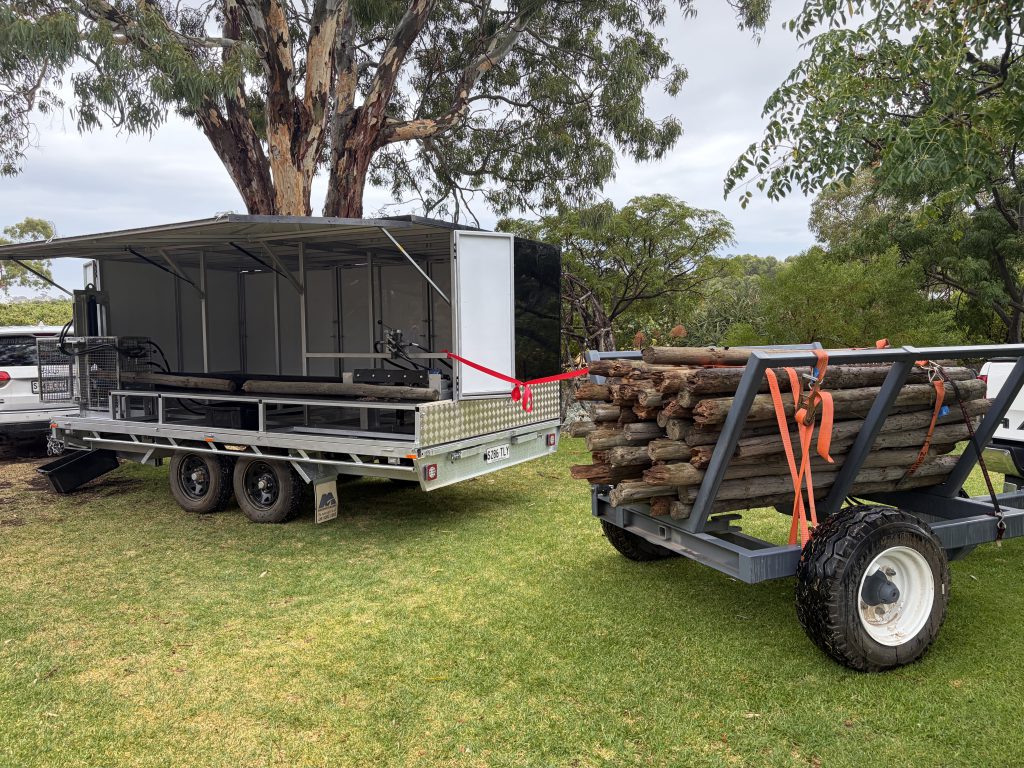 The project is focussed on stripping the CCA posts while safely collecting and disposing of the waste contaminated sawdust. Photo: Bruce Mitchell
Vineyard management company FABAL Group has been engaged to develop the technology to process the end-of-life posts for reuse.
FABAL Group CEO Ashley Keegan said that for growers the project was critically important.
“What I think it represents is just the first palpable, practical step to solve a real problem,” he said.
“Our industry creates 700,000 broken posts per year. Those accumulate to the point where there’s piles of those stacked down the back fences of all our vineyards.”
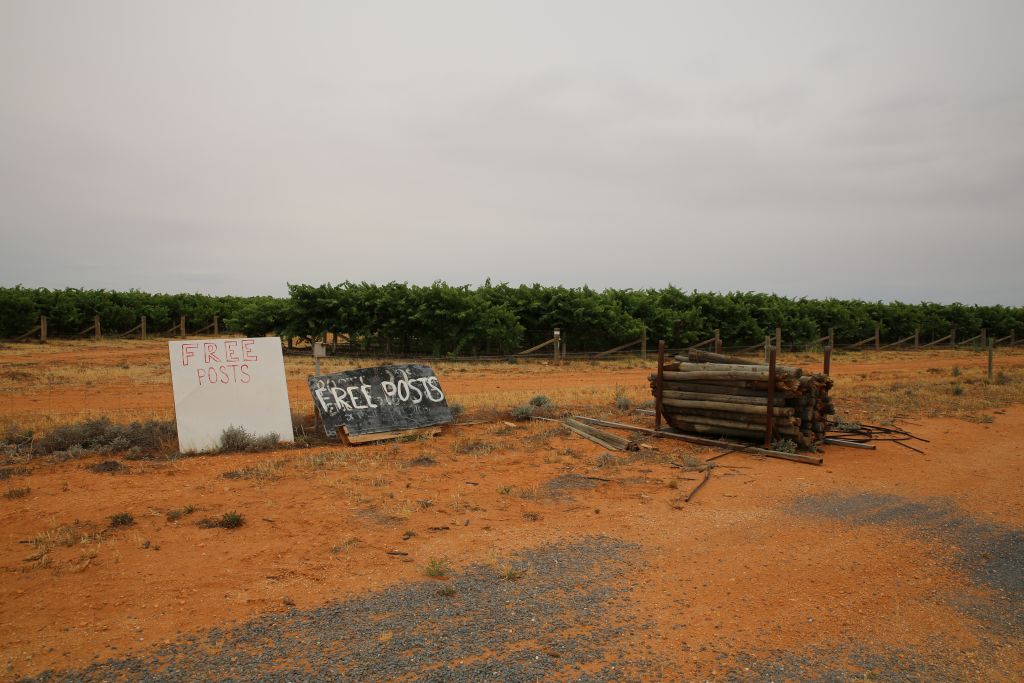 Unwanted CCA-treated posts piled outside a large vineyard in the Riverland. Photo: Meg Riley
“You combine that another estimated 2.5 million posts coming into the pipeline because we’re having to readjust and restructure due the acute situation that we’re in, and we have a real problem.”
Keegan said he was deeply passionate about the problem for two reasons.
“The first is very simple, and it’s the financial reason, because at the end of the day, there’s only one legal, responsible way for us to dispose of posts at present and that’s through in our licensed landfill,” he said.
“To put that in context, it’s about $3.50 to $5.50 per post for us to do that, depending on the transport component. It’s an enormous amount.
“Let me put some context around that. Every hectare of vineyard that we have uses, on average, 600 to 700 posts per hectare. So do the simple maths, and you end up with $2500 to $3000 a hectare just in that single waste stream.”
And Keegan said that can represent between 10 and 25% of the entire value of a vineyard just in one single waste stream.
“And don’t even get me started on the cost to get them out of the paddock, to actually prepare them to be able to be disposed of,” he said.
Keegan said the second reason he was passionate about the project was because growers were facing a lack of sensible commercial opportunities to solve the problem of disposing of used treated posts.
“And it produces this sort of catatonic state of inaction,” he said.
“Or even worse, it encourages us to keep doing what we’re doing, which is what our industry doesn’t need.”
He said the pilot project was not going to be the single solution to the problem.
“What I think it represents for us as growers is just a single palpable, practical plan that is just one part of the solution.”
Are you a Daily Wine News subscriber? If not, click here to join our mailing list. It’s free!
Dining and Cooking