
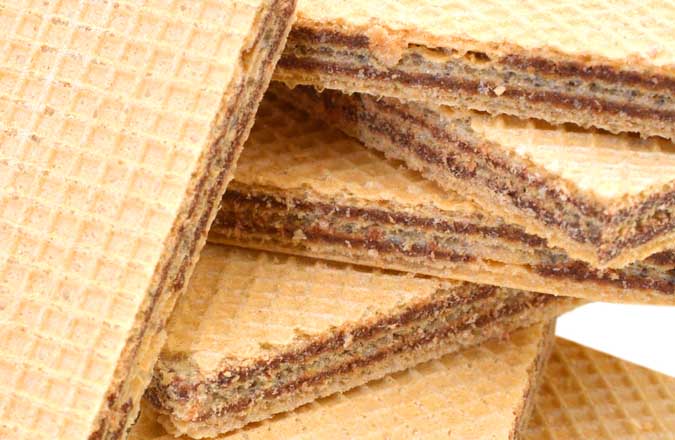
Il wafers Made in Italy is undergoing a phase of technological and commercial evolution, aiming for all-round excellence. While the crunchy wafer alternating with cream remains the heart of the product, the Italian food industry has successfully elevated this snack to a symbol of innovation. Through investments in Research and Development (R&D), domestic producers are responding to consumer expectations regarding environmental sustainability and nutritional profiles, with an increasingly broad offering.
Market Dynamics: The Export Boom in 2024-2025
Il global wafer market reached a value of $7,2 billion in 2024, with an expected compound annual growth (CAGR) of 5,8% until 2030, highlighting strong dynamism in the international confectionery segment. Europe maintains its leadership in production and consumption, while progressive penetration of high-potential markets in Asia-Pacific and North America is being recorded (Mordor Intelligence, 2025).
For Italy, theagri-food exports reached a historic record of 70,3 billion euros in 2024, +7,1% compared to the previous year, and is approaching the 73 billion mark in 2025 (ISMEA, 2026). The baked goods and confectionery sector – which includes wafers – contributed significantly to this result, with an export value of over 4,3 billion euros (UnionFood, 2025).
The main destination markets for the Italian wafers include Germany, France, the United Kingdom, the United States and, increasingly, countries in the Middle East and East Asia, where the perception of ‘Made in Italy’ confectionery continues to grow.
From the medieval host to steam technology: the roots of excellence
The origins of the wafer date back to European Middle Ages, when thin, crispy wafers were prepared with wafer irons heated over an open fire. The term ‘wafer’ derives from the Old French ‘wafre’, in turn from the Frankish ‘wafel’, indicating precisely these thin, fragrant preparations. In Italian Renaissance, the wafers were enriched with spices and honey, served in noble courts as a symbol of refinement.
Modern industrial wafer production consolidated between the nineteenth and twentieth centuries, when important Italian entrepreneurial families brought the artisanal confectionery tradition to the mass market. A crucial moment was the introduction of steam-heated plates in the 20s, which allowed large-scale production while maintaining the characteristic crunchiness.
Historic companies such as Loacker, founded in 1925 in Bolzano by Joseph Loacker, contributed to the international diffusion of Italian wafers, combining South Tyrolean tradition with cutting-edge production technologies. Other companies, such as Manner (with Austrian-Italian roots) and Venetian producers, consolidated the reputation of Italian wafers in European and overseas markets after World War II.
Geography of Taste: Innovation’s Production Districts
In Italy, the wafer production It is mainly concentrated in the North and North-East of the country, with industrial centres in Trentino-Alto Adige, Veneto, and Piedmont, areas rich in confectionery traditions and with privileged access to high-quality raw materials such as Piedmont PGI hazelnuts and Alpine milk.
Trentino-Alto Adige represents the productive heart thanks to the presence of Loacker, which produces over 90.000 tons of wafers per year in its plants in Bolzano, Renon, and Heinfels (Austria). Veneto is home to numerous manufacturers specializing in wafers for the retail market and for the professional channel (pastry and ice cream), among which Crich (1870) stands out. Piedmont combines wafer production with the excellence of local hazelnuts, creating specialties that are also appreciated abroad.
These regions boast factories that combine modern production techniques with respect for raw materials, guaranteeing consistency, flavor and quality standards high in Made in Italy wafers.
Wafer Engineering: Thermal Processes and Clean Labels
– basic ingredients wafers include:
wheat flour top quality;
vegetable oils or fats (coconut oil, cocoa butter);
milk powder or derivatives for the creamy filling;
natural flavors (Bourbon vanilla, cocoa powder, toasted hazelnuts);
emulsifiers (soy or sunflower lecithin);
leavening agents (sodium bicarbonate).
Il industrial production process It is divided into the following phases:
Processing the dough: flour, water, sugar and additives are mixed until a smooth and homogeneous batter is obtained, with controlled viscosity to ensure uniform cooking;
Cooking on plates: the batter is automatically poured onto metal plates heated between 140°C and 160°C. Cooking lasts approximately 2-3 minutes per waffle, during which the water evaporates creating the characteristic porous and crunchy structureThe plates can be flat (for thin wafers) or with decorative patterns;
Layered assembly: the cooked wafers are alternated with creamy fillings Made with vegetable fats, milk powder, cocoa, or hazelnuts. Automated systems apply uniform layers of cream (1-2 mm thick), ensuring the optimal wafer-to-filling ratio (typically 40% wafer, 60% cream).
Cooling and cutting: the multilayer blocks are cooled in temperature-controlled tunnels, then cut into standard formats (single, double, squares) using precision blades;
Secondary: packaging takes place in a protective atmosphere or with barrier materials to preserve fragrance, crunchiness and fragility, protecting from humidity and oxidation.
Segmentation and new trends: from ‘gourmet’ to ‘free-from’
The panorama of the Italian wafers It is extensive and includes:
hazelnut wafers: made with toasted Italian hazelnuts (often Nocciola Piemonte PGI), appreciated for their aromatic richness and the creaminess of the filling;
cocoa wafers: with layers of dark or milk chocolate cream, often with cocoa of selected origin (Ecuador, Ghana, Ivory Coast);
vanilla wafers: with delicate and traditional flavours, often with natural Bourbon vanilla from Madagascar;
lemon wafers: fresh and aromatic, they use essential oils of Sicilian or Calabrian citrus fruits;
biological variants: with ingredients certified from organic farming, sometimes even Fairtrade;
gluten-free wafers: formulated with alternative flours (rice, corn) for celiac consumers
versions with less sugar: in accordance with Regulation (EC) No. 1924/2006, Article 9, i.e. with a minimum reduction of 30% compared to the average of the best-selling products in the same category on the Italian market
Nutritional profile and transparency on the label
According to the data of the CREA – Food and Nutrition Research Center, 100 grams of wafers provide on average:
carbohydrates 76,2 g (of which sugars 26,7 g);
The average serving indicated is 30 grams, taking into account the lightness of this type of product in relation to its volume, and their energy density.
Shopping Guide
To purchase quality Made in Italy wafers:
favor products with organic ingredients; and sustainable (e.g. FairTrade and Rainforest Alliance certified cocoa);
check the list of ingredients, preferring natural flavours, the absence of hydrogenated fats, and the use of Italian raw materials;
The team of GIFT (Great Italian Food Trade) offers specialized support to international buyers in identifying certified and reliable Italian suppliers, facilitating the meeting between international demand and supply of excellent Made in Italy products.
Conclusions
The success of Italian wafers in the world is not a static fact, but the result of a unique ability to combine the quality of raw materials
(like the Piedmont Hazelnut PGI) with a forward-looking industrial vision. The push toward lower-sugar products, the elimination of hydrogenated fats, and energy optimization of cooking processes demonstrate that the industry is ready for the challenges of 2030. For international buyers, choosing a Made in Italy wafer today means choosing a product that guarantees food safety, constant innovation, and timeless global appeal.
GIFT (Great Italian Food Trade) Editorial Team
References

Dining and Cooking