
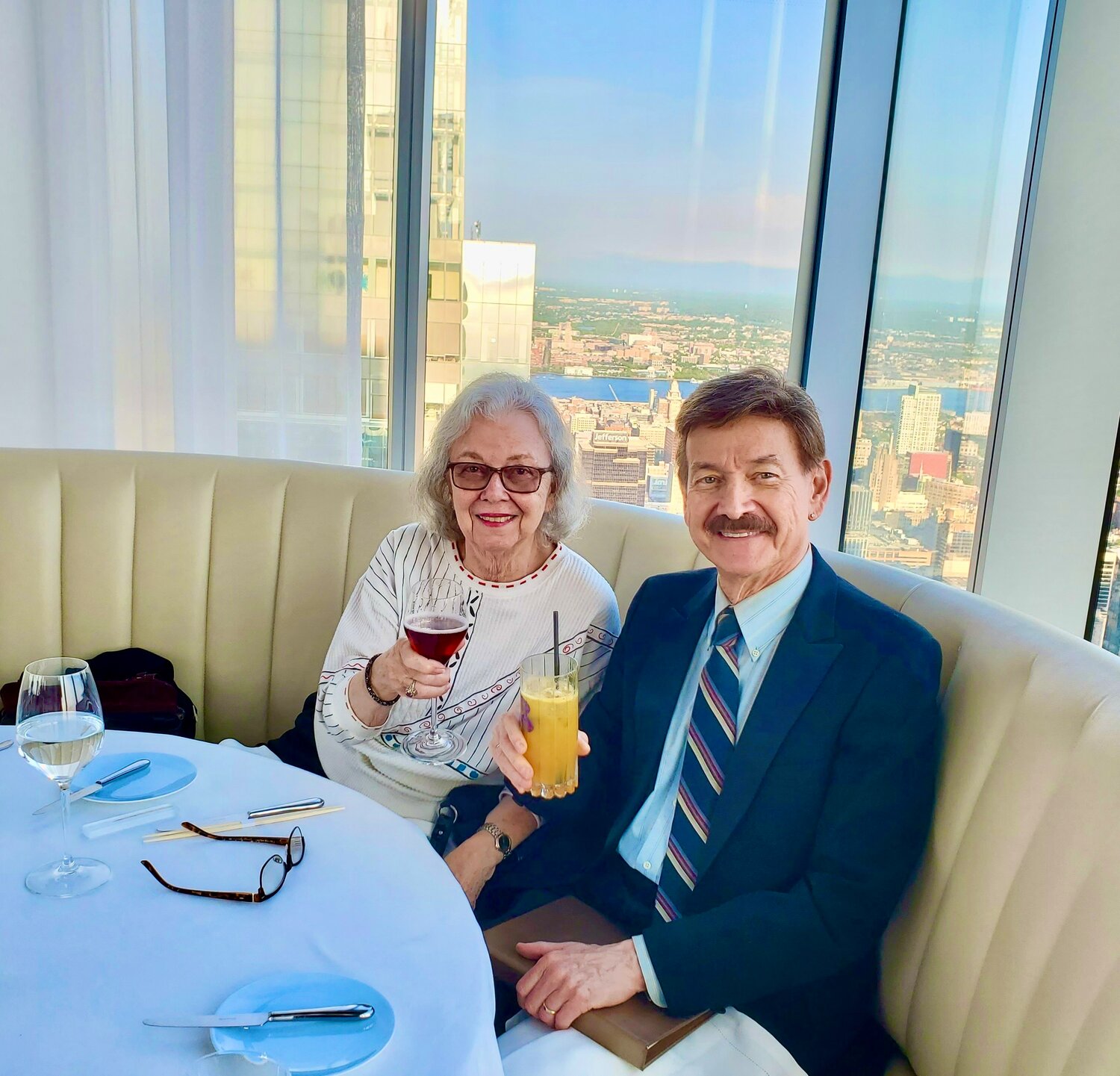
I was born in South Philly but grew up in a working class rowhouse family of seven in West Oak Lane. My father had to drop out of South Philadelphia High School when he was 14, and my mother never made it past grade school, so money was very tight. I must admit I always envied kids who went to private school and could afford summer camp, braces for their teeth, sports equipment, bicycles, restaurants and family vacations because I could not, although I always had after-school jobs starting at age 10. I never even knew a kid who went to private school until I went away to college.
I was taken to a restaurant once a year on my birthday at the Oak Lane Diner. (Believe it or not, according to Mr. Google, it is supposed to reopen in the relatively near future at 6528 N. Broad St. after being closed for 10 years because of a fire.) Most of the food at home was, to be kind, pedestrian, so I thought the meatloaf and fries at the Oak Lane Diner constituted fine dining.
My first newspaper job, as a reporter at The Philadelphia Tribune, paid $80 a week (for 50 hours of work) before taxes, $69.45 after taxes. (I swear I am not making this up. I still have my first pay stub to prove it.) My wife made $100 a week as a public health nurse, so the tradition of penurious dining continued. On the rare occasion when we went to a restaurant (no desire for fast food), it was to a restaurant called Happy Paradise at 9th and Arch Streets in Chinatown. Many readers will not believe this, but an entire dinner — one appetizer from Column A and one entree from Column B — cost $3.50. I never ordered a glass of wine because that was another $3.50.
By the time I was 40, my wife and I had never been within screaming distance of an upscale restaurant. For our wedding “party,” we bought two trays of cold cuts and cheese from ACME, the “caterer,” for $14. In early 1981, a friend of mine named Jesse, a native of Dallas, Texas, who came to Philly to get an MBA at the University of Pennsylvania’s Wharton School and then worked as a stockbroker, wanted to place a friendly bet on the Dallas Cowboys. They were about to play the Eagles in the upcoming NFC Championship game.
I always wondered what expensive food (excuse me, “cuisine”) tasted like in the fine dining restaurants I read so much about, so I hatched an idea that I thought would finally get us into an upscale establishment. I bet on the Eagles, who were a three-point favorite, and I said, “Jesse, here is what I would like to bet: Whoever loses the bet has to take the winner and a guest to any restaurant of their choice in Philadelphia.” He said OK.
My faith in the Eagles paid off. They won the game in frigid weather, which the Cowboys were not used to, 20-7. So I called Jesse and said, “OK. We are ready to collect on the bet. We would like you to take us to Le Bec-Fin.” That restaurant, run by legendary French chef Georges Perrier, was then the most expensive restaurant in Philadelphia with a fixed price of $65 for dinner plus wines.
“Are you kidding?” Jesse exclaimed. “This was supposed to be a regular restaurant.”
“I do not recall anyone using the word ‘regular,’” I replied. “It was ‘any restaurant’ of the winner’s choosing! Are you trying to back out of the bet?”
Reluctantly, Jesse agreed and did not take a date/companion/wife to dinner to save money. The food was ambrosial. I had never tasted anything remotely like the wine-reduced sauces, the tender steaks (I have not eaten meat for decades, but I did then), the exquisite desserts, etc. I asked the sommelier to pick the wine since I knew nothing about any wine costing more than $2 a bottle (or box).
He selected a Chateau Mouton Rothschild, 1969, a full-bodied Bordeaux, for $120. Jesse almost fell out of his chair. (The same bottle today, if you could find it, would cost at least $700 and maybe more than $1,000.) The sommelier had to “decant” the wine to eliminate the sediment. I had no idea what that was about. He might as well have been excavating an archaeological site in Turkey, but the flavors were divine, sublime. We traveled home to Mt. Airy on a cloud. I promised myself that I would have to taste flavors like that again and again.
I began reading everything I could about fine food and wine. As a reporter, I was able to interview chefs, managers and restaurant owners and learned quite a bit. Then, on Dec. 15, 1981, the newspaper I was working for, The Philadelphia Journal, went out of business, largely because the union we belonged to, the Newspaper Guild, persuaded the members to reject a demand by management that we take a 12 percent pay cut. About 200 employees lost their jobs.
Out of work, I began calling weekly newspapers all over the area, trying to get freelance assignments. After numerous rejections, an editor, Andy Hachadorian, at the now-defunct Main Line Chronicle, who said he was familiar with my byline, asked if I would like to try writing a restaurant review column. Duh! Does a pig have knuckles? So I started to do it every week.
A few months later, when I called Ruth Russell, then-editor of the Chestnut Hill Local’s “Local Life” arts and entertainment section, she also asked if I would like to try restaurant articles on a probationary basis. A writing duo, Flourtown residents Richard and Missy Lee, had been writing the “Table Hopping” column, Russell said, but they stopped doing it because they were paying more for the dinners than the $25 they were paid for the column.
I continued writing the column for the Main Line Chronicle until it closed and then the Mainliner News, and then the Main Line Times (later purchased by the Mainliner News), as well as the Local, both for 35 years, until 2017. I have been asked to resuscitate the column from time to time for the Local. I have tried to make up for that first 40 years in a culinary desert, and so far it’s working. Now I am ready for an after-dinner glass of Sandeman Rich Ruby Port.
You can reach Len Lear at lenlear@chestnuthilllocal.com.
Dining and Cooking