
By JUDE WATERSTON
It seems to me that there are certain foods over which people never feel wishy-washy. They either love or hate such things as okra, anchovies, beets, olives, Brussels sprouts and calf’s liver. Vogue Magazine’s former food critic, Jeffrey Steingarten, once wrote of his quest to develop a taste for Korean kimchi (spicy fermented pickled cabbage), clams and anchovies. He was, however, unable to convince himself that he had acquired a fondness for rasmalai, one of the many off-beat desserts he had sampled at Indian restaurants.
In 1989 my sister Janet and I prepared for a trip abroad. It occurred to me that visiting Italy would present me with the chance to taste olives right smack in the middle of one of their places of origin. But I had a long and healthy hatred for olives. Having been in the bar business in my early 20s, I’d tried the only kind of olive that you find in pubs: a khaki colored orb stuffed with a limp piece of pimento that has been sitting for years in a putrid, cloudy liquid and is plopped in the occasional martini.
I love food so much and have always prided myself on the fact that I am not squeamish about trying new foods. So I reasoned that as a prelude to our upcoming trip, I should give olives a real chance. I was determined. One morning around that time I was in a large gourmet supermarket and noticed the proliferation of olives from Italy, France, Greece and Spain. There must have been 20 kinds of purple, green, rose and black olives.
I bought a half-pound of assorted olives and dug in. I found, to my surprise, that they varied greatly in taste and texture. Some were pulpy and almost winey tasting, while others had a slight bitterness and taut or wrinkly skin. I didn’t fall in love right away, though. I kept trying different kinds until I found five or six that I preferred. Once we arrived in Italy, I gave myself up to the passion and found that I had become crazy about olives.
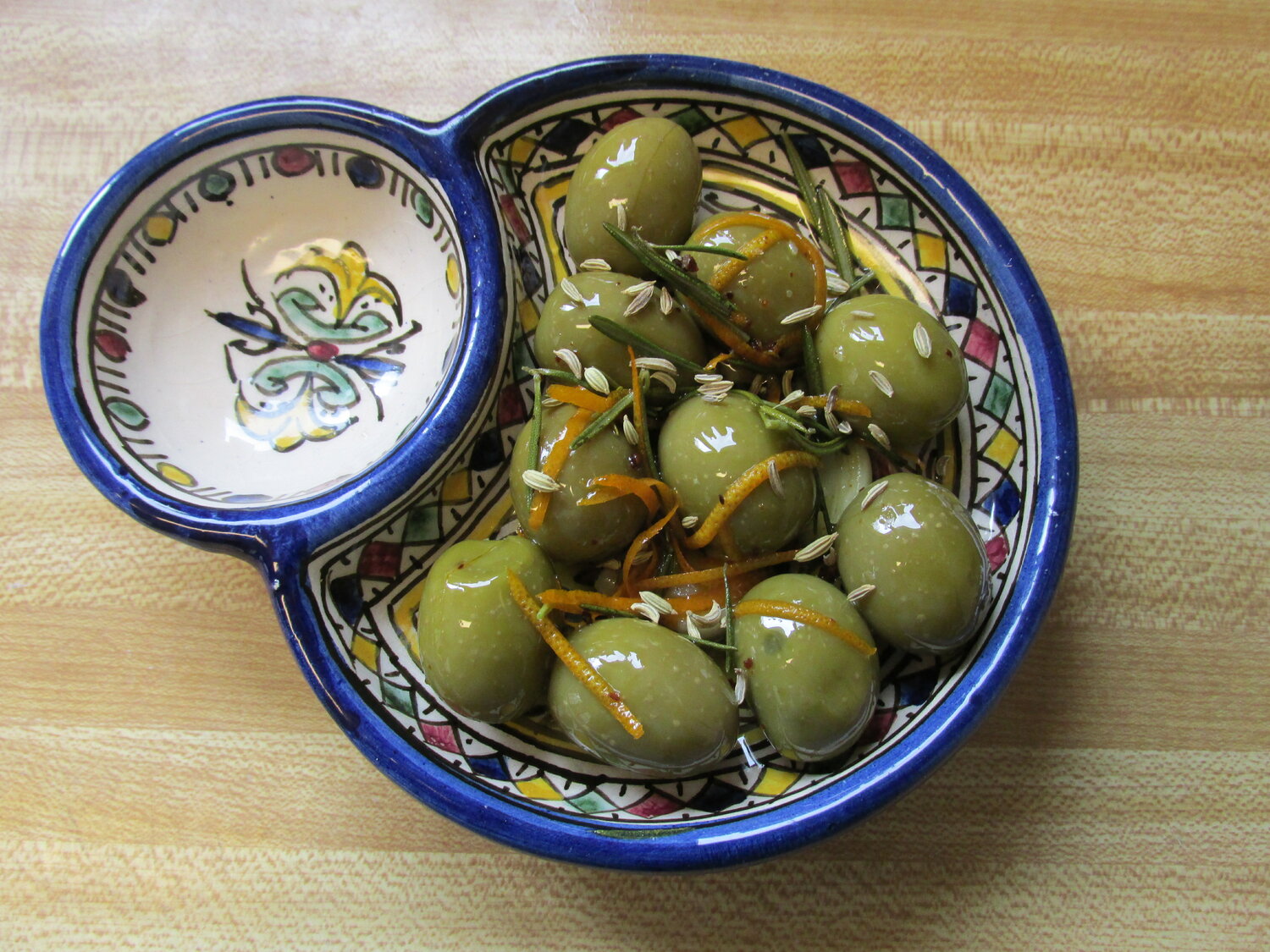
Since then, I always keep a jar of mixed olives at hand. Sometimes I leave them in the fridge in their brine, but once in a while I place a couple dozen in a wide-mouthed mason jar and cover them completely (by at least an inch) with good-quality extra-virgin olive oil and leave them on the counter to be consumed within a couple of months. The oil eventually becomes strongly flavored and is wonderful drizzled over pasta or soup. When friends visit and I put out an assortment of hors d’oeuvres, I serve the olives sprinkled with fresh herbs, such as rosemary, tarragon, or thyme, or dried spices like cumin or fennel seeds, and garnished with finely grated lemon or orange zest. I even bought two cookbooks devoted to olives.
Now that I have found this appreciation, my only problem is that the person I live with, my sister Janet, is one of those people who detests olives! Unreasonably, it irks me that I overcame my distaste for olives and Janet won’t even entertain the idea of trying one when I put them out for guests.
If you happen to be lucky enough to be surrounded by olive lovers, try using them in unexpected ways. Add them to Latin-inspired yellow rice pilaf, or throw some in a salad. The Italian pasta sauce, puttanesca, is made with an unusual combination of piquant and savory ingredients, including olives, which work well together through they sound as though they couldn’t possibly. Puttanesca, or “whore’s sauce,” is rumored to have come about by ladies of the night quickly throwing together the odds and ends they found in their pantries to make a sustaining pasta dish between clients.
Dining and Cooking