
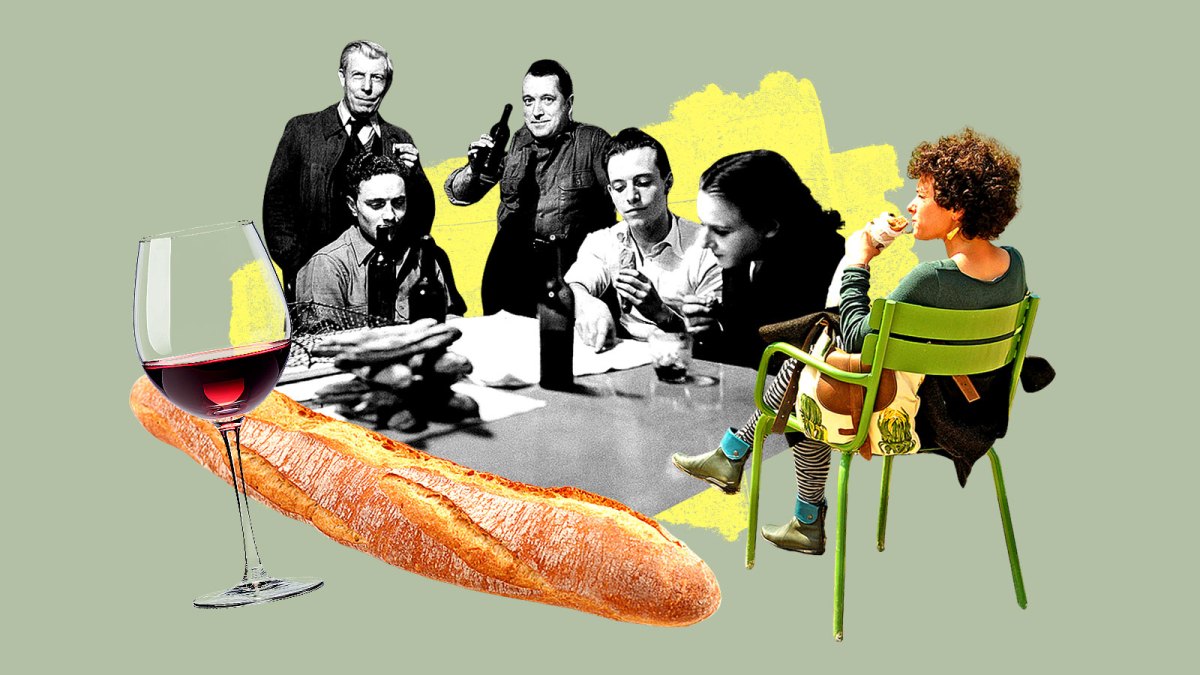
The Nouvelle Gare brasserie in Paris’s 13th arrondissement was serving traditional fare, such as rib steak, kidneys and beef tartare, to mostly grey-haired diners washing down their lunches with a glass of red on Tuesday. It was 2pm, and none seemed in any hurry to return to work.
Down the road at La Felicità, which describes itself as a “sexy food court”, the mood was different. The overwhelmingly young employees of the start-up incubator next door tucked into dishes such as Crazy San Marzano pasta, Végé-dream Burger and Piggy Pop, which turned out to be focaccia, porchetta and roast potatoes. A couple of men had a glass of beer on the table in front of them, but there was no wine to be seen.

AFP journalists take a “boozy” lunch break, in 1946 in Paris
AFP
Léo, 36, who works in the car hire sector, was sitting on his own in front of his computer. “I’ve got a meeting in five minutes and I don’t have time to eat now,” he said. “I’ll have lunch later when I’m finished.”
• Dining solo moves up the menu at Michelin-star restaurants
He is by no means an exception. According to French media reports, tensions are rising in the country’s business sector as younger generations eschew the traditional lunch with colleagues.
A poll commissioned by Openeat, a digital luncheon vouchers provider, found that 29 per cent of employees under the age of 25 regularly lunched alone, compared with 22 per cent of 25 to 34-year-olds, 16 per cent of 35 to 49-year-olds and 12 per cent of the over-49s.
In a country that has long placed food at the centre of its national culture, the move to solo dining is part of a sometimes bewildering lunchtime change. The average worker spent 90 minutes over lunch 20 years ago, studies show. Now, 45 per cent of those who work on company premises spend less than half an hour, according to the Openeat poll. The figure is 52 per cent for those who work from home. Only 11 per cent go to a restaurant every lunchtime and, of these, about half do not touch a drop of alcohol, the poll found.
Yet even if lunchtimes have become shorter and less inebriated, they remain a significant daily event for a nation that does not yet appear ready for a British-style sandwich while tapping at the computer.
Commentators say staff are still expected to eat together, even briefly. They are viewed dimly if they go off on their own.
• 12 of the best things to do in France for solo travellers
Les Echos, the financial daily, said eating alone was a “taboo” subject in the national corporate culture. Solo diners were seen as antisocial and unlikely to be good team members, it said. It quoted a fortysomething employee of a small company who refused to sit down for two lunches with sales staff “because I wanted to get home earlier to take care of my daughter”. She was accused of snubbing her colleagues.

Ioana Timoce, a model, enjoys a coffee, alone
LIONEL BONAVENTURE/AFP
Le Monde pointed to a generational divide, saying Generation Z was often filled with “dread” at the thought of having to put up with workplace chatter during the midday break. One 25-year-old told the daily she hated the “patriarchal” atmosphere that meant underlings felt obliged to laugh at their managers’ jokes during lunch. She took to eating alone, but her contract was terminated because of her perceived failure to integrate into the company.
At La Felicità, many diners were sitting alone with only their smartphones for company. “I really don’t want to talk to anyone during lunch,” said a young man eating a plate of spaghetti. He declined to answer further questions.
Léo Duquenois, 25, an engineer at Kuli, a start-up with an artificial intelligence platform designed to help brands find influencers to market their products, was more loquacious. He was eating with Jonathan Hassan, 30, the firm’s founder. They said they generally took 30 to 45 minutes for lunch, sometimes chatting about work, but mostly about other topics. “It’s important for me to have a break,” Hassan said. “I’m more productive afterwards.”

Edouard Manet captured France’s love of a hedonistic lunch with Le Dejeuner sur l’herbe (Luncheon on the Grass)
LEEMAGE/GETTY IMAGES
Duquenois said he enjoyed lunching with colleagues, but conceded that those who did not could easily feel stigmatised in France . “People sometimes want to eat alone but don’t feel they can do so, and they force themselves to have lunch with their colleagues.”
Yet Christophe Nguyen, a psychologist, said that an era of open-space offices, video conferences and endless online messaging had reinforced the appetite for solo dining.
“For some young people, it is a moment for psychological recovery, particularly in a context of intense cognitive, emotional or collective demands,” he told Le Monde. “Eating alone enables you to regulate the level of stimulation.”
Dining and Cooking