
Sign up for the Slatest to get the most insightful analysis, criticism, and advice out there, delivered to your inbox daily.
The Italian American “red-sauce joint” is an institution in this country—or at least it used to be. From its early-20th-century origins in working-class Italian immigrant communities—in which traditions of the homeland were fused with American cookery—this sauce-first-pasta-later, carb-loaded style of dining spread outward all over the country. Meatballs were made bigger, everything from chicken to ziti became blanketed with gooey mozzarella, and red sauce became the defining (and reductive) characteristic of a beautiful cuisine. But as popular as they were with diners, over time red-sauce restaurants became antiquated in the eyes of the culinary elite. As Anthony Bourdain put it, “Somewhere in the late 70’s or 80’s, red sauce was no longer cool. It was no longer authentic. Tuscan was ‘in’. … You could eat in Italian restaurants in New York for ten years and never even see red sauce. We were almost made to feel bad about any secret appetites we might retain for spaghetti and meatballs.”
Thankfully, this style of food is haute again, enjoying a much-deserved reappraisal in the form of buzzy new restaurants. Spaghetti and meatballs, chicken Parmesan, chicken piccata, calamari, and even chicken Marsala have all become chic. Is it millennial nostalgia? The Bear effect? The appeal of comforting food in uncomforting times? I’d wager all three.
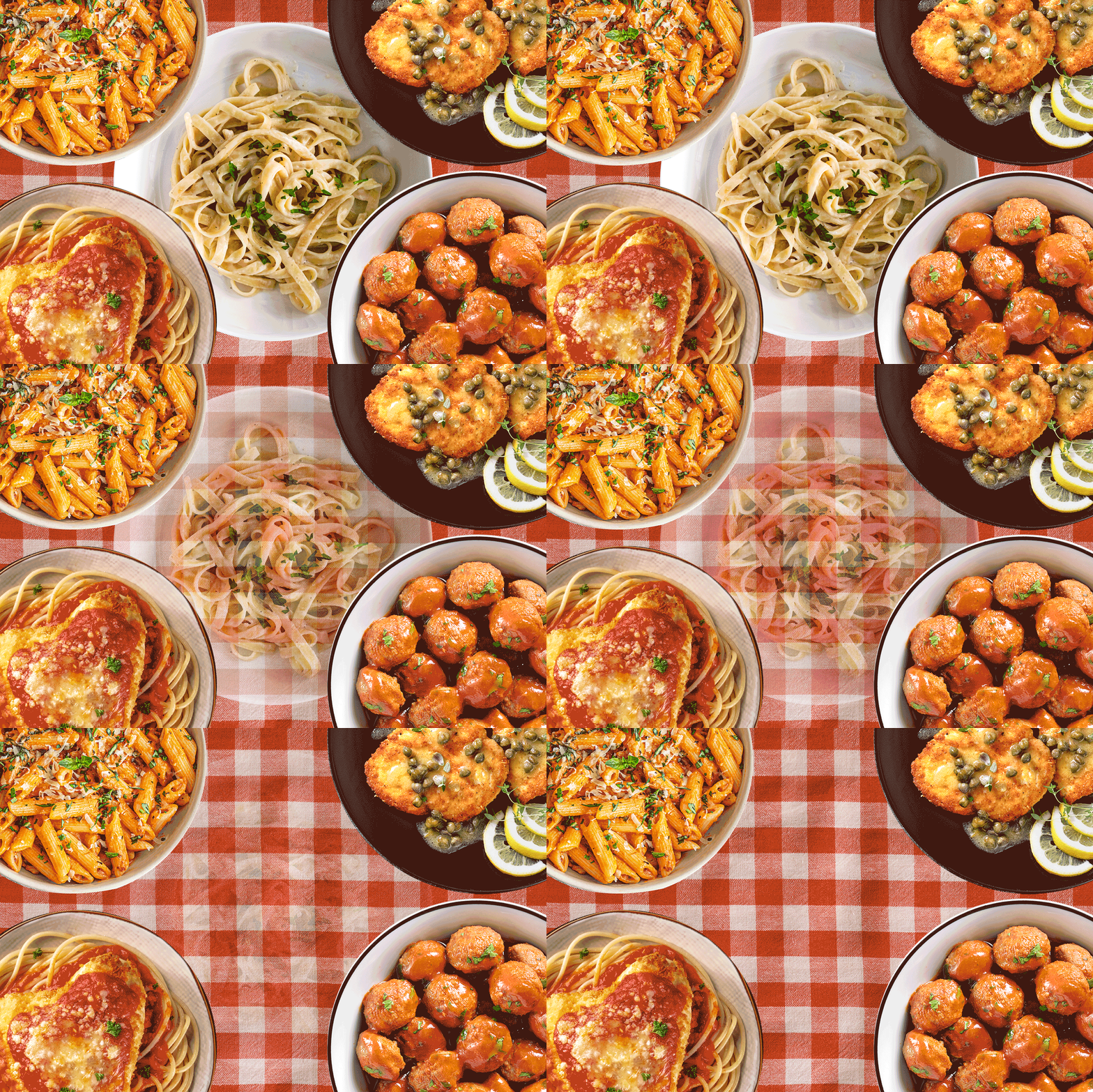
But when you scan the menus of these newer spots, there’s one glaring omission from that roll call of classic dishes, and I believe that it has been left out on purpose. It’s thick, heavy, and cheesy, but it’s also smooth, velvety, and buttery. It’s blank white and monochromatic, and yet a core food memory for thousands. I’m talking, of course, about fettuccine Alfredo.
Now, just so we’re on the same page, when I say fettuccine Alfredo, I mean the cream-based gut bomb available at your local Olive Garden, not the purportedly “authentic” version with butter. Italians—truly a people never shy about calling out any perceived food crimes—are quick to point out that the American version isn’t real Alfredo at all, that the real deal actually doesn’t contain any cream. “Why? Why? It’s done the wrong way, by the wrong people,” decries Vincenzo of Vincenzo’s Plate, a popular YouTube series, of the dish.
This argument is both annoying and pedantic. Pasta with butter clearly falls into the category of pasta al burro; any long noodle with cream sauce is the correct fettuccine Alfredo, at least colloquially speaking. The latter has become so popular in America that it has claimed the name entirely. There won’t be any authenticity debates today.
What there will be, though, is a culinary search party. Fettuccine Alfredo used to be all over Italian American restaurant menus, and in this renaissance era, it’s gone missing. Deleted. Rubbed out. Whacked. I first suspected that something might be amiss in July 2023, with the opening of Donna’s in Echo Park, Los Angeles—a restaurant so good that Lesley Suter of Eater Los Angeles said that it made her believe in hype restaurants again. Per the “Our Story” section of its website, Donna’s is “inspired by an east coast, red sauce joint. The menu is made up of those Italian-American classics that you expect, but done really well with California ingredients.” Naturally, the establishment serves meatballs, Parm, piccata, garlic bread, the usual suspects—but no fettuccine Alfredo. What gives?
And it’s not just Donna’s that’s at fault. I’m going to pound my fist on this checkered tablecloth: Alfredo is noticeably absent from the reconceptualized La Dolce Vita in Beverly Hills, and you won’t find it at reborn legacy restaurants like Brooklyn’s Jr & Son either. You see meatballs and penne alla vodka at New York’s iconic Rao’s, but not a creamy fettuccine in sight. Emilio’s Ballato in NYC? Jemma in L.A.? No Alfredo. I challenge you: Find a newer Italian American restaurant that serves fettuccine Alfredo. The dish is going extinct, and I think I know why.
To test my theory, I checked in with some chefs and restaurateurs—why were they so intent on disappearing such a delicious dish? James Rigato is famous for his turn on Top Chef, but his greatest achievement is running one of the most consistent restaurants in the country: Mabel Gray in Detroit. He also helms one of the best Italian American pop-ups I’ve ever had the pleasure of experiencing, Sunday at Nonna’s. When I attended last summer, I enjoyed crispy chicken cutlets with salsa verde, cavatelli with corn and Parmesan, garlic bread sopping with butter, hulking meatballs cloaked red, and tiramisu served with a side of Italian rainbow cookies. All of them being passed around on these giant oval platters, much like you would experience at Grandma’s house. Noticeably, however, Rigato didn’t serve Alfredo. So I texted him a hypothetical:
If you opened an Italian American restaurant tomorrow. Something cool and fun but well-made food: Chicken parms and vodka sauce and meatballs. Would you put fettuccine Alfredo on that menu? Or would it be left out?
“Great question,” he responded. “I think yes. But it would be something like a parm rind simmered milk sauce with roasted garlic. And then it would be a pulled chicken or smoked and pulled chicken. Spinach or roasted broccoli. I’d have to do something to make it enjoyable to make and redeeming to serve. Fresh fettuccine too, of course.” Finally, he delivered the blow I had been waiting for: “But straight up Midwestern wallpaper paste Alfredo. Nah.”
Aha! Rigato confirmed what I had suspected: that fettuccine Alfredo, in its standard form, is seen by many chefs as crude. It’s creamy and indulgent but also lacks depth. After all, this style of Alfredo is believed to have taken shape back in 1966, when Pennsylvania Dutch Noodle Company started hawking its egg noodles. While these are now most commonly used as a serving base for meat braises or regional takes on chicken and dumplings, the OG package featured a recipe for “Alfredo sauce” that included cream, Swiss cheese, Parmesan, and butter. Damn, that actually sounds pretty good. But also far from Italian. German immigrants in Pennsylvania? We’re nowhere near Nonna’s table.
I can’t help but ruminate on Rigato’s barb, “Midwestern wallpaper paste.” What exactly makes Alfredo “Midwestern”? What makes any food Midwestern? Speaking strictly in terms of a perceived negative culinary implication, I think it’s these two qualities that are at issue: blandness and heaviness. When Midwestern food is both bland and heavy, it gets slandered. And what’s blander and heavier than the very stuff that makes Alfredo: heavy cream.
Cream is blunt. Loud. Low-class. At least, that’s the view among many diners and chefs these days. Just look at the list of James Beard semifinalists this year. You won’t find many cream-forward restaurants. I recall a conversation I had recently with Argentinian chef Javier Bardauil. The two of us, sitting at his restaurant enjoying a carajillo, were waxing about leaving restaurants feeling tired and full. He had strong words for such kitchens: “Cream and butter, man. When a chef uses that, they’re overcompensating.” Alfredo is all cream and butter. And when you pair it with pasta? Nighty night. You should probably call an Uber home. Alfredo driving is drunk driving.
But can the good name of Alfredo di Lelio (the poor Italian soul who’s been attached to the American version) be saved? I spoke with Christian Stagliano, of the aforementioned Donna’s in Los Angeles. He’s the sous-chef and has worked at a handful of Italian restaurants in Southern California, including Union in Pasadena (no Alfredo there either). I asked him, “Is Alfredo too lowbrow for a modern Italian American concept?”

Danny Palumbo
White America Is Wrecking One of the Best Winter Foods. Here’s How to Do Better.
Read More
“Well, I wouldn’t go that far,” Stagliano said, “to say it’s lowbrow for a modern concept, especially for an Italian American restaurant that welcomes modern ideas and techniques. We did a fettuccine with Parm fonduta and spring vegetables.” But, he concedes, “I feel a lot of places put a splash of pasta water and heavy cream and call it Alfredo, when it needs more love than that.”
For Donna’s seasonal riff on fettuccine Alfredo, Stagliano went lighter and more veg forward. Interestingly, fonduta—a creamy, cheesy dipping sauce originating in the Piedmont region—reads more Swiss than anything Italian. Still, this Alfredo dish feels wholly inventive. It’s something Californian and decidedly springlike. In short, Stagliano decided that Alfredo needed a bit of reimagining. It’s like chef Rigato says: He wouldn’t just serve a bowl of cream and noodles. He’d employ finesse and creativity.
It may be that Alfredo isn’t like chicken Parm or red sauce—dishes that are best when they’re treated traditionally. While I certainly have a nostalgic soft spot for a classic, cream-based Italian American Alfredo, it is admittedly nothing I’ve ordered much in the past decade. Perhaps Alfredo shouldn’t remain so static; maybe it needs to evolve with people’s tastes. And until restaurants start to reinvent this dish beyond those gloppy Pennsylvania Dutch roots, the vanishing act will continue.
This Content is Available for Slate Plus members only
There’s a Conspiracy Against One of America’s Favorite Pasta Dishes. I Think I’ve Identified the Culprit.
It’s worth noting that as fettuccine Alfredo fell from grace, something else happened within the larger Italian American restaurant diaspora. It’s been replaced. Swapped. Usurped. By what, you ask? Vodka sauce. Look at restaurants like Carbone, Musso & Frank, the aforementioned Jemma, Jr & Son, and even Donna’s. On each of these restaurant menus you won’t find Alfredo, but you will find vodka sauce. This tells us something about people’s dining habits. They aren’t looking for that old-school gut bomb; they want something spicier, sexier, and boozier. Alfredo sauce has been given its pink slip. Adapt or die, they say. Hell, cacio e pepe speaks more to the times than Alfredo does. Most of us just don’t want a bowl of cream anymore.
But hey, if you’re a fan of Alfredo, take comfort in knowing that the dish still thrives in Midwestern Italian American joints, and you’ll definitely find it in the more divey, family-friendly Italian restaurants in Jersey and Philly. Perhaps where the weather is colder, where the sky is a bit uglier, the straightforwardness of fettuccine and cream makes a bit more sense. But for Alfredo to survive in the bigger markets, in the buzzy and stylish nuovo Italian American scene, it’s going to have to change. Cream usually rises to the top—but in the case of our friend Alfredo, it’s just dragging a (potentially) good man down.

Sign up for Slate’s evening newsletter.
Dining and Cooking