
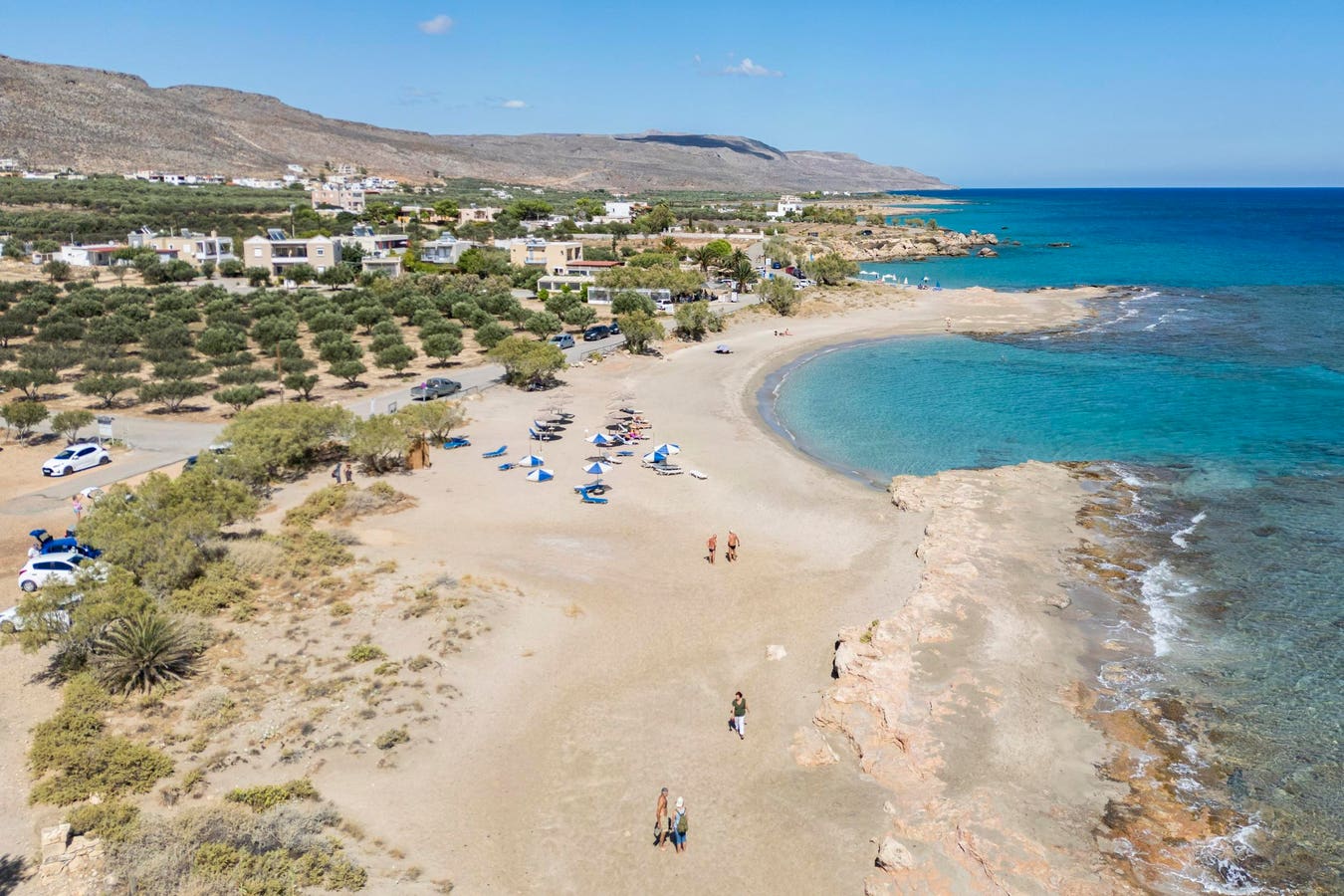
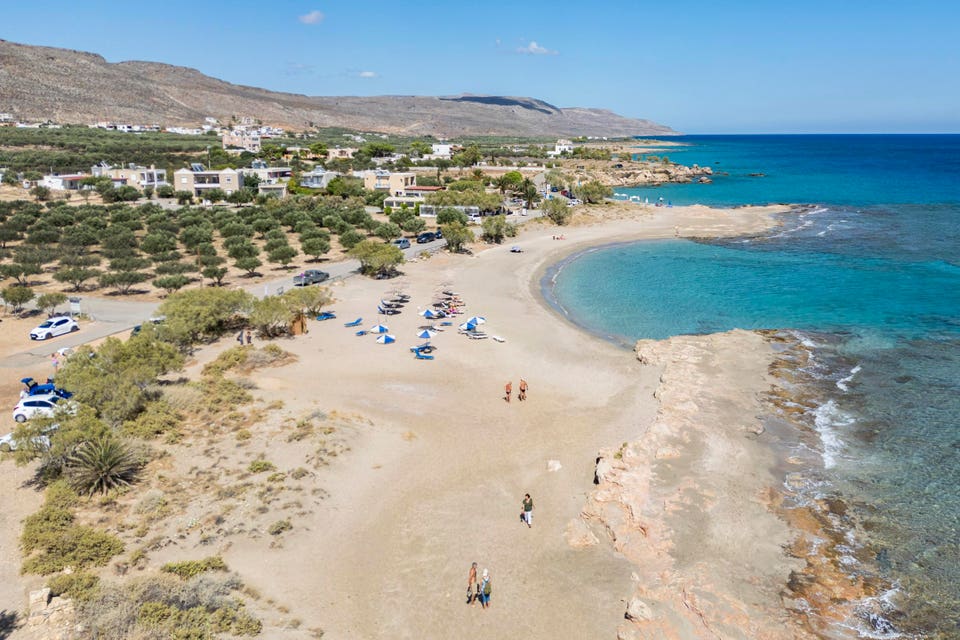
Aerial panoramic view from a drone of Xerokampos sandy beach with tourists and umbrellas next to an olive grove. An olive grove is an agricultural olive plantation, a cultivated area of olive trees grown for fruit or oil, characterized by a geometric planting layout. The trees are typically planted in a structured, geometric arrangement to optimize space for cultivation and harvesting with the primary purpose to produce olives, which are then used for making olive oil or are consumed as table olives. Creta island in the Mediterranean sea is famous for the high quality olive oil production, while Greece is one of the global producer and largest exporters along with Spain and Italy. Xerokampos, Crete island, Greece on October 7, 2025 (Photo by Nicolas Economou/NurPhoto via Getty Images)
NurPhoto via Getty Images
There’s a particular kind of longing that settles in when February wraps is foggy or snowy; for those of us at the edge of Europe, the Mediterranean sits so close, and its pull goes beyond geography. It’s a tug toward a way of living and eating that has been perfecting healthy skin for centuries.
I discovered this in Sardinia while celebrating my son’s first birthday at the Conrad Spa at Chia Laguna. Postpartum had done a number on my skin, and I walked into the spa hoping for little more than a decent massage. What I walked out with was something harder to shake: a completely different understanding of what skincare could actually be.
The Mediterranean Ritual Embedded In Traditional Treatments
The treatment itself wasn’t wildly different from other massages I’ve had, but the ingredients told a different story entirely. After a purifying steam bath came a Sardinian salt scrub, followed by a citrus fruit massage that moved through layers of fragrance and sensation like a slow reveal. The mastic, juniper, and lavender oils surprised me most and worked into the massage in ways I’d never experienced. They were actively relieving tension, stimulating circulation, detoxifying and rebalancing everything in one seamless ritual. Though I didn’t try this, the menu also featured a gentle massage using Himalayan pink salt hot stones paired with a fine pink salt body mask, finished with an essential oil treatment my therapist called “soothing and regenerating.”
This detoxifying salt massage draws directly from Mediterranean traditions that have used mineral-rich sea salt for centuries to purify, rebalance, and restore the skin’s natural vitality.
Conrad Spa at Chia Laguna
What stayed with me long afterwards was a conversation with the spa manager. She explained that the Sardinian essences and local botanicals weren’t just mood-setting touches. They were central to the entire wellness philosophy. “These Sardinian essences and local fragrances are central because they express the island’s unique identity. By using native botanicals and aromatic notes inspired by the Mediterranean landscape, the spa creates authentic sensory rituals that connect guests to Sardinia’s heritage, traditions, and natural rhythms,” Giulia Piras told me.
The Conrad Spa’s Bioaquam Path took this further, reinterpreting the ancient Roman tradition of salus per aqua (health through water) into a curated sequence of hydrotherapy experiences meant to be shared. Water is as much about connection as restoration.
Why Mediterranean Ingredients Scientifically Work
The rituals weren’t spa innovations dreamed up for tourists, but part of daily life. Sofia Milos, a Greek-Italian and founder of RADIANT, a natural skincare line handcrafted in Florence, put it simply: “Mediterranean wellness rituals treat the skin as an extension of overall health. Think of it as food for the skin.”
Olive oil and avocados are just two of the cornerstone ingredients in Milo’s skincare line.
RADIANT By Sofia Milos
Your skin isn’t just a surface. It’s an organ that makes up roughly 15% of your body weight and covers up to two square meters. It renews itself about every 28 days when you’re young, but that process slows with age. By your 50s, that cycle can stretch to 60 days or more. What you eat, what you apply, how you live: all of it feeds into that cycle.
The Mediterranean approach gets this instinctively. Dr. Grace Ayensu-Danquah, a dermatologist who studies where traditional Mediterranean practices meet modern skin science, explains over an email interview: “From a medical standpoint, skin health depends on three fundamentals: barrier strength, controlled inflammation, and efficient repair. Mediterranean-inspired ingredients naturally support all three. Their antioxidant and anti-inflammatory properties help protect against environmental stress while reinforcing the skin’s ability to retain moisture and recover.”
The science backs this up. A large prospective study of nearly 67,000 French women found that higher adherence to the Mediterranean diet was linked to a meaningful reduction in overall skin cancer risk. As for visible aging, the results are equally compelling: a clinical trial published in Medicina found that polyphenols from extra virgin olive oil (specifically oleocanthal and oleacein) produced an average 23% reduction in wrinkle count over just 30 days. Women aged 45 to 79 saw reductions of up to 34%.
CORIGLIANO ROSSANO, CALABRIA, ITALY – 2018/11/07: Olives in the net during the olives harvest in southern Italy for the production of Italian Extra Virgin Olive Oil. (Photo by Alfonso Di Vincenzo/KONTROLAB /LightRocket via Getty Images)
LightRocket via Getty ImagesNatural Ingredients Found In The Mediterranean That Do The Heavy Lifting
Not all Mediterranean ingredients are equal, but a handful have earned their place through centuries of use and modern clinical validation. Dr. Ayensu-Danquah highlights several standouts. Sea salt helps rebalance and refine skin while supporting hydration and mineral replenishment (which explains why that Sardinian salt scrub felt so transformative). Watermelon extract adds hydration support and antioxidant protection, helping skin maintain clarity and vitality. Extra virgin olive oil deserves special attention; it’s packed with over 230 minor compounds including polyphenols, tocopherols, and squalene. Research shows that oleocanthal, an anti-inflammatory compound in olive oil, has properties similar to ibuprofen.
“Together, these ingredients reflect a holistic Mediterranean approach to skincare,” Dr. Ayensu-Danquah adds, “combining time-honored ingredients with modern clinical science to deliver effective, accessible daily treatments that promote healthy skin over time.”
The beauty of the Mediterranean philosophy is that it doesn’t require a plane ticket to Sardinia. In fact, Milos spent three years working with a top Italian cosmetic chemist in Florence to translate this ethos into her RADIANT skincare line. Each formula is natural, chemical-free, farm-sourced, and hand-processed using ingredients grown in Mediterranean soil meant to “nourish and plump while supporting the skin’s natural regenerative process.”
The Conrad Spa at Chia Laguna in Sardinia exposes guests to a wide range of Mediterranean ingredients that have skin and health benefits.
Conrad Spa at Chia Laguna
The Conrad Spa at Chia Laguna offers another way to take the experience home through its Nature Bissé skincare partnership, extending the ritual beyond the treatment room into everyday life. Or, you can just visit the gorgeous oasis when it’s open for the season in the spring. Although the most important takeaway about Mediterranean rituals is not a product or experience, but the understanding that skin, like the rest of your body, thrives on care.
Dining and Cooking