
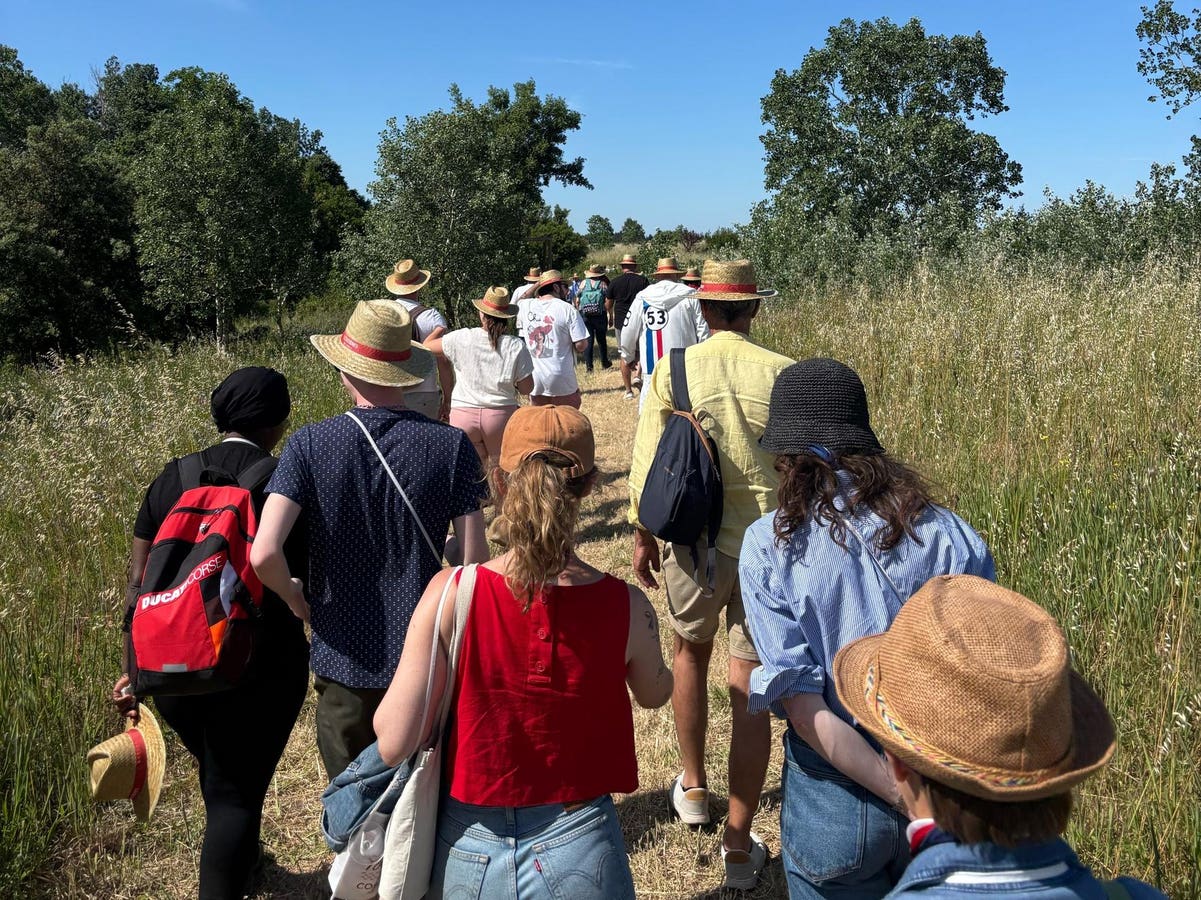
Vignes Toquées gastronomic trail through the Costières de Nîmes region of French wine country.
Jill Barth
On a June morning this summer, you could be in Europe, drinking French wine among ancient pebbles deposited by the Rhône River millennia ago, watching Chef Julien Caligo’s team set up the first of six courses that will be served to 3,400 people walking through these vineyards today.
This is Vignes Toquées, an annual gastronomic trail through the Costières de Nîmes appellation that pairs Michelin-starred cuisine with wines from 35+ local producers. For 77 euros per person, partakers get an 8km walk, six courses, unlimited wine tastings and direct access to the winemakers themselves. It’s the kind of experience that would cost hundreds of euros elsewhere, if you could find it at all.
The Rhône Valley’s Cool Secret
Costières de Nîmes occupies a paradoxical position: it’s the southernmost appellation in the Rhône Valley, yet it produces some of the region’s freshest wines. The secret lies in what winemakers call their “superpower,” a unique thermal breeze phenomenon created when cool Mediterranean air meets the heat absorbed by the appellation’s signature rolled pebbles.
“Costières de Nîmes reds are historical to the Rhône Valley and the Languedoc, but the unique taste is more of the way of southern Rhône,” Jérôme Castillon, co-president of the appellation and proprietor of Château l’Ermite d’Auzan, told me during a recent research trip to the region. “Freshness is the flagship.”
Costières benefits from afternoon sea breezes that cool the vineyards and preserve aromatic intensity. The result? Wines with the structure and complexity of their northern Rhône neighbors, but with a distinctive brightness that makes them remarkably food-friendly, and often more affordable than some other cru-level wines of the region.
The Roman amphitheatre in Nîmes is considered the best-conserved of the ancient world.
Jill BarthWine Bar Brings Vineyards To The City
Currently, around half of the region’s hectares are planted with Syrah, the iconic Northern Rhône grape that thrives on these well-draining pebble soils. Blended with Grenache, Mourvèdre and increasingly with Marselan, which Castillon calls “a very interesting varietal.” There is also a growing demand for, and supply of, white and rosé wines.
In spring 2025, Costières de Nîmes opened Le Verre des Costières, a wine bar directly across from Nîmes’ spectacular Roman arena. The tasteful space with a generous terrace serves as what the appellation calls its “urban ambassador.” It’s a place where locals and tourists alike can explore the diversity of Costières de Nîmes terroirs without driving into the countryside.
“The challenge for the new team is to balance export recognition compared to the local market,” Castillon explains. The wine bar addresses this directly, strengthening connections with Nîmes residents while introducing international visitors to the appellation.
Château de Nages proprietor, Isabel Gassier, in her regenerative vineyards.
Jill BarthFrench Wine From Regenerative Agriculture
At Château de Nages, Isabel Gassier is pioneering an approach to viticulture that positions Costières de Nîmes at the forefront of French wine’s sustainability momentum. Standing among her regenerative vineyards, among the first to earn the certification in France, she explained her philosophy to me with elegant simplicity: “Feed your soil and your soil will feed your plants in return.”
The numbers tell a compelling story. This is one of the Rhône Valley’s greenest appellations, with about 30% of vines farmed organically, that’s alongside a growing number of regenerative vineyards. Over half of production originates from HVE properties, a unique French program that addresses ecological practices.
Gassier’s vision goes beyond organic certification to true habitat restoration.
“The more complex the ecosystem, the more it regulates itself,” she notes, gesturing to hedgerows planted with native species and nesting boxes installed for birds that feed on pests. “A sterile environment allows pests to take over.”
The appellation has introduced five grape varieties resistant to drought and disease, allowing winemakers to adapt to changing conditions while maintaining quality.
As Gassier notes, “Southern Rhône wines evolve in the glass.”
For Gassier, the mission extends to accessibility. “I really want to make wines you can feel confident about buying,” she says. “Accessibility is really important to us.” It’s a philosophy reflected in both pricing—exceptional bottles often retail for under $25—and in the appellation’s new urban presence.
Resisting Homogenization
It’s an inspired location. Nîmes itself rewards several days of exploration, from the magnificently preserved Roman arena (one of the world’s best) to the UNESCO-listed Maison Carrée temple. The juxtaposition of 2,000-year-old Roman architecture with contemporary wine culture captures something essential about this region: deep roots, modern vision.
Costières de Nîmes vineyards span 24 communes between Nîmes and the Camargue wetlands, creating a landscape that shifts from pebbled terraces to Mediterranean garrigue to pink flamingo-dotted ponds. Visit a manade (bull ranch) in the morning, taste wine in the afternoon, watch the sunset over Roman ruins in the evening.
“The modern world tries to homogenize everything,” Castillon reflects during a tasting at l’Ermite d’Auzan, “but life is about tasting something different while preserving tradition.”
It’s a philosophy embodied in Costières de Nîmes itself, a wine region shaped by Cévennes culture to the north and Italian, Spanish, Camargue and Provençal influences to the south. The Mediterranean spirit here isn’t monolithic; it’s a cool network of traditions that have layered over millennia.
Plan Your Visit
When to go: Vignes Toquées takes place June 6-7, 2026. Reservations opened December 1, 2025, at costieres-nimes.org. Summer months offer JeuDiVin Thursday evening tastings on Nîmes’ Esplanade and various estate events.
Where to stay: Nîmes serves as the ideal base, offering everything from boutique hotels to apartments. The city is 90 minutes from Marseille airport.
Don’t miss: Le Verre des Costières wine bar (opening spring 2025), Château de Nages for sustainability insights, l’Ermite d’Auzan for aromatherapy pairings, and the Nîmes Roman arena and Maison Carrée. There are dozens of wineries that welcome visitors. To find one that fits your trip, check out costieres-nimes.org.
Getting there: Marseille (MRS) is the closest international airport. Nîmes has a TGV station with direct connections to Paris (under three hours to French wine country!).
More From ForbesForbesRhône Valley Wine: Quality And Diversification Balance Market TestsBy Jill BarthForbesFrench-American Winery Collaboration Taps Into Dessert Wine MarketBy Jill BarthForbesWhy Now Is A Great Time To Join A Wine ClubBy Jill BarthForbesChoose Organic Wine: A Winemaker’s PerspectiveBy Jill Barth
Dining and Cooking