
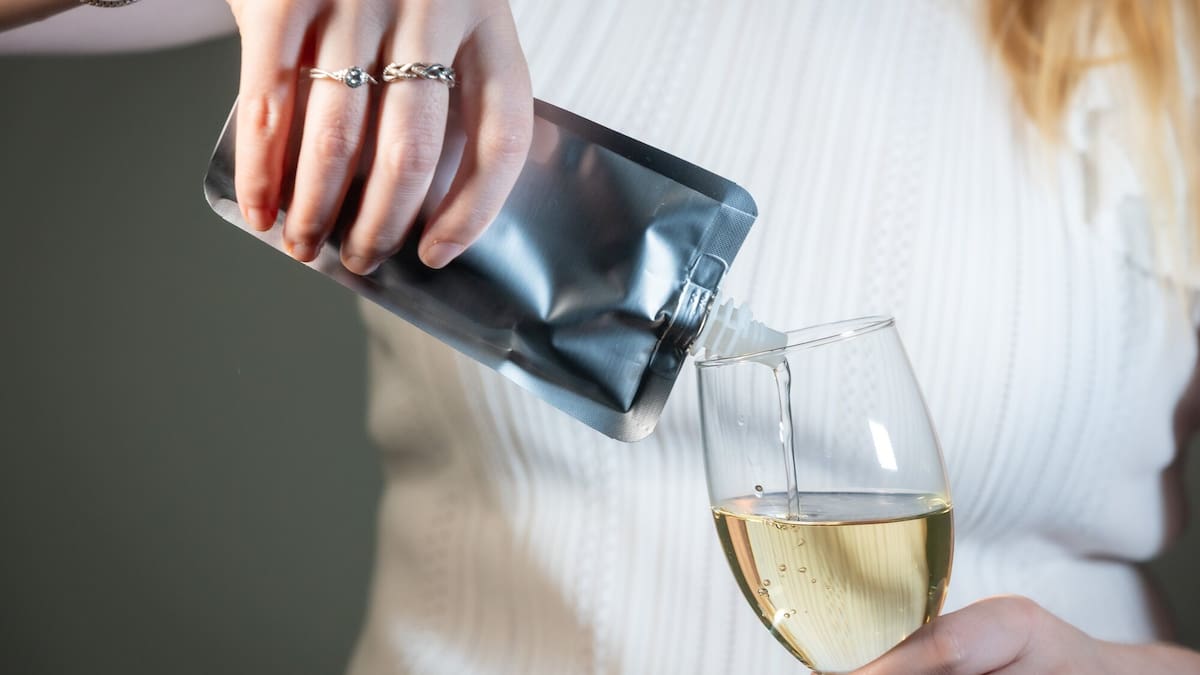
Wine packaged in pouches, cans and boxes is niche but on the rise. Johanna Thornton investigates the appeal and asks if New Zealand is behind when it comes to the rest of the world.
Picture this. You’ve just reached camp for the night on a multi-day hike, set up your
tent in time for a beachside sunset, or dismounted your horse after a long trek. You reach into your chiller bag for a wine and pull out a … single-serve pouch.
These are the kinds of scenarios Neil Pattinson, managing director of Whistling Buoy Wines, envisages happening with increasing frequency with the launch of his new Vino range of pouch wine.
At Vino’s soft launch at the Royal A&P Show in Christchurch in November, “everyone, right across the age and gender demographic, got very enthused and immediately had ideas on where they would take their pouched wine”, says Pattinson of Vino’s 150ml pouches containing Whistling Buoy’s pinot gris, rosé and pinot noir, made from grapes grown at the winery’s Charteris Bay vineyard and in Waipara.
Neil Pattinson, managing director of Whistling Buoy Wines, has launched the new Vino range of pouch wine.
From festivals to picnics and out on a boat, Pattinson says these lightweight pouches are destined to go where cumbersome glass bottles can’t as they are made from laminated aluminium soft plastic with an outer cardboard sleeve, both recyclable, with no chance of breaking en route. Yes, you can sip it straight from the pouch, or pour it into a glass if you prefer.
While pouches are something of a novelty in Aotearoa, in Australia “bagnums” are widely available at liquor retailers. A cheeky nod to the magnum, these 1.5-litre pouches hold two bottles’ worth of wine, come with a built-in handle (get it? Bag-num?), and can be poured straight from pouch to glass. Bagnums stay fresh in the fridge for up to four weeks after opening, making them as suited to a single glass as they are to sharing. Mail-order premium wine subscriptions in pouch form are also a thing; the lightweight format is well-suited to home delivery, and smaller samples are ideal for trying a new wine before committing to a whole bottle.
Drinking less and choosing differently
Vino’s pouches and other alternative wine packaging, from cans to bags and boxes, are part of a growing response to changing global drinking patterns. Wine and beer consumption is on a long-term downward trend, falling 8.3% for the year ended December 2025, to reach the lowest amount recorded in the 15 years that Stats NZ has been collecting the data. In 2024, wine consumption was down 3.3%, the third consecutive decline to the lowest level since 1961, according to the International Organisation of Vine and Wine (OIV). The OIV links the decline to shifting health attitudes and economic pressures, particularly among younger drinkers, who are consuming less alcohol overall and placing greater value on portability, convenience and lower-impact packaging.
“We have a lost generation that has gone to RTDs that offer smaller and more appealing formats,” says Pattinson, pointing to a recent local study by EIT student Casey Mackintosh, undertaken in partnership with Villa Maria in 2023, which highlights Gen Z’s preference for beer and RTDs over wine, with “taste, packaging and alcohol percentage” steering them away from wine. His pouches have been designed with this demographic in mind. “The Gen Zers get very excited about the look, the novelty and the flexible nature of the pouches,” he says.
Pouches, cans and casks may get the side-eye from some wine drinkers, but when it comes to environmental impact, the numbers speak for themselves. Wine packaging, particularly glass, accounts for a significant portion of wine production’s overall environmental impact, anywhere from 40-80%. Bag-in-box and pouch packaging can produce up to 80-87% fewer carbon dioxide equivalent (CO2e) emissions per litre than standard glass bottles.
Fugitive launched its organic Marlborough Sauvignon Blanc in a 2-litre bag-in-box in 2023. Photo / Peanut Butter Vibes
Cask wine’s eco redemption
Winemaker and NMIT wine lecturer Nadine Worley is well-versed in these figures. She co-founded Marlborough’s Fugitive Wines with Logie MacKenzie and is on a mission to “do things better”, not just in her organic vineyard, but also in how wine is packaged. After experimenting with reusable kegs for bars and retail in 2020, which proved logistically challenging for a small winery, she began searching for an alternative that maintained wine quality while minimising environmental impact.
In 2023, Fugitive launched its organic Marlborough Sauvignon Blanc in a 2-litre bag-in-box, after sourcing a premium (LDPE) mono material bag and tap compatible with soft-plastics recycling.
“No one wants more plastic in the world, so having a lightweight, fully recyclable bag was the game changer for us,” says Worley.
Winemaker and NMIT wine lecturer Nadine Worley is the co-founder of Marlborough’s Fugitive Wines.
Cask wine’s dodgy reputation has proven surprisingly easy to shake.
“It is definitely a conversation starter when you walk somewhere with a box of wine. Almost everyone we talk to has a story about some hideous cask wine they or their parents drank in the 80s, but once we explain why we are doing it and they get to taste the wine, the reaction is overwhelmingly positive.”
Beyond the novelty, the 2-litre format has proven practical too: it pours easily by the glass, stays fresh in the fridge for longer than an open bottle, and is compact and lightweight for camping or boating trips.
On the question of whether alternative packaging can deliver the same quality as glass, Worley is firm.
“Absolutely, alternative packaging can offer the same quality. Wine quality comes way before packaging, from the vineyard and winemaking.”
She notes wines intended to be drunk young, such as Marlborough sauvignon blanc, are perfectly suited to box, can or keg formats.
“Glass bottles will always have a place… But realistically, 70-80% of wine is drunk within a week of purchase, so it doesn’t make sense that as an industry, we are packaging it like it will be aged 20 years in the bottle.”
When a can makes more sense than a bottle
Canned wine is another small but growing sector in New Zealand. Globally, the category is expanding at pace, with industry forecasts predicting year-on-year growth of about 10%. Locally, major players are beginning to engage. Villa Maria has recently entered the market with pinot gris, sauvignon blanc and sparkling rosé in 250ml cans, targeting drinkers drawn to “portability and ease”.
Alpha Domus now produces its Beatrix Sparkling Rosé in a 250ml can.
For Alpha Domus, an independent organic single-vineyard winery in Hawke’s Bay, the decision to release its Beatrix Sparkling Rosé in a 250ml can followed years of observation and research, driven by third-generation winemaker Beatrix Ham. Already a favourite in bottles, Beatrix Sparkling Rosé is lower in alcohol and, according to Ham, perfectly suited to a format that prioritises on-the-go versatility and single-serve drinking (anyone who’s ever put a utensil into the neck of a half-drunk bottle of bubbly will understand the appeal).
“For some, wine in a can is an adjustment of perception. We’ve had very few negative comments, with the can being positively embraced by all generations,” says Ham. Crucially, switching from a 750ml bottle to three 250ml aluminium cans reduces Alpha Domus’ carbon emissions by up to 79%; transporting wine in cans shaves off 35-49% of emissions and recycling aluminium requires 90% less energy than glass.
By The Bottle in Auckland’s Mt Eden offers drinks in a range of alternative formats.
What consumers are saying and buying
On the shop floor at By The Bottle in Auckland’s Mt Eden, which is known for stocking forward-thinking organic and biodynamic wines, spirits and beers, co-owner Pete Connell says customers “haven’t been fazed by alternative formats”, and education in shops, restaurants and bars is key if the perception of quality is going to change.
By The Bottle’s shelves offer a glimpse of what adventurous drinkers are embracing, everything from canned pet nat and sparkling rosé, to bag-in-box wine and a growing range of canned aperitivo and spritzes with a wine base such as Spritzetto, Zoncello and Melbourne-based Kiwi Dave Verheul’s Saison “Amaro Tonic”.
“We’ve found these formats have especially come into their own in the warmer months, being so convenient for travel and barbecues,” says Connell. “Outdoorsy types love them.”
Alternative formats are also great for those wanting to drink less.
“I’ve especially noticed that with older customers, who want to enjoy a glass without having to open a whole bottle. As consumers are becoming more considerate of how much they drink, a can or a bag-in-box that stays fresher longer is an appealing option over opening a bottle,” says Connell.
Dicey’s “Dice Central Otago Pinot Noir” 2-litre bag-in-box has been popular this summer. It’s made by Bannockburn-based brothers Matt and James Dicey as a response to what they call the “staggering” carbon footprint of glass packaging. Dicey’s box wine is not only an optimal eco choice, it’s also a direct challenge to the perception of cask wine as low quality. The pinot noir is made with the same care as the rest of the Dicey range, and the quality shows in the glass. “It’s made in a vibrant, fresh style that we enjoy drinking chilled,” says Connell.
The next chapter for alternative wine packaging
While alternative packaging options such as Dice are a “great start”, Connell says New Zealand is in a “watch this space phase”.
“I can understand why there would be caution from the producer’s point of view. There’s investment involved in the winery and changes required to bottling and canning facilities. There’s also a big risk in changing something that producers get one chance at a year to sell in a market as small as New Zealand’s.”
He points to the industry’s shift from cork to screwcap as a useful precedent.
“It took a massive, concerted effort by wineries to get the trade and consumers’ heads around the closure change from cork to screwcap. One of the key things about this effort was it included some of our best small producers, like Kumeu River, demonstrating that this wasn’t about cost cutting or a compromise in quality.”
Structural barriers have also slowed uptake. Worley notes minimum order quantities for alternative formats can be prohibitive for smaller producers, with bag-in-box units often requiring runs of 10,000, alongside the need for specialised equipment and recycle-ready materials (Worley and Mackenzie imported their own bag-in-box machine from Italy, for example). As a result, New Zealand has lagged behind markets such as Scandinavia, the US and Australia, where cans fill plenty of picnic blankets and bagnums are in many fridge doors.
Still, she believes momentum is building, pointing to trials at bottling companies and growing interest among producers. “It is definitely happening.”
Shop the story: 7 alternative formats to try now
Dicey’s “Dice Central Otago Pinot Noir” 2-litre bag-in-box
Cask wine made cool. A textural and lively Central Otago Pinot Noir in a 2-litre bag-in-box that stays fresh for up to a month. Try it chilled.
Vino Mix n Match 6-Pack
Six single-serve pouches containing two each of pinot gris, rosé and pinot noir, ideal for your next Great Walk.
Alpha Domus Beatrix Sparkling Rose, 4-Pack Cans, $35
Lower-alcohol (8.9%) sparkling wine in a 250ml can made from Hawke’s Bay merlot grapes.
Fugitive Organic Marlborough Sauvignon Blanc 2025, 2-litre
Premium organic Marlborough sav in a recyclable 2-litre bag-in-box, equivalent to 2.6 bottles.
Joiy Still Wine Mix Set of Four
A mixed four-pack, featuring one of each variety: Savvy Society, State of Grace Pinot Gris, Gryphon Pinot Noir, and Grand Rouge.
Delinquente Tuff Nutt Pet-Nat 2024
A sneaky Aussie addition, this dry, citrusy natty is ideal for picnics, camping, or having on hand in the fridge.
Squealing Pig Marlborough Sauvignon Blanc 1.5-litre Bagnum, $38
One of the few bagnums available in New Zealand, this 1.5-litre is full of tropical fruit and citrus, and potential.
More different ways to drink
Dining and Cooking