
Sign up for the Slatest to get the most insightful analysis, criticism, and advice out there, delivered to your inbox daily.
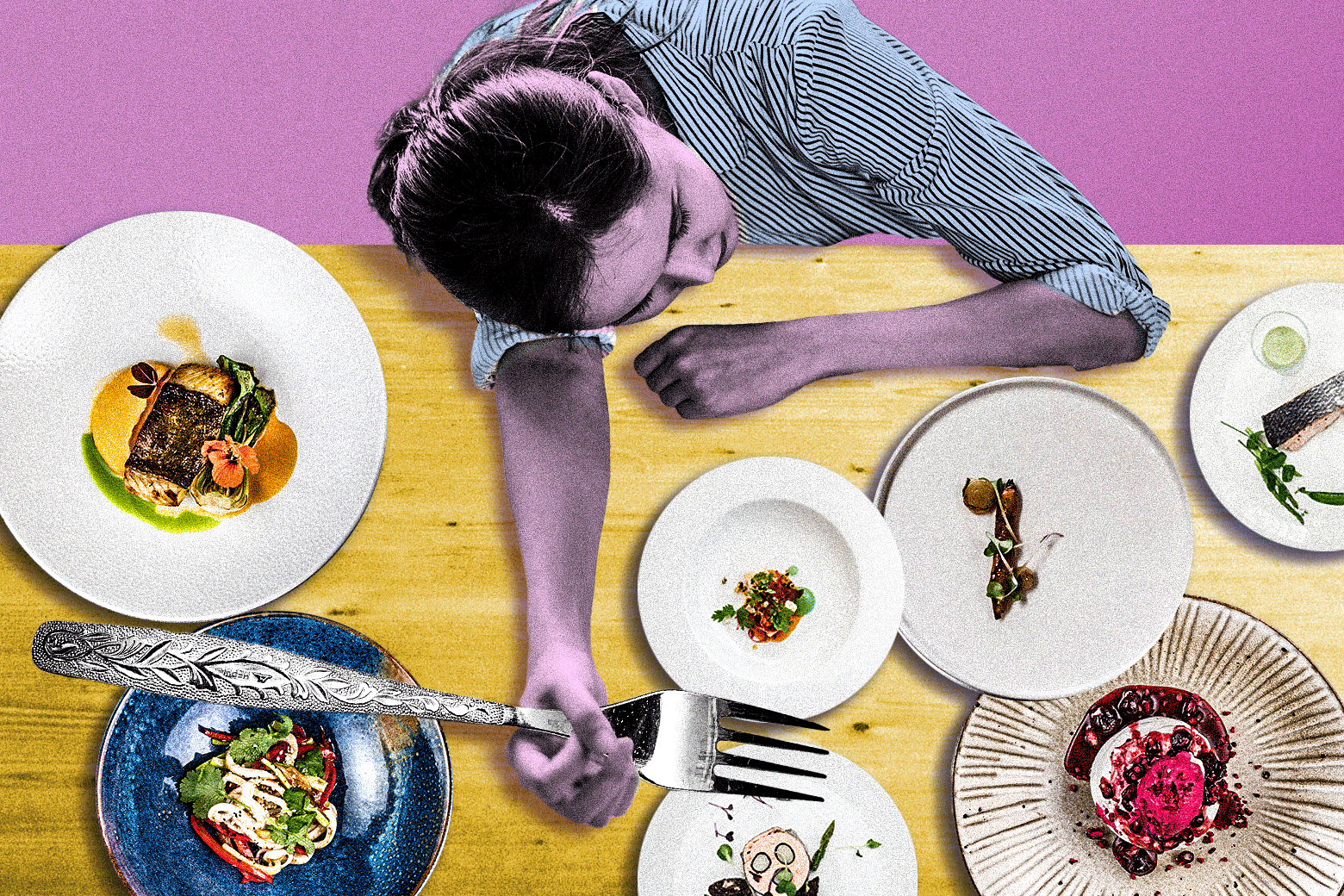
The tasting menu, the staple format of fine dining, is almost begging you to roll your eyes at it. I’m guessing you’re picturing too many forks in prim rooms with overdesigned bites of food that still leave you hungry. And you don’t need to have been served a tasting menu to know how exactly it could go wrong. Just imagine being in Homer Simpson’s ironic hell, strapped to a chair and force-fed until presumably you explode. (It doesn’t matter that Homer liked it. You wouldn’t.) You are trapped in a bad play, orchestrated and performed almost without you, where there’s not even the mercy of an intermission during which you may sneak out.
And even if the food is good, you’d be forgiven for passing on a meal that’s longer than the three-plus-hour run time of Avatar: Fire and Ash.
These are privileged problems. And complaints about tasting-menu tyranny aren’t exactly new. In 1998, restaurant critic Ruth Reichl chronicled a particularly bad experience, saying “by the time you have slogged through an appetizer, soup, entree and salad, you may dread the arrival of dessert.” In 2012, Pete Wells lamented that “expensive tasting-menu-only restaurants are spreading like an epidemic” across the country. In 2013, Corby Kummer wrote in Vanity Fair that “a diner’s pleasure is secondary” where tasting menus are concerned, as they crescendoed to 20, 30, 40 courses. And who could forget Geraldine DeRuiter’s experience at the Michelin-starred Bros. in 2021, which she described as being “as though someone had read about food and restaurants, but had never experienced either, and this was their attempt to recreate it.”
So this has been going on for some time. But recently, an editor lamented the dogged persistence, despite all this criticism, of the tasting menu, and the way it felt more like bait for a Michelin star than anything with a diner in mind. Perhaps the tasting menu is a matter of a frequency illusion—you can’t unsee them even when other fine-dining options abound. I bristled. I had thought we were past the point of tasting menus being the be-all and end-all of fine dining. To me, most of the exciting restaurants receiving accolades and stars appeared to follow à la carte dining models. Some places were giving up their tasting menus!
Then Matthew Schneier at GrubStreet reviewed the tasting menus at Cove and Saga in New York, calling both restaurants “stymied by the worn-out format.” And I remembered that despite the grumbling, you still can’t throw a rock in NYC or Houston or L.A. without hitting a $150-plus omakase, and the restaurants still associated with the superlative “best” around the world—Alinea, Pujol, Maido—are all tasting menus. Tasting menus are still metonymy for wealth, extravagance, and taste. If they are bait, though, who is taking it has shifted over the past decade.
The tasting menu was born from the marriage of Japanese kaiseki and French nouvelle cuisine; the resulting menu degustation in the 1960s was “at least four courses, each no more than a few bites, and saw the chef take greater authority over the diner’s experience than was previously common,” wrote Anna Haines in TASTE. But in the 1990s, the menu began to grow, with both Thomas Keller at French Laundry and Ferran Adria at El Bulli lengthening the format to hourslong meals. Their subsequent accolades inspired others to do the same.
Meanwhile, the rise of food entertainment meant that the average diner could more easily learn the contours of the tasting menu before ever experiencing one. Top Chef allowed viewers to learn about foams and sous vides, while in 2011 Jiro Dreams of Sushi taught Americans to value omakase sushi. Its director, David Gelb, would go on to create Chef’s Table, which followed chefs like Dan Barber, Dominique Crenn, and Massimo Bottura through their restaurants, all of which have earned multiple Michelin stars. If you watched any food TV, you quickly got the impression that tasting menus were the best you could get.
It’s not hard to see why a chef would choose the format. “From a business perspective, it works for restaurants. Margins are small. If you can guarantee people are booking tickets in advance, that they’re spending a lot of money, you can do more than the small little neighborhood restaurant that doesn’t have that guaranteed income,” says chef Danny Garcia, winner of Top Chef Season 21 and a seasoned vet of restaurants like French Laundry, Crown Shy, and Time and Tide. With a set menu, there’s no need to guess how much food to order, or frantically tell the servers to push the halibut. Hell, with an omakase, you don’t even need to pay for a gas hookup to open a restaurant.
More romantically, though, it’s a way for a chef to express themselves, which diners have come to expect as the public image of chef has shifted from the laboring toward the artistic. “I don’t believe that most chefs get into tasting menu or omakase formats accolade-first,” says Bill Addison, restaurant critic at the Los Angeles Times. “In a lot of cases, it’s because they’ve come up in that system and then really want to do something that expresses their own character as a chef, or it’s because they love the idea of benevolently controlling the meal.”
But regardless of intention, accolades are awarded. Are tasting menus more likely to attract them? It depends on what you mean by accolades. There’s the World’s 50 Best list, which at a glance appears to be entirely full of tasting menus serving molecular gastronomy-ish plates that can look more like abstract sculpture than food. For Michelin, it’s mixed. Of the three restaurants that earned one star in Philadelphia’s first year on the Michelin guide, all three serve a set multicourse menu (though Her Place Supper Club does it with far more communal, family-style vibes). Feld and Smyth in Chicago were both newly awarded Michelin stars this year, and both serve tasting menus, while Kasama, which moved from one star to two, serves an à la carte menu during the day and a tasting menu for dinner. But in New York, many Michelin-starred restaurants serve both an à la carte menu and a tasting menu, and plenty of restaurants that retained stars this year, like Semma, Crown Shy, the Four Horsemen, and Oxomoco, don’t offer a tasting menu at all.
And then there’s the rest of food media. On Eater’s Best New Restaurant list this year, only 2 of the 15 solely offer a tasting menu (Kabawa and Ki). Three out of 20 listed by Bon Appétit this year are tasting-menu restaurants (Provenance, Feld, and Wildweed). Food & Wine’s restaurant of the year is Diane’s Place, a Hmong all-day cafe in Minneapolis. And Esquire’s pick of the year, RVR, is an izakaya and tavern serving hand rolls and highballs. If a chef were trying to guarantee recognition in 2026, a tasting menu doesn’t exactly seem like a slam dunk.
Some of this stems from the fact that traditional media increasingly can’t afford to send its writers to eat $500 meals every week, so their coverage skews quotidian, while institutions like Michelin and influencers who are willing to accept free meals for coverage can hit the fancier spots. And Addison notes that the “epidemic” of tasting menus Pete Wells spoke of in 2012 was hit hard by the actual COVID-19 epidemic. But it’s also that the tasting menu has lost some of its shine. “I think my generation of diners aren’t so excited about a tasting menu,” says Garcia. “You might be more excited about the cool little neighborhood spot.” Like all trends, it’s faded some as consumers look for the next hot thing.
Danny Palumbo
One of the Most Iconic Dishes on the Italian Restaurant Menu Is Heading Toward Extinction. I Think I’ve Figured Out Why.
Read More
Still, the lure of awards is strong for chefs. Meghan McCarron recently wrote for the New York Times about the tricky role the award plays in the restaurant industry, arguing that “increasingly, winning—and retaining—Michelin stars is one of the few guaranteed paths for restaurants to attract new diners.” Tasting menus aren’t necessary, but serving the same menu to every guest makes it easier to control for the quality and consistency judges look for. And while some media may be championing more casual neighborhood spots, the people with money to spend on tasting menus look to Michelin and World’s 50 Best for more rarified experiences. “It is my feeling that Michelin in particular is entwined in the success of restaurants like that,” says Addison. Rather than a mere prize, the Michelin star is the way a tasting menu restaurant survives.
If tasting menus aren’t guaranteed hits, and if there are not, despite the impression you might get from some lists, more of them than there were before, then what smarts about their continued prominence is something deeper. As the rich get richer and the poor can’t afford to eat out with any regularity, a tasting menu becomes a symbol for everything that’s out of reach. A regular meal, however expensive, can always be written off as satisfying your most basic need to eat. But you cannot argue that a 15-course dinner, each course paraded out over three hours like show dogs, is about fulfilling a biological need for hunger. This is pure, vulgar indulgence.
Bill Gates’ Latest Confession Is Hardly the Worst Thing From the Epstein Files—but It May Be the Most Humiliating
Then again, value is in the stomach of the beholder. Name me one person who hasn’t saved up, at least once in their life, for a celebratory meal. The promise of fine dining, and specifically of the tasting menu, has always been that your investment of time and money will be returned in the form of pleasure and, depending on the drink order, fond memories. And as some logic goes, the bigger the risk, the bigger the reward—three hours and hundreds of dollars, but perhaps the most exciting culinary experience of your life.
The problem is, even with accolades and assurances that this meal may indeed be extraordinary, it’s harder to justify that risk. And so any dream of creative expression, of sublime hospitality, is curdled by the knowledge that this is all just too much. Maybe to bring joy back to the tasting menu, they need to become not so rarified—and indeed, the under-$100 tasting menu does seem like it’s beginning to bud. Or maybe they could just wrap it up a little earlier. Time is money, after all.

Sign up for Slate’s evening newsletter.
Dining and Cooking