
Banner photo by Matthew on Unsplash. Other photos courtesy of Monica Larner
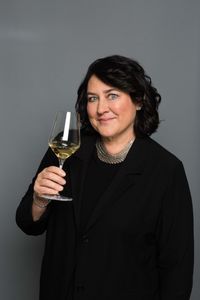 Monica Larner lives in Rome and is a certified sommelier and an award-winning reviewer and writer for the Robert Parker Wine Advocate, an influential consumer publication.
Monica Larner believes Italian grape growing is a special art. Larner, who lives in Rome, is a certified sommelier and an award-winning reviewer and writer for the Robert Parker Wine Advocate, an influential consumer publication. She has traveled all over Italy for assignments: a vineyard in Campania, where grapes are grown on trees, requiring harvesters to use special ladders for retrieval; Pantelleria, with its dry heat, where sweet dessert wine is made from raisins, and vines are placed into small holes to protect them from the strong winds; and Sicily’s Mount Etna, where grapes are susceptible to some of the most extreme climate conditions in the world.
“I feel like an Indiana Jones in the vineyard,” says Larner (’90, COM’92), the author of two books about Italy. “Viticulture is so important to Italy’s history. This is how people relate to their earth. My work is a window into antiquity.”
Larner reviews more than 3,000 Italian wines every year. But she considers herself a journalist first and foremost. She received her undergraduate degree in journalism from BU and her master’s degree in journalism—with a minor in Italian studies—from NYU. She has reported for the Rome bureau of Businessweek and written about wine for the Italy Daily of the International Herald Tribune. Shortly after moving to Rome in 2003 to pursue freelance writing, Larner was approached by Wine Enthusiast to be the magazine’s first Italy-based correspondent, where her formal tasting training officially began. She joined The Wine Advocate in 2013.
Larner says to do the role of wine critic justice, she must tell the full story of Italy’s robust culture of wine and winemaking.
“Wine criticism is changing,” she says. “It used to be—forget the storytelling, it’s only what’s inside the bottle. But the passionate wine consumer wants more. You have to give them more.”
Reviewing Italy’s complex range of grapes and wine styles requires Larner’s commitment to storytelling. Take Nebbiolo, a finicky grape native to Piedmont that “shows its most beautiful results in harsh conditions” and is a reflection of Piedmont’s resilient history, she says. Giving wine identity is at the heart of her work.
But there are strict rules when it comes to ethically reviewing wines—such as not accepting complimentary wine or meals from producers—which Larner is careful to follow. “In Italy, culturally, this is a challenge, and the fact that I’m a woman comes into play,” she says. “It’s hard to get that message across, but after doing this for 20 years now, I feel like I’ve succeeded. People know where I stand.”
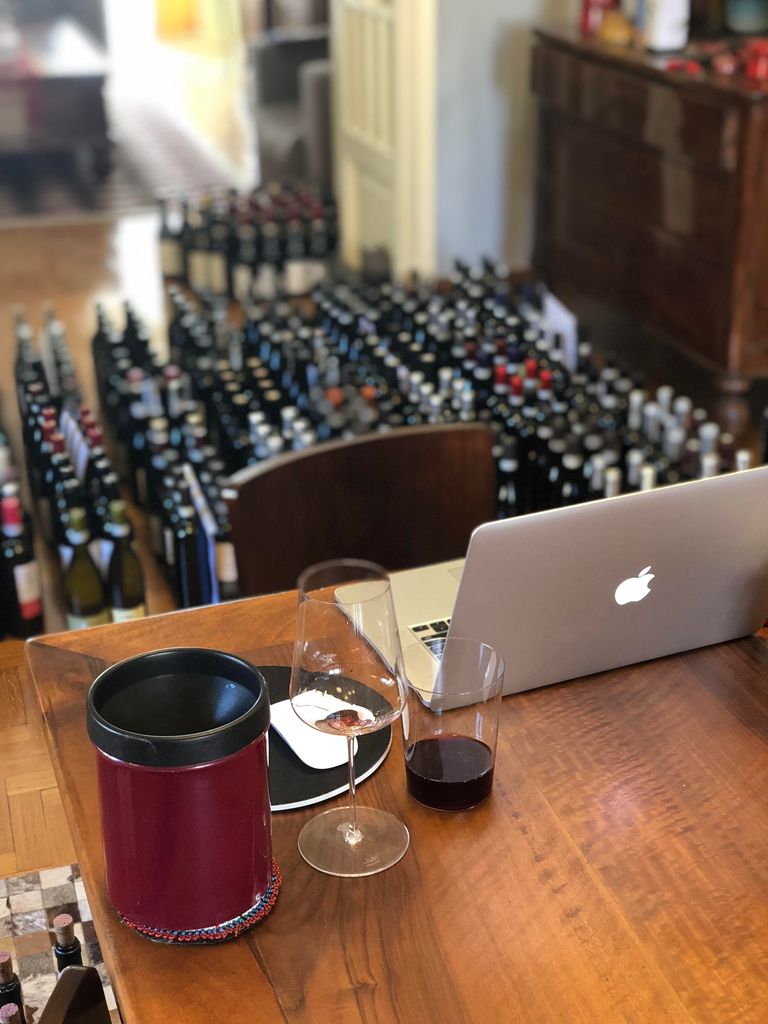 Larner reviews more than 3,000 Italian wines each year. “Wine criticism is changing,” she says. “It used to be—forget the storytelling, it’s only what’s inside the bottle. But the passionate wine consumer wants more. You have to give them more.”
Her relationship with Italy began long before the start of her career. When she was 11, her father, Stevan Larner, a successful cinematographer, moved the family from Los Angeles to Rome to shoot the 1983 TV miniseries The Winds of War. What was supposed to be a six-month trip turned into a longer stay when “a big love affair” blossomed between her dad and Italian wine and culture, she says. For four years, her family divided their time between California and Rome.
Years later, her father retired to California and bought land in Santa Barbara with the goal of creating a wine label under the Larner name. It was an undertaking the entire family was involved in. “I was getting the tractor stuck in the mud,” Larner says with a laugh. “It was a very boots-on-the-ground experience.”
Her father’s dream was cut short in 2005, when he died after a vineyard accident. But her brother, Michael, attended enology school and has carried on the venture. Stevan Larner’s legacy lives on in Larner Vineyard and Winery.
“[My father] never once said to us, ‘You should go into wine.’ It was just his pure passion that inspired our paths,” says Larner.
To be working for Robert Parker’s brand is a full-circle moment. “When I was a kid, my father talked about Parker all the time,” says Larner. “He would buy wines according to Parker. He was a total nerd about this stuff.”
Larner, who shares her father’s passion, reflects on the future of the Italian wine industry and her role in it with palpable excitement. “What makes Italy competitive in the long run is, Italian grapes can’t travel,” she says. “We haven’t seen great successes traveling far outside the boundaries of Italy.”
Thousands of grape varieties exist across Italian soil. “Many of them are not even registered yet,” says Larner. In the face of worsening climate change, these grapes have needed to be resilient and adaptable. She’s optimistic that Italy’s extensive biodiversity will only strengthen its edge. “As climates get drier or hotter or rainier or more flooded, this richness will serve us well when we understand better how different grapes react. With every new grape [variety], there’s more material. Italian wine is well-poised for [the future].” And Larner will be there to capture it all.
Dining and Cooking