
Eataly Coming Soon I read on the large panel at JFK’s terminal 8 in New York. The massive Italian marketplace and its eateries were moving into the airport? That woke me up. Past security, I’d been trudging along with one thought and one thought only, no falling asleep at the gate.
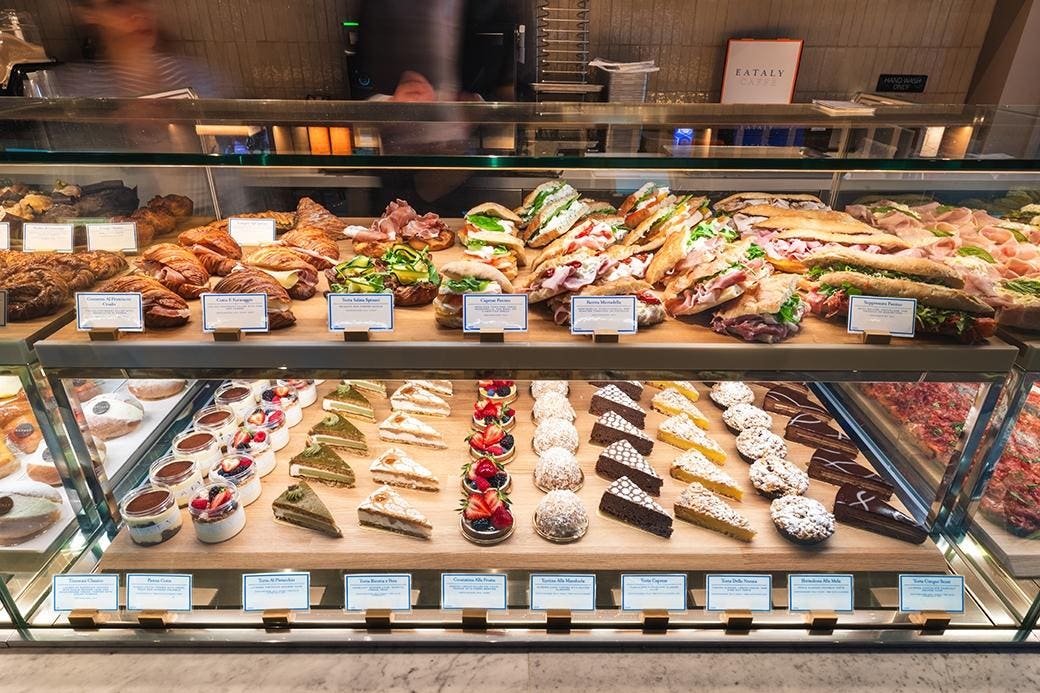
Paninis and Pastries at the new Eataly Caffè in New York
YUXI LIU
It turns out Eataly, post-Mario Batali, is in the midst of a national expansion, thanks to Investindustrial, the new majority stakeholder. How timely then that UNESCO decided, just last December, to inscribe Italian Cooking on the representative list of the Intangible Cultural Heritage of Humanity, the program meant to protect traditions and artisanal skills, among other traits.
Italian actress Sophia Loren, wearing a floral dress, a chef’s hat and a crucifix necklace, cutting slices of ham with a big knife, surrounded by cooks in a restaurant kitchen, Venice, 1955. (Photo by Archivio Cameraphoto Epoche/Getty Images)
getty
Growing up in Geneva, Switzerland, an hour’s drive from Northern Italy, Italian cuisine was ubiquitous. At the International School where I spent 13 years, we were fed spaghetti “bolognese” at the cafeteria, went out for puffy, sizzling pizza cooked in a wood Iburning oven, and constantly kept tabs on where to find the best gelato in town. Once I moved to New York, I learned a different repertoire: Italian-American cuisine.
I remember how stunned I’d been, back in 2010, when what the New York Times then called “an Italian food hall” landed on West 23rd Street near Fifth Avenue. In the first weeks, it seemed every food lover in New York was checking out the gigantic market that stocked Italian jams, cheeses, and salumi we’d only seen at small family-owned shops like Di Palo, a staple on Grand Street since 1925.
The first Eataly outpost to open in New York in 2010
Eataly
Today, Eataly is more than a market, more than a cluster of restaurants, and more than a cooking school. It has become a destination for tourists and locals alike.
Curious, I sat down recently with Enrico Panero, Vice-President of Research & Development, to learn how Italian cuisine was driving this expansion.
Tall and thin, Mr. Panero may hold a food lover’s overarching dream job. Born in Turin and trained as a chef in Italy where he cooked at several Michelin-starred restaurants, Mr. Panero was working in the kitchen when Eataly, created by founder Oscar Farinetti, first launched in 2007 in Turin.
“Since then, our DNA has not changed,” he said. “Our motto is eat, shop and learn, and we believe that the best possible, simple ingredients yield the best flavors.”
A twinkle in his eyes, he launched into his ideal version of spaghetti al pomodoro (spaghetti in tomato sauce) and even though Marcella Hazan may be rolling in her grave —her signature sauce calls for butter, onion and 45 minutes—I am listening.
Spaghetto al Pomodoro at Eataly
Eataly
“We use the best tomato we can find. For us, it’s the Cosi Com’è (meaning, as it is) tomatoes in glass jars, preserved in their own juice. You add olive oil, salt and basil and in two minutes, you have the best sauce.”
That sauce is everywhere: in the retail shops around the country, thirteen so far including Los Angeles and West Palm Beach, in the new airport outposts and in the new Eataly Caffès (there are three in Manhattan) modeled after the Italian “bars,” where city dwellers often get the espresso and cornetto that make breakfast, then the panino at lunch and the aperitivo before dinner.
Mr. Panero touts innovation, but after I ask what makes those tomatoes so good, he sighs, “They are picked ripe, by hand.” And the simplicity of that makes complete sense. Turns out the key to Eataly’s success seems to be at the crossroad of tradition and innovation.
Every two months, the restaurants highlight a different region. “But we strive,” said Mr. Panero, “to go beyond the obvious.”
To honor Northern Italy and the ski resort Cortina d’Ampezzo, where the Winter Olympic Games are about to start, the menus feature regional favorites such as spaetzle, polenta fritta and even goulash from Trieste.
Cooking classes sell out regularly, but the education flow seems to go both ways.
“In New York at the new caffès, we had to start offering pizza and paninis at seven a.m.,” he said. “We teach what we love but we are also learning what our customers love.”
Dining and Cooking