
Anything else you’re excited about?
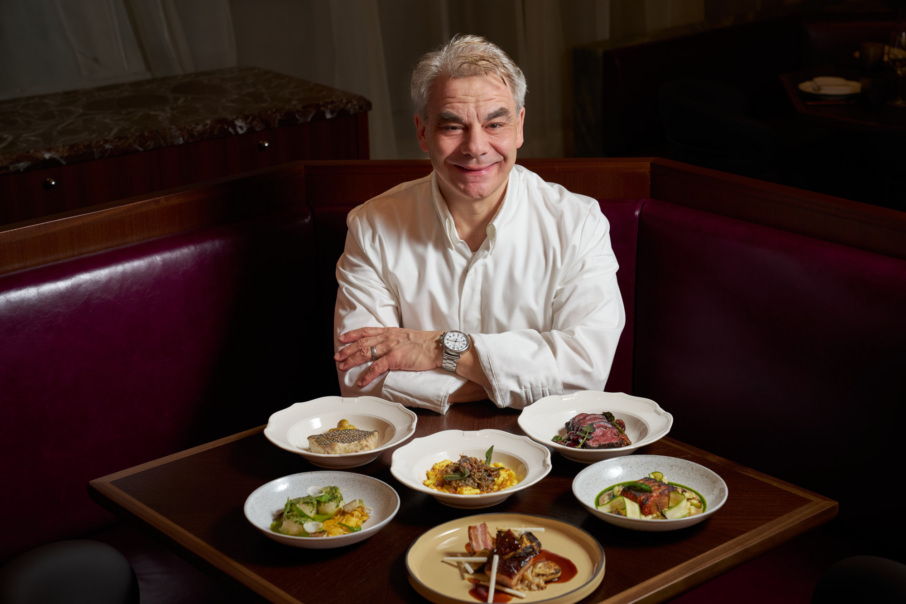
Alsace is known for charcuterie, so there will be housemade sausages: boudin noir, cabbage-and-cheese sausage, truffled liverwurst made with veal liver. It’s also famous for foie gras, of course, which I’ll serve with quince, Gewürztraminer gelée, and country bread.
We’re also experimenting with beet spaghetti made with beet juice, dressed with oysters, horseradish, salmon roe, and topped with black caviar — almost like borscht flavors inside pasta, with the richness of oysters and maybe smoked sturgeon. There’ll be spaetzle with caramelized onion coulis, and a saffron pasta with rabbit.
And in the wood fire?
A whole loup de mer, whole chicken, steak, of course, but also squab, duck, pork, maybe lamb. Also, venison, which we cure lightly with gin, salt, fennel seeds, and star anise.
You’ve always been committed to sustainability. How will that be expressed at Saverne?
Sourcing the right products from the right people is essential. It comes down to how farms are run, how animals are treated, and whether the quality is truly there.
We work with a farm in Vermont for butter. Lamb comes from Elysian Fields in Pennsylvania. The chicken is a yellow chicken from Pennsylvania as well. With fish, we go directly to small fishermen.
The hardest part is that many small farms get bought out by larger companies. We find the right partner, it works for a few years, and then they’re sold. That’s an ongoing challenge.
Some of your haute cuisine colleagues have long ago branched out into more casual concepts. You’ve stayed true to fine dining. What made you make the move now?
Well, it’s not that we’re changing our point of view or moving away from fine dining. We’re maintaining the same level of quality. The sourcing and technique remain central.
I’ve wanted to do a woodfire concept for a long time. The difficulty was permits. “Live fuel” regulations are strict, especially in a tower 66 floors up. Wood-fired cooking has become increasingly difficult everywhere, including Europe. We’re losing many small places that were doing wood-fired pizza because of the regulatory burden. But bringing that element of the countryside into the city — the smell of wood fire, the warmth, the glow — it feels very meaningful.
Dining and Cooking