
November 10, 2025
3 min read
Add topic to email alerts
Receive an email when new articles are posted on
Please provide your email address to receive an email when new articles are posted on .
“
data-action=”subscribe”>
Subscribe
We were unable to process your request. Please try again later. If you continue to have this issue please contact customerservice@slackinc.com.
Back to Healio
Key takeaways:
More participants with IBS assigned to the Mediterranean diet achieved clinical response vs. those given traditional dietary advice.
More research is warranted to validate the findings.
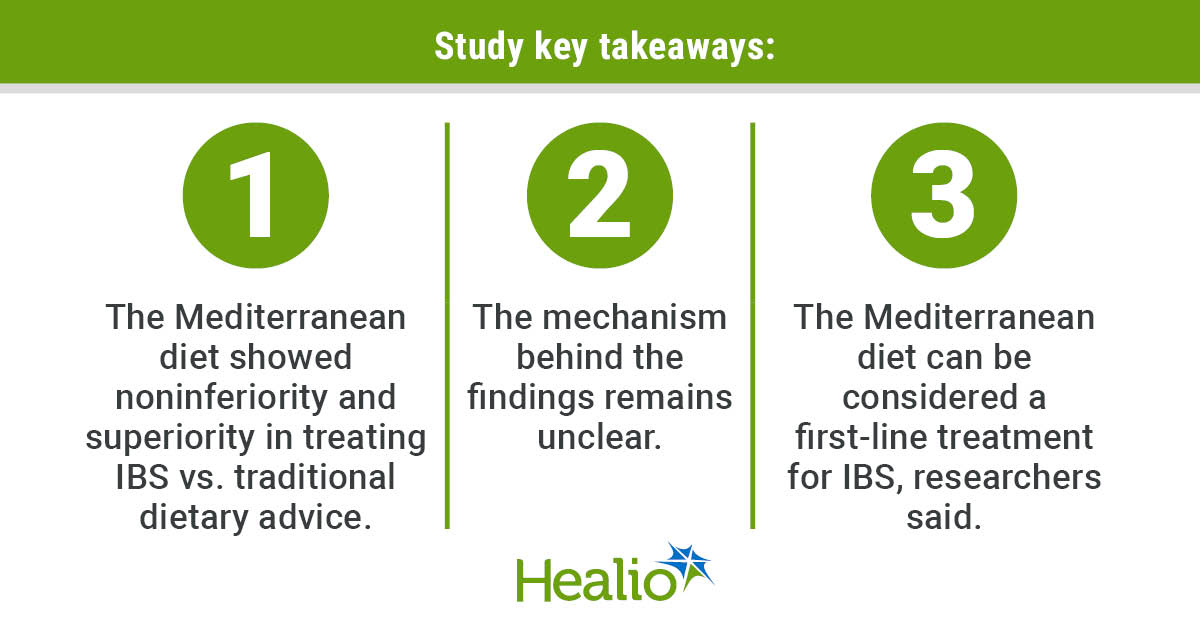
The Mediterranean diet showed superiority as a first-line intervention for irritable bowel syndrome vs. traditional dietary advice, according to the results of a randomized controlled trial.
Such findings “exceeded expectations” and show that clinicians “now have evidence-based support to offer the Mediterranean diet as another first-line treatment for IBS,” Imran Aziz, MBChB, MD, a senior lecturer and consultant gastroenterologist at the University of Sheffield in the U.K., told Healio. “This provides another practical option before escalating to the more demanding low [fermentable oligosaccharides, disaccharides, monosaccharides and polyols (FODMAP)] diet.”
Data derived from: Bamidele JO, et al. Ann Intern Med. 2025;doi:10.7326/ANNALS-25-01519.
The Mediterranean diet was named the best overall diet by U.S. News and World Report for the past 8 years. Research shows it can reduce the risk for chronic diseases.
Recent cross-sectional studies also show it may reduce the prevalence of IBS, Aziz and colleagues wrote in Annals of Internal Medicine. However, it “has not yet been subject to any adequately powered head-to-head randomized trials in IBS,” they added.
The researchers said current guidelines recommend traditional dietary advice as a first-line treatment for IBS and the low FODMAP diet as a second-line option.
But “few evidence-based dietary options exist,” Aziz said. “Current first-line traditional dietary advice helps around 40% of patients, while the second-line low FODMAP diet is complex, restrictive and requires dietetic supervision.”
In the current study, the researchers assigned 68 individuals with IBS to the Mediterranean diet and 71 to traditional dietary advice for 6 weeks.
The primary endpoint was the proportion of individuals achieving clinical response, defined as a 50-point or greater reduction in the IBS Symptom Severity Scale. Secondary outcomes included changes in quality of life, mood, somatic symptoms and diet satisfaction.
The traditional dietary advice used in the study was based on guidance from the British Dietetic Association, which recommends “to adopt sensible eating habits and avoid excess fatty foods, spicy foods, processed foods, caffeine, fizzy drinks and alcohol,” Aziz and colleagues wrote.
The researchers reported that the primary endpoint was met by 62% (95% CI, 50%-73%) and 42% (95% CI, 31%-55%) of participants assigned the Mediterranean diet and traditional dietary advice, respectively.
The difference in clinical response favored the Mediterranean diet over traditional dietary advice (risk difference = 20 percentage points; 95% CI, 4-36 percentage points), “demonstrating noninferiority and superiority,” the researchers wrote.
Aziz and colleagues also noted that the Mediterranean diet was associated with a greater reduction in the mean IBS Symptom Severity Scale after the intervention (difference = –36.7; 95% CI, –70.5 to –2.8). There were no statistically significant differences in quality of life, diet satisfaction, somatic symptoms or mood changes.
The mechanism behind the findings remains unknown. In fact, the researchers said that components of the Mediterranean diet, like grains, fruits, vegetables and pulses, can increase IBS symptoms — “for example, due to their gas-producing effects” — and seemingly make the intervention “counterintuitive” compared with the low FODMAP diet.
“Whether there is a specific or synergistic effect of the [Mediterranean diet] in beneficially regulating the microbiome-gut-brain axis warrants investigation,” they wrote.

Imran Aziz
Aziz suggested the diet “possibly works through other beneficial mechanisms like anti-inflammatory effects or gut microbiome changes.”
Aziz and colleagues noted several study limitations, including being unable to blind participants to their assigned diet, and the 6-week trial duration “limits assessment of long-term benefits, both gastrointestinal and broader health outcomes like mental and cardiometabolic improvements.”
“Longer-term studies are needed to assess sustained benefits and broader health outcomes like mental health and cardiovascular effects,” Aziz said.
Still, the study “provides patients with another evidence-based first-line dietary choice for IBS,” and patients can also benefit from the Mediterranean diet’s “well-established general health advantages (eg, cardiometabolic and mental health benefits).”
For more information:
Imran Aziz, MBChB, MD, can be reached at primarycare@healio.com.

Ask a clinical question and tap into Healio AI’s knowledge base.
PubMed, enrolling/recruiting trials, guidelines
Clinical Guidance, Healio CME, FDA news
Healio’s exclusive daily news coverage of clinical data
Learn more
Add topic to email alerts
Receive an email when new articles are posted on
Please provide your email address to receive an email when new articles are posted on .
“
data-action=”subscribe”>
Subscribe
We were unable to process your request. Please try again later. If you continue to have this issue please contact customerservice@slackinc.com.
Back to Healio
Dining and Cooking