
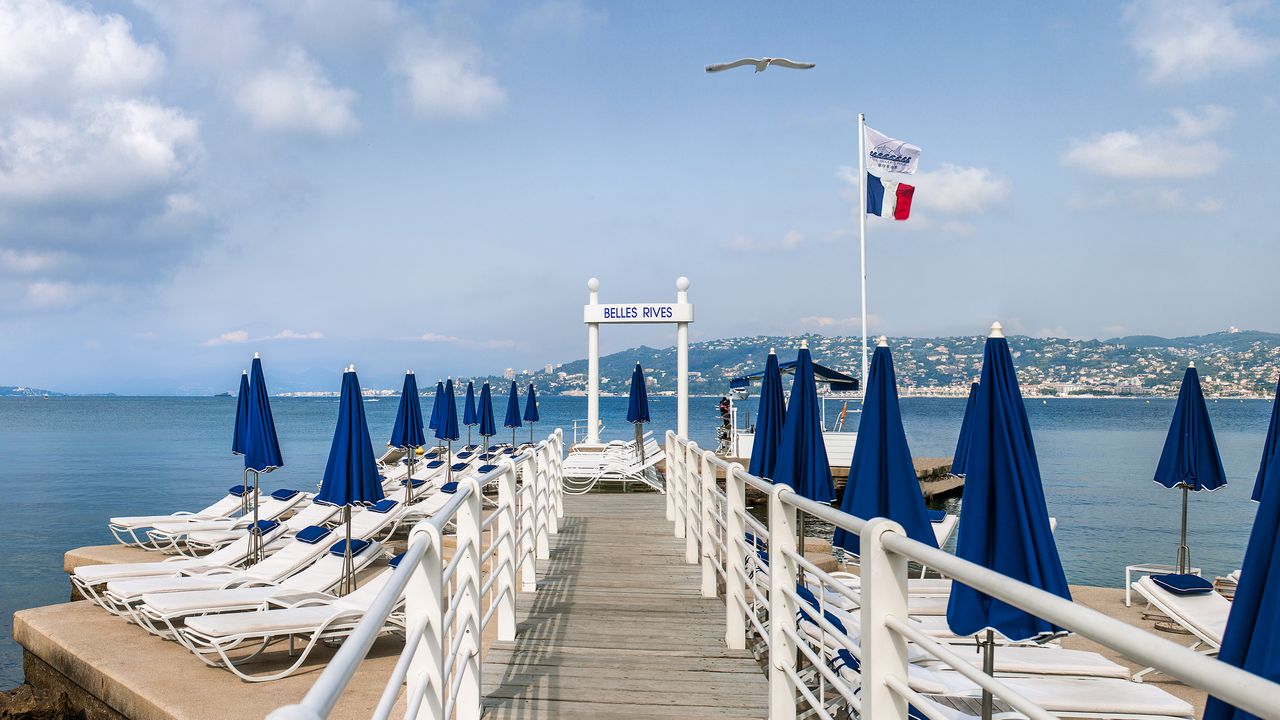
A few hours after I arrive at Hôtel Belles Rives in the south of France this summer, I’m seated at dinner when I see a flash of green light ricochet across the glittering water. It’s almost too perfect.
I’ve come here to visit the places that inspired the writer F. Scott Fitzgerald as he traveled across France with his wife and daughter in the 1920s. I’ve ended up in a scene from his most famous novel. In The Great Gatsby, the light at the end of Daisy Buchanan’s dock shines green, entrancing Gatsby. I’m staring at a pinprick of a lighthouse in the middle of the Mediterranean Sea while a glass of vermentino sweats on the table in front of me, but still. I’m entranced.
“Almost too perfect” is close to how Fitzgerald must have found this place. Long ago, he rented the house that became this hotel, then called Villa St. Louis. In a letter he sent to the writer Ernest Hemingway, he explained that being back in such a beautiful house had made him happier than he’d been in ages. Now, traces of him are all over the quite beautiful hotel that was later built here, which opened not long after the Fitzgeralds left in 1927. Just off reception, there’s a bar bears his name, and black-and-white portraits of him and Zelda blown up near the Art Deco elevator. Then, there’s the Prix Fitzgerald: an annual prize celebrating a writer who explores the same themes that captivated Fitzgerald in his own work. The event, held while I’m in town and this time honoring the esteemable writer Richard Ford, draws a crowd of well-dressed locals and Fitzgerald enthusiasts, who snack on bite-sized empanadas and arancini while the prosecco flows.

Photo: Courtesy of Hôtel Belles Rives
The hotel is perched just above the sea in Juan-les-Pins, the charming little sister town to Antibes. It boasts around 40 rooms and five stars, and I promise no one on the premises has ever heard of Alo Yoga. Older women wear linen sets to breakfast. Younger women traipse down to the beach in gauzy sarongs and piles of gold necklaces. Men wear loafers on the sand. The cocktails are pleasingly fussy and delicious. The croissants are warm. I never want to leave. No wonder the wealth-obsessed Fitzgerald didn’t either. The south of France is a status tracker’s paradise. Yachts gleam on the sparkling water. One guest at Belles Rives is wearing diamond studs so big, I can see them from a third-floor terrace, like a pair of icebergs on a lounge chair.
Marianne Estène-Chauvin, the current owner of Belles Rives, tells me that her grandparents fell in love with the villa where the hotel now sits while the Fitzgeralds were still living there. The two had crossed paths at a bus stop—a chance encounter that changed their lives. Her grandfather Boma had come to France from what was then Russia, fleeing pogroms and persecution, and had planned to work in the area just long enough to afford a ticket to New York. Her grandmother Simone invited him to spend the night at her house, as the next bus out of town didn’t leave until morning. He never did make it to Marseille—or to New York.
Dining and Cooking