
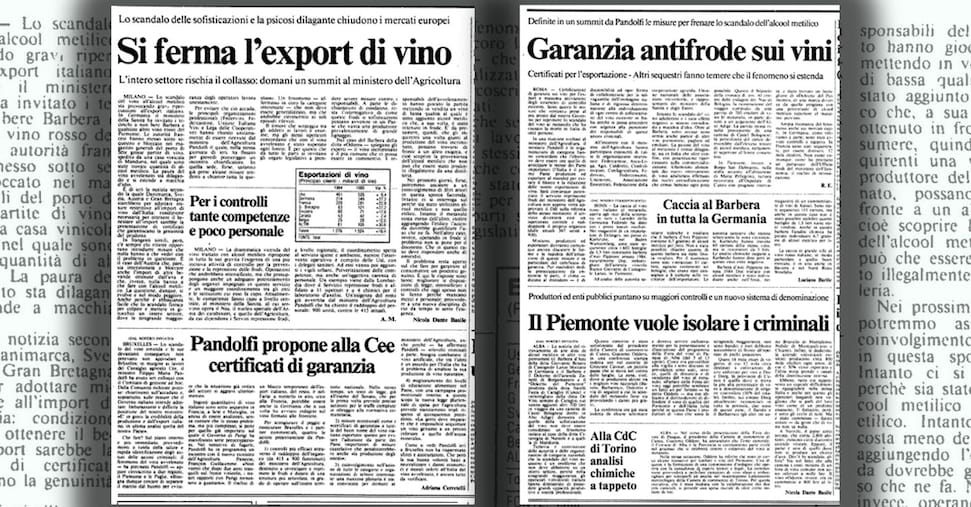
Over the years it has become the emblem of rebound, of the possibility of rising from one’s own ashes. It is the methanol wine scandal that exploded on 17 March 1986. A case of gross adulteration with methanol added to wine. This is a natural alcohol which, however, when wilfully increased, can cause intoxication, serious injuries, blindness and – unfortunately – even death. And indeed there were 23 deaths and dozens of people suffered permanent damage.
Human and economic tragedy
This resulted in a very serious crisis for Italia wine. An estimated half a billion euro loss (on a sector turnover that at the time was 2.5 billion) collapse in exports (minus 40% in one year and minus 80% in Germany, then the leading foreign market and still one of the main outlets for Italian wine). 70% collapse also in domestic consumption.
A devastating image loss from which many were certain they would never recover.
Almost all the leading Italian vignerons, excluding the younger ones, have at least one memory connected to that terrible crisis. One of the most famous producers, Piero Antinori, recounted some time ago that he was on a trip to Canada in March 1986 with his daughter Albiera, the current president of the group. And that trip marked his daughter’s international debut because he, at the time president of Federvini, was forced to leave her in Canada and immediately return to Italia where ‘the world seemed to be coming down’.
The Quality Revolution
And instead? Instead, from that very moment, Italia wine started what has been labelled the ‘revolution of quality’. Production has fallen by over 40% (from 76.8 million hectolitres to 44.3 today). A productive downsizing that has not prevented Italia from remaining the world’s leading producer of wine. At the same time, wines with geographical indications (IGT, DOC, DOCG), which in 1986 were just 10% of the total, now account for over 60% of Made in Italy production. “A passage,” commented Coldiretti, “that shows how the world of Italia wine has conquered world leadership positions in recent years by focusing on quality linked to the territory, rather than on quantity at a low price.
Within this framework of qualitative escalationexports grew more than 10 times from 800 million euro in 1986 to over 8 billion today. The sector’s turnover has risen from 2.5 billion to over 16 billion.
Dining and Cooking