
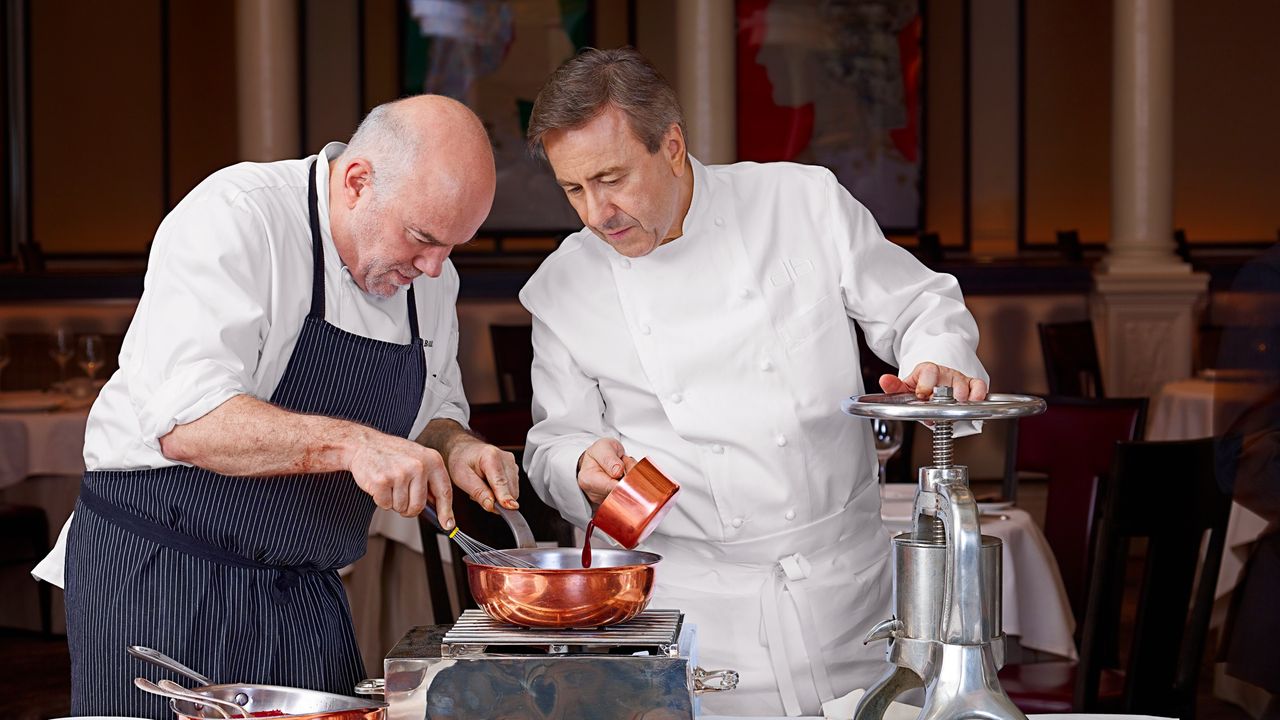
Many were so lyonnais in spirit that Boulud considered preparing them in their city of origin. Or, at least, he pretended to. Boulud doesn’t have a three-star cooking space in Lyons. He also wouldn’t have a predatory brigade of take-no-prisoners cooks at his beck and call. And then there was the question of a prep kitchen: in Lyons, nothing; in Manhattan, beneath the restaurant Daniel, on East Sixty-fifth Street, a purpose-built cooking factory, marginally larger than the sports arenas found in most mid-sized towns. For these and other reasons, it was Lyons that came to New York. And so, too, did I. And, because the restaurant doesn’t do a lunch service, that killer Michelin-three-star cooking space became, in effect, my office. Like my fellow-commuters on the subway, I started at around eight each morning.
There were obvious challenges in making a chartreuse. For me, there were additional challenges, in knowing how to think about it. The difficulty was the name. La Chartreuse is a mountain range, about ninety minutes east of Lyons by car. L’Ordre des Chartreux is a monastery built in those mountains. It is known for the extreme lifelong vows it imposes (like not talking, ever). Then, there was Chartreuse the drink, an herbal distillation originally made by the monastery from an anonymous recipe discovered in 1605. And, finally, there is the adjective “chartreuse,” a neon green, the color of the drink. These words—a mountain, a monastery, a drink, a color—are related to each other in obvious ways. Chartreuse the dish didn’t seem to be related to any of them. For Boulud, a chartreuse was this: a game-bird confection that looks like a joke birthday cake.
It took three days.
On Day One, we made the farce—the filling, which was chopped-up cabbage sautéed in pork belly, duck fat, and foie gras, plus whatever leg meat from game birds happened to be hanging around. (There happened to be a lot.) Who could come up with a fattier cabbage? It was the meatiest vegetable I remember eating. It was insanely satisfying. It compounded my confusion.
Why “chartreuse”? No one understood the problem. I searched the digital holdings of the Bibliothèque Nationale de France, looking for edible examples of the word. I found several, all in the nineteenth century. Nothing explained how they came to be called what they were called. You don’t name a dish after a bunch of monks for no reason, do you?

“All we know is it happened between the hours of 9 A.M. and 4 P.M.”
Cartoon by Benjamin Schwartz
On Day Two, the birds were prepared. Most chartreuse recipes call for one bird, a fat one, like a pigeon or a partridge, secreted inside the casing, a vegetable mold, which is then turned out onto a plate. Ours, being an extravagant tribute to Nandron’s Citroën DS trunk, called not for a single fat fowl but for a cacophonous flock—fat and skinny, big and small, quails, woodcocks, doves, pheasants, and both a pigeon and a partridge. Bernard Vrod, a maître d’ at the restaurant, is a hunter. We used only the breasts, roasted pink. They would be stacked neatly inside the mold like Lincoln Logs and then held in place by the farce, shovelled in and pressed tight.
Finally, we addressed the casing. This was Day Three. The casing was made from root vegetables—white turnips, yellow and orange carrots, in our experiment—sliced thin on a mandoline, steamed until pliable, and trimmed into shape with a knife. The casing was the responsibility of Chad Brauze, an American interloper in an overwhelmingly French kitchen. Chad was beanpole tall, had black horn-rimmed glasses and a baseball-diamond aw-shucks manner. Boulud had asked him to help out with the logistics on the more historically knotty dishes. It was Chad, for instance, who determined the dimensions of each root-vegetable slice in the casing. In his spare time, Chad is a student of mathematics at Columbia University. He came up with a precise triangulation formula intended to eliminate overhangs and overlaps, each piece falling into place as in a children’s puzzle. In practice, the pieces shrank; the formula was useless; and much snipping was needed to get the thing to fit into its snug, pastry-cake illusion. At one point, five of us were bumping shoulders, squeezing our triangles into an increasingly small-seeming mold, lifting them out again to re-trim, our fingers becoming more balloonlike the closer we got to finishing.
Dining and Cooking