
This article discusses racist language and discriminatory action, which may be distressing for some readers.
Playwright and performer Katia Café-Fébrissy’s Rhymes with Vinegar transcends language to tell a stirring cultural narrative about discrimination and power.
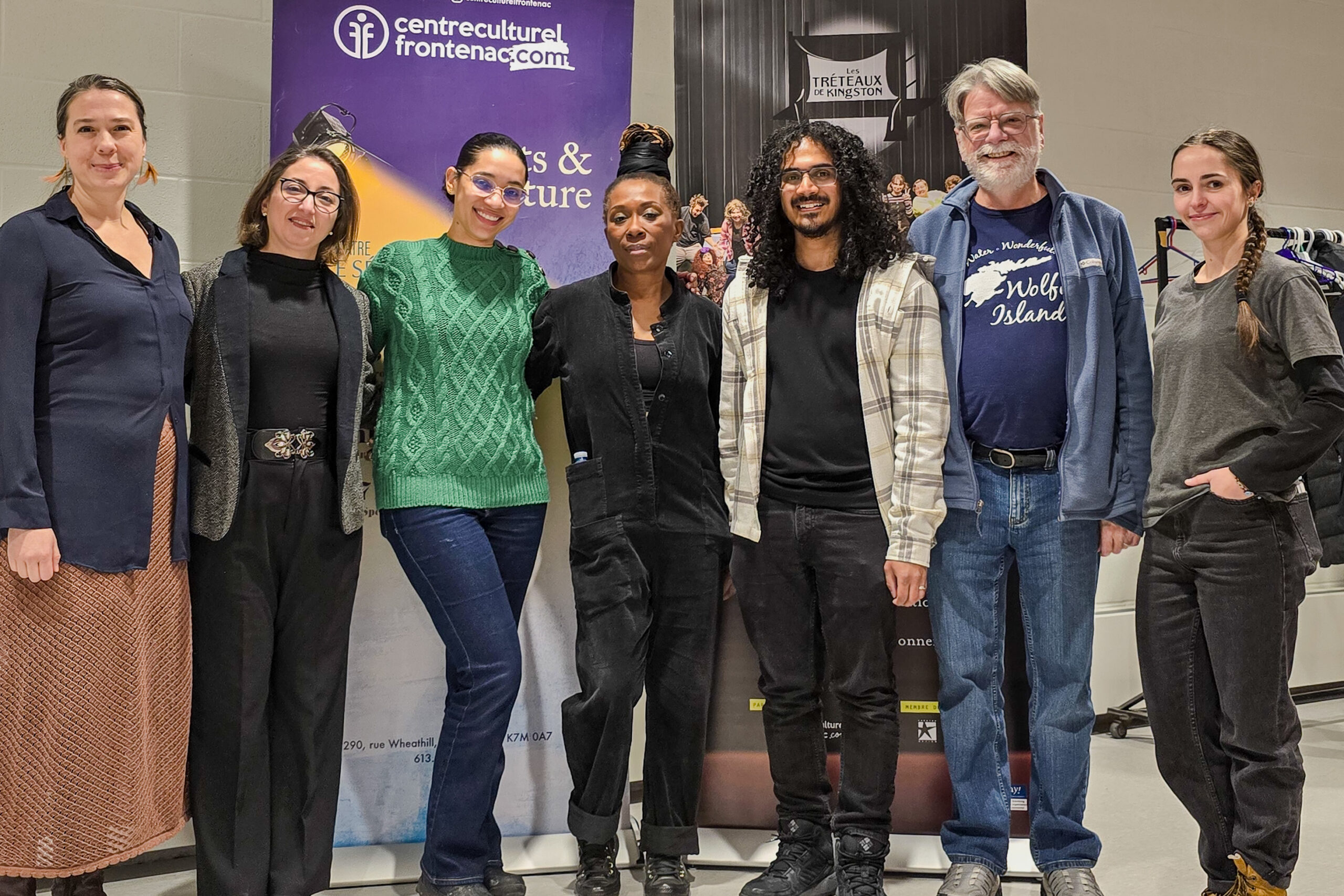
On Feb. 6 at 7:30 p.m., the Centre Culturel Frontenac hosted the performance of Café-Fébrissy’s one-woman play, Rhymes with Vinegar. Though not every seat in the house was filled, the audience enthusiastically engaged with the multi-genre performance. The show takes control of her family’s experience navigating a discriminatory school board.
The show was based on an experience where Café‑Fébrissy stood up to the Ontario Catholic school system when her son got in trouble for sharing his history with his friends. The atmosphere of the play was intimate, almost as if you were gossiping with a friend in her living room, demonstrating the play’s excellent use of the one-person medium.
Though the play’s real-life inspiration was based on conversations in English, she told the story in French, working for the primarily French audience that joined me that night. However, the story was still easy to follow for English speakers due to subtitles on top of the stage (as long as said English speakers sat high enough in the theatre to comfortably see both Café‑Fébrissy and the subtitles).
Dressed in black clothing with minimal stage décor—just two chairs—the space was a sandbox for Café-Fébrissy to play in and tell her story. And that’s exactly what she did; through fun storytelling, exaggerated expressions and hand movements, she took you through a winding narrative without sacrificing a single second of your attention.
The story began with Café-Fébrissy’s son telling her about an incident at his Catholic school, where he got in trouble for saying the “n-word” in recess when educating his non-Black friends about the word’s meaning. This resulted in back-and-forth emails between her and her son’s teacher, escalating into a meeting with the school’s principal.
Eventually, the escalation of the case continues until Café‑Fébrissy and her husband have no choice but to fight for their son’s right to free speech in a court of law.
After keeping the audience on the edge of their seat, hoping for her son to receive justice, Rhymes with Vinegar ends on a note of continued struggle. After transferring her son to a private school, he again encountered racial slurs, which the principal tells Café‑Fébrissy her son must have “misunderstood.”
The performance closed with Café‑Fébrissy posing a rhetorical question to the private school principal: “What could he have heard—vinegar?” Followed by a standing ovation from the audience, the outcome reflected the play’s central tension: the gap between what institutions say they support and what they actually do when faced with uncomfortable truths.
The English subtitles, unfortunately, weren’t of much help during the French Q&A session that followed, where Café‑Fébrissy held onto the audience’s attention with her humour. Though emotionally stirring, the conversation was tough to follow as a non-French speaker, but I chose to stay because of Café‑Fébrissy’s immense skill at holding the audience’s attention.
Ultimately, the play calls out the lack of efficiency with which institutions respond to claims of discrimination–they’re all for posts for Black History Month or additional diversity training, but when it comes to implementing any change, they’re incapable of doing so.
Café-Fébrissy’s story shares how Ontario’s Catholic school system failed her son, and many other Black kids discouraged from sharing their history and their identity with their friends. By bringing her story to the stage, Café‑Fébrissy transforms her personal struggle into art, confronting audiences with the consequences of systemic racism in schools.
Tags
black history month, Centre Culturel Frontenac, live theatre, Rhymes with Vinegar, Theatre
All final editorial decisions are made by the Editor(s) in Chief and/or the Managing Editor. Authors should not be contacted, targeted, or harassed under any circumstances. If you have any grievances with this article, please direct your comments to journal_editors@ams.queensu.ca.
Dining and Cooking