
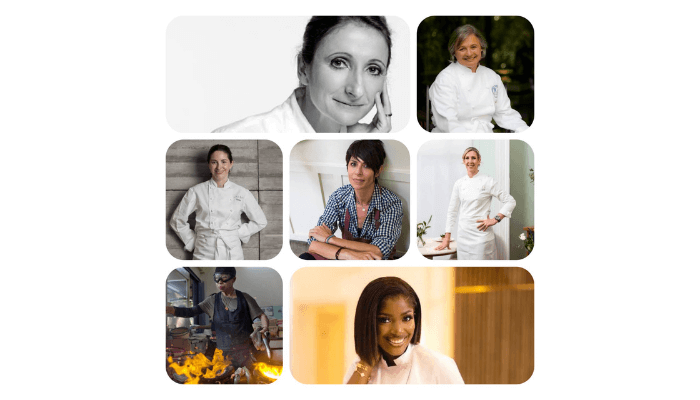
Ask anyone who has ever eaten a great meal cooked by their mother, their grandmother, or the woman who ran the local kitchen they grew up going to, and they will tell you that women can cook. The world has always known this. And yet, for most of culinary history, the professional kitchen operated as though it did not.
Awards, accolades, Michelin stars, and head chef positions — these went almost entirely to men. The gap between who cooked and who got credited for it was never about talent. It was about access. Even today, just six per cent of Michelin-starred restaurants are female-led. That number tells you everything about how far the industry still has to go.
That has been changing, slowly and then unmistakably, driven by a generation of women who refused to accept it. This International Women’s Day, we are celebrating some of the chefs at the forefront of that shift. Women who have earned Michelin stars, broken records, and built restaurants that are counted among the best in the world. Women who have done it on their own terms, in their own kitchens, with their own food.
Here are 8 female chefs who are changing the culinary world.
Anne-Sophie Pic (France)
Anne-Sophie Pic grew up around one of France’s most celebrated restaurant kitchens. Her father and grandfather had both held three Michelin stars at Maison Pic in Valence, and the family name carried enormous weight in French gastronomy. When her father died before he could properly train her, Pic found herself running the kitchen largely on her own, without formal culinary school or a clear mentor. The restaurant lost its third star in 1995. She spent years working to earn it back. She did, in 2007 — and in doing so became the first French woman to regain three Michelin stars in decades, the fourth female chef to win three Michelin stars, and was named the Best Female Chef by The World’s 50 Best Restaurants in 2011. She now holds eleven stars across her various restaurants. Her cooking is precise and refined but draws openly on memory and personal history, and she has spoken about the importance of evolving recipes rather than simply preserving them
Nadia Santini (Italy)
Nadia Santini did not grow up dreaming of becoming a chef. She studied linguistics and married into the family behind Ristorante Dal Pescatore in Canneto sull’Oglio, a remote village in Lombardy. She gradually took over the kitchen and, in time, made it one of the most respected restaurants in Italy. In 1996, she received three Michelin stars, becoming the first woman in Italy to do so, and in 2013 she was named World’s Best Female Chef by The World’s 50 Best Restaurants. Her cooking is rooted in the traditions of the Po Valley — fresh pasta, seasonal vegetables, slow-cooked meats — but executed with a lightness and precision that has attracted diners from around the world. She has spoken about wanting her success to signal to other women that the top of the profession is genuinely open to them.
Adejoke Bakare (UK)
Adejoke Bakare did not follow a conventional path into professional cooking. She is largely self-taught, and her big break came in 2019 when she won the Brixton Kitchen competition, which awarded her a three-month restaurant residency in Brixton Village. From there, her reputation grew steadily. Chishuru, her West African restaurant, was named Time Out’s Best London Restaurant in 2022, the same year she appeared on the list of 100 Most Influential Women in Hospitality. Then, in 2024, she was awarded a Michelin star, becoming not only the first Black woman in the United Kingdom to receive one, but only the second Black woman in the world to do so. Later that year, she was named Chef of the Year at the National Restaurant Awards. Her cooking is rooted in the flavours of West Africa, and she has been open about her desire to bring that cuisine the serious culinary recognition it has long deserved.
Elena Arzak (Spain)
Elena Arzak represents the fourth generation of her family at Arzak, the San Sebastián restaurant that her great-grandparents opened as a wine bar in 1897. She spent years training in kitchens across Europe and Japan before returning to work alongside her father, Juan Mari Arzak, who is widely credited with helping to define modern Basque cuisine. The restaurant holds three Michelin stars and has been ranked among the best in the world . She was also named best Female Chef in the World in 2012. Elena is now one of the leading figures in Basque gastronomy in her own right. Her cooking balances deep respect for the region’s culinary traditions with a consistent drive to experiment with new techniques and presentations.
Dominique Crenn (USA)
Dominique Crenn grew up in Brittany and moved to San Francisco in her twenties without formal culinary training, finding work in restaurant kitchens and learning on the job. She spent time cooking in Indonesia and worked her way through various senior kitchen roles in the United States before opening Atelier Crenn in 2011. In 2018, she became the only female chef in the United States to attain three Michelin stars. The restaurant is known for a style of cooking she describes as poetic culinaria — menus that tell a story and treat each dish as an idea rather than simply a plate of food. She was awarded the Best Female Chef Award in 2016 by The World’s 50 Best Restaurants and in 2018, she was awarded the James Beard Foundation Award of Best Chef: West.
Clare Smyth (UK)
Clare Smyth grew up in rural Northern Ireland and left school at sixteen to begin working in kitchens. She eventually trained under Gordon Ramsay at Restaurant Gordon Ramsay in London, where she became head chef and helped the restaurant maintain its three Michelin stars. She was the first woman to hold that position there, winning the Chef of the Year award in 2013, and achieved a perfect score in the 2015 edition of the Good Food Guide. She opened Core by Clare Smyth in Notting Hill in 2017, with a menu built around British produce and a philosophy that treats the vegetable as the centrepiece of the plate as often as the protein. The restaurant has three Michelin stars, making her the first ever female chef and second overall to gain three Michelin Stars and become a Three-Hatted Chef.
Jay Fai (Thailand)
Duangporn Songvisava, known as Jay Fai, has been cooking on the streets of Bangkok’s Samran Rat neighbourhood since the 1980s. She learned to cook from her father and has run her own stall for decades, working alone over open charcoal flames and wearing ski goggles to protect her eyes from the heat — a look that has become her trademark. In 2018, she was awarded a Michelin star, one of the more unexpected announcements in the guide’s history given the setting and a recipient of Asia’s 50 Best Restaurants Icon Award in 2021. Her crab omelette and drunken noodles are among the most sought-after dishes in the city. She continues to cook every service herself.
Hilda Baci (Nigeria)
Hilda Baci, born Hilda Effiong Bassey, is a chef, restaurateur and entrepreneur based in Lagos, where she founded and runs My Food by Hilda. She is one of Nigeria’s most recognisable culinary figures, though the moment that brought her to global attention came in May 2023, when she cooked for 93 hours and 11 minutes in a bid to break the Guinness World Record for the longest individual cooking marathon. The attempt drew massive crowds in Lagos and was followed closely across social media worldwide. In September 2025, at the Gino World Jollof Festival in Lagos, she prepared a pot of Nigerian-style jollof rice weighing 8,780 kilograms, simultaneously earning Guinness World Records for the largest serving of jollof rice and the largest serving of any rice dish. She is now a three-time Guinness World Record holder. Beyond the records, what has been notable about Baci’s rise is what it represented for Nigerian cuisine. Each achievement brought a wave of international coverage and, with it,fresh curiosity about the food culture she was showcasing.


Dining and Cooking