
Summary 
Scientists warn that the recent weather extremes in Andalusia are part of a broader transformation of the Mediterranean climate, with rising temperatures intensifying aridity and extreme rainfall episodes continuing to strike. Researchers at the Andalusian Institute of Agricultural Research and Training have published recommendations to help olive growers restore soil stability and protect future harvests, emphasizing the importance of protecting soils, monitoring tree health, and carefully planning harvesting operations to mitigate long-term productivity losses.
The weather extremes that recently disrupted parts of Andalusia’s olive oil sector may have appeared sudden and exceptional. But scientists warn they are unfolding within a broader transformation of the Mediterranean climate. Rising temperatures are increasing the atmosphere’s capacity to draw moisture from soils, gradually intensifying aridity even as extreme rainfall episodes continue to strike.
On rainfall we still have some uncertainty, but on evaporation we do not. Water that reaches the ground evaporates much faster today than it did thirty years ago.- Piero Lionello, climatologist, University of Salento
“The main feature of the Mediterranean climate is its huge variability. Such irregularity in the signal might severely interfere with our ability to spot a trend,” Piero Lionello, climatologist and professor of physics of the atmosphere and oceanography at the Department of Biological and Environmental Sciences and Technologies of the University of Salento, in Italy, told Olive Oil Times.
“We are unequivocally witnessing climate change, a climate trend of anthropogenic origin caused by our emissions. Based on our scientific knowledge, the increase in CO₂ concentrations in the atmosphere and other greenhouse gases clearly explains what is happening,” he added.
The combination of strong winds and heavy rainfall not only hit Jaén, the heart of Spain’s olive oil production, but also other Andalusian provinces, including Córdoba.
“The weather conditions that occurred in the Subbética region of Córdoba during approximately the second half of January and the first half of February 2026 caused prolonged water saturation of the soil profiles,” officials at the Technical Department of the cooperative Almazaras de la Subbética told Olive Oil Times. “Episodes of strong winds with gusts caused a massive detachment of fruit, followed by frosts that damaged both the fallen olives and the trees.”
The cooperative is one of the most awarded producers in the history of the NYIOOC World Olive Oil Competition.
“There were intense surface runoff and localized overflows, landslides that caused the dragging and uprooting of olive trees, breakage of trunks and branches in mature trees and the uprooting of young trees due to the strong wind gusts,” the officials said.
In response to the recent floods, researchers at the Andalusian Institute of Agricultural Research and Training (IFAPA) have published a set of recommendations to help olive growers restore soil stability and protect future harvests.
The recommendations focus primarily on protecting soils and restoring orchard conditions after prolonged saturation. IFAPA researchers advise growers to avoid working waterlogged soils, since machinery traffic can compact the ground, worsen structural damage, reduce infiltration capacity and increase the risk of future erosion.
Instead, researchers recommend stabilizing the surface as quickly as possible. Maintaining or restoring vegetative cover between rows is considered one of the most effective tools for reducing runoff and preventing topsoil loss, particularly in sloped groves where intense rainfall can rapidly carve channels and carry sediment downhill.
The guidelines also stress the importance of inspecting and repairing drainage infrastructure.
Another key recommendation concerns the health of the trees themselves. Prolonged soil saturation can stress olive roots and create favorable conditions for fungal diseases. IFAPA researchers therefore advise growers to monitor orchards closely after floods, looking for signs of root stress, canopy decline or the emergence of pathogens associated with excessive humidity.
Finally, the institute recommends carefully planning the resumption of harvesting operations once groves become accessible again. Returning to the fields too early can further damage already weakened soils, while a gradual resumption of normal practices allows orchards to stabilize and reduces the risk of long-term productivity losses.
“The first measure we took was to report the damage suffered in the olive groves of our members to the public administration so that they would be aware of the seriousness of the situation both environmentally and economically,” Almazaras officials said.
The cooperative’s officials also acknowledged the spread of some fungal diseases following the prolonged rain. “In addition, many access roads became unusable, olive grove lanes became impassable, there was a risk of machinery overturning and soil compaction due to forced transit,” they said. “The combination of all these factors generated fruit drop with the impossibility of harvesting, soil loss with structural degradation and, of course, a loss of quality in the olive oils.”
They said members of the cooperative have been implementing vegetative cover between rows for years. “This cover has prevented the situation from becoming even more chaotic, as it has prevented the formation of gullies in areas with steep slopes,” the officials said.
“In areas where growers not only left vegetative cover between the rows but also under the canopy of the olive trees, a large part of the production had already been harvested, so the damage was somewhat lower,” they added. “Harvesting as early as possible allows us not only to obtain fruit of excellent quality but also to avoid the risk of fruit drop.”
“Now we still need to collect the olives that remained in the field and carry out treatments to prevent the diseases that may arise from this whole situation,” the officials said. “The main risks are soil loss due to runoff and crop loss.”
Lionello said that while the Mediterranean climate has always been marked by sharp swings between wet and dry periods, the system’s balance is shifting as temperatures rise. Even when rainfall totals remain uncertain or highly variable, the increasing atmospheric evaporative capacity is steadily reducing the amount of water available in soils.
“The aridity of a region is determined by a balance between how much it rains and how much water evaporates,” he said. “On rainfall we still have some uncertainty, but on evaporation we do not. Water that reaches the ground evaporates much faster today than it did thirty years ago.”
According to the climatologist, the crucial question for agriculture is not simply whether rainfall increases or decreases, but how much water ultimately remains accessible to crops.
“What matters to farmers or to those managing water resources is not just whether it rains less,” Lionello said. “What matters is how much water remains available in the system.”
Rising temperatures are lengthening the dry season across much of the Mediterranean basin. “The warm season, which is typically dry, is becoming longer,” he said. “The soil dries out earlier in the year.”
 Pago de Espejo
“These changes are already reshaping agricultural strategies,” Lionello added. “Most olive growers in Italy did not irrigate in the past. Now they do, because irrigation increases production but also increases sensitivity to water shortages. Sometimes water is lacking because there is less of it, and sometimes because agriculture demands more.”
While scientists continue to investigate how extreme precipitation patterns may evolve in the Mediterranean, Lionello said the long-term trend toward greater climatic stress is already evident. “Each year can be different from the previous one,” he said. “But the overall tendency is clearly moving in this direction.”
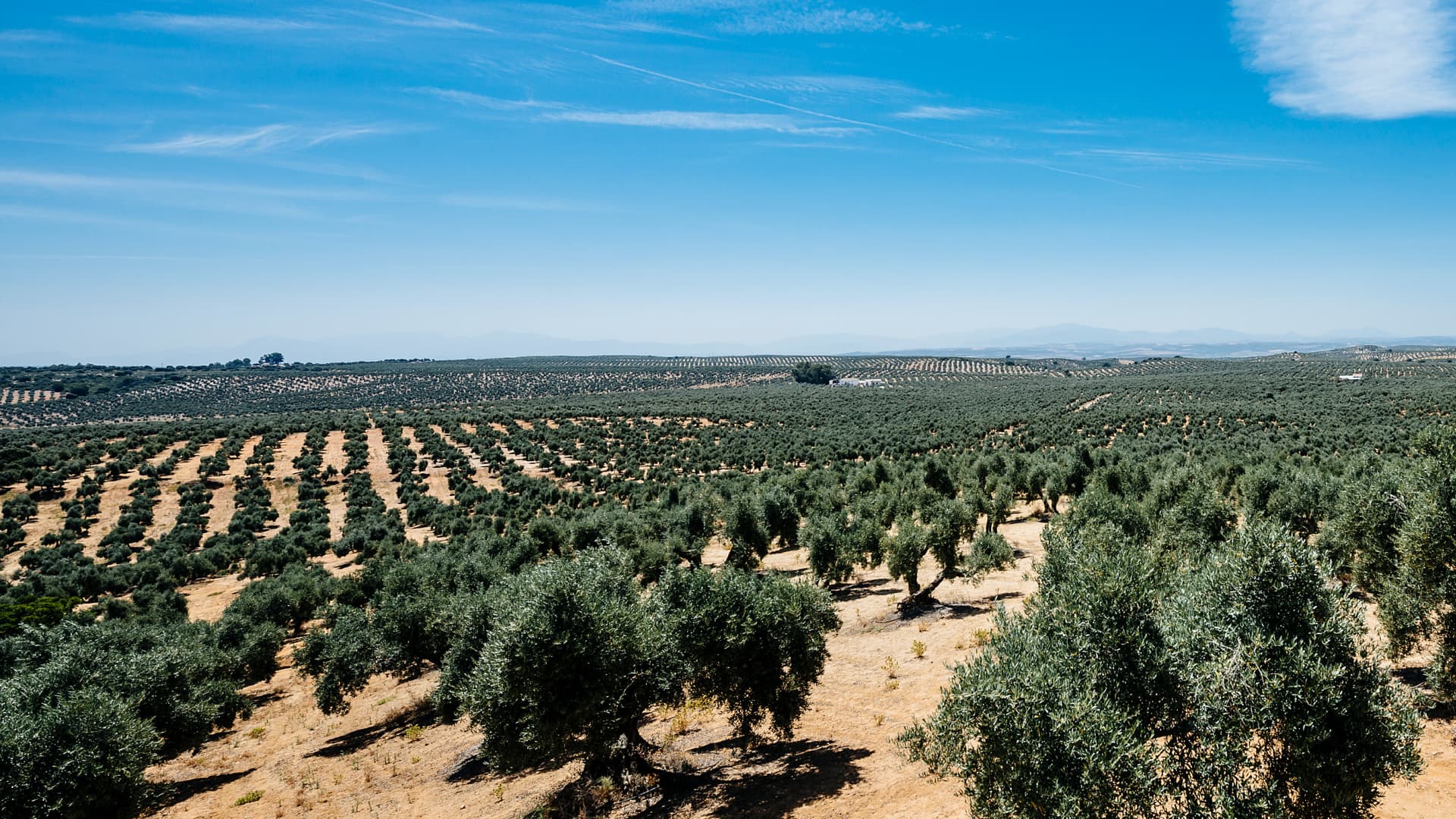
For growers on the ground, however, climate debates often translate into more immediate concerns. Rosario Minchón of the multi-awarded olive oil producer Pago de Espejo, in Jaén, whose early harvest had already concluded before the worst of the rains arrived, framed the issue in practical terms.
“Some years we have a lot of rain and some years we are completely dry. In my opinion, in Spain, water is the first issue and soil is the second,” she said, warning that decades of erosion have already depleted large amounts of topsoil.
For Minchón, strengthening water management systems and protecting soils will remain central priorities for the resilience of olive groves in the years ahead.
Dining and Cooking