
Unlock the Editor’s Digest for free
Roula Khalaf, Editor of the FT, selects her favourite stories in this weekly newsletter.
This article is part of FT Globetrotter’s guide to Paris
Île Saint-Louis is a small, cobblestone-rich, largely residential island on the Seine with a population of less than 4,500. It connects the city’s Left and Right Banks, and exudes a charm so quintessentially Parisian that by walking its streets you could quite possibly imagine yourself as F Scott Fitzgerald on the way to meet Gertrude Stein.
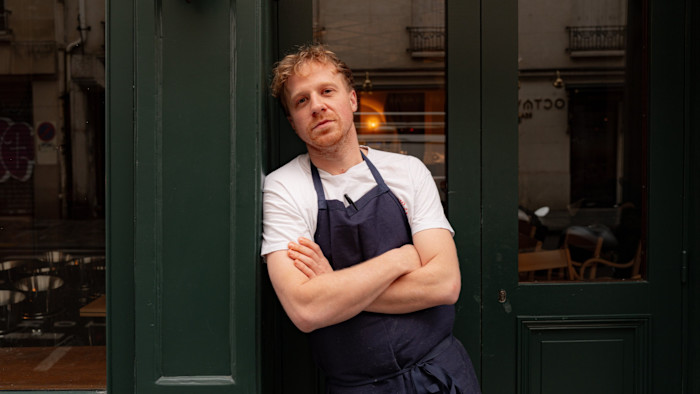
“I think we’re hitting the area at a great time,” Cypsèle restaurant’s Polish-born chef Marcin Król says, referencing the more than 11 million visitors drawn to the area since Notre-Dame on neighbouring Île de la Cité reopened in December 2024. Île Saint-Louis itself claims landmarks such as Hôtel Lambert — where Polish émigrés once gathered — and famed ice creamery Berthillon. It is now seeing new energy with the Musée Vivant du Fromage and Komorebi boutique, both of which opened last year. “We got really, really lucky with the location,” Król emphasises.
 Île Saint-Louis, with Notre-Dame on the neighbouring Île de la Cité © Getty Images
I’m at Cypsèle for the restaurant’s fifth-ever service, trying the seven-course tasting menu (€145 at dinner, or an abridged four-course for €85 at lunch), which changes daily depending on what Król’s 14 producers have at the time. The restaurant opened at the end of November, marking a new phase in the renaissance of the Île Saint-Louis.
Calling a Parisian restaurant produce-focused might sound banal, but Król is utterly obsessive about it. Before opening Cypsèle, instead of planning the menu in a test kitchen, Król invested in research trips around France to build personal relationships with producers and begin crafting dishes. There’s bread studded with a rare red rice from Camargue, an abundance of fish from the same supplier used by seafood guru Alexandre Couillon, and citrus from French and Canadian lawyers-turned-farmers based in Alentejo, Portugal, about whom co-owner Quentin Loisel waxes lyrical as he presents a dessert dedicated to them.
With the dégustation format and focus on the country’s finest seasonal ingredients, the food feels French, but with its multitude of influences is distinctly modern Parisian, from Japanese touches like pollock tempura to Basque-style char across multiple courses.
 Gnocchi fritto with raw squid and capers at Cypsèle © Haejo Nam
 After spending a year at Noma, Marcin Król worked in Sweden, Japan and Chile before arriving in Paris
The global perspective is also distinctly Krol, whose style is otherwise hard to define. After summers spent working in kitchens as a teen in London, at 18 he landed in Copenhagen for a two-week stage at Noma and ended up staying for a year. He later worked in Sweden and Japan, and then spent a year at Boragó — a trailblazing restaurant in Santiago, Chile — before eventually arriving in Paris, training under the legendary Iñaki Aizpitarte at Le Chateaubriand, and later joining the kitchen at cutting-edge restaurant Maison Sota.
Cypsèle (the botanical term for a dandelion seed) is the kind of boundary-pushing eatery you’d expect to find in the 11th arrondissement, the heart of Paris’s “bistronomy” revolution of the past couple of decades. Restaurants such as Septime, Le Servan, Bistrot Paul Bert, and Król’s alma maters Le Chateaubriand and Maison Sota sprung up in the former working-class neighbourhood to offer a rejoinder to the perceived stuffiness and heft of French cuisine, planting the flag for casual fine dining. Though the 11th is still an epicurean hub, its influence is increasingly found in quartiers where serving natural wine was once considered sacrilege, such as AT in Saint-Victor and more recently Orson in the 6th and Geoélia in the 16th.
 Housed in a former pharmacy, Cypsèle was refurbished in collaboration with London-based studio Nice Projects
On Île Saint-Louis, my previous visits were for L’Étiquette, a cave à vins specialising in rare low-intervention wines. Its owner Hervé Lethielleux found himself branded the “fool de l’île” when it opened in 2012 just across the road from Poget & De Witte, a huîterie boasting the city’s best oysters but which had an uninspired wine list. But Lethielleux made the correct prediction about the Île’s changing tastes; punters now order oysters from Poget & De Witte to have with their vins naturels at L’Étiquette.
It’s this spirit of reinvention that Cypsèle exemplifies, a distillation of the island’s revitalisation. Król teamed up with London-based design studio Nice Projects for the space’s refurbishment. Once a pharmacy, it now features restored 17th-century wooden shelving, curved pale wood chairs in its two rooms, handmade mosaic floors and a swirl of neon lighting circling the dining-room ceiling — a Victor Urtuzuastegui installation designed to evoke Parisian tabacs. Despite the open kitchen’s visible intensity, the atmosphere remains easy-going — serious about the food, but never taking itself too seriously.
 Król’s dishes include spit-roasted red partridge with tardivo confit
In the best possible way, the space feels improvised, which is also the approach the food takes. “I think the whole thing for me is I cook the way I like to eat,” Król says, “which is quite simple and very pure.” His cooking is at its best when he most embraces this, as in a sea bass dish where cubes of pristine raw fish and crème cru (raw cream) are wrapped conically in slices of kohlrabi and topped with chamomile-infused oil, creating a world-class temaki.
His technical skill shines in a fillet of tender shrimp-stuffed sole, its centre kept pearlescent pink. Sauce Dugléré — a classic reduction of white wine, shallots, tomatoes, and fish stock, updated with rose-infused butter — glosses the fish and its accompanying tiny potatoes.
 Desserts at Cypsèle include chestnut and quince Paris-Brest . . . © Haejo Nam
 . . . and citrus and saffron givré © Haejo Nam
A spectacularly late-autumnal Paris-Brest may be the highlight: its bronzed, crackling crust layered with sumptuous chestnut diplomat cream and interlaced with slices of cognac-poached quince. Supremely silky ice cream spiced with cardamom leaf seals the deal.
Król’s cuisine is provocative and intriguing, something you may not expect from a chef with a photograph of Danny DeVito on the pass in lieu of a grand chef. But his laid-back demeanour belies his ambition for the restaurant to be “full all the time”.
Like Lethielleux before him, he accepts that conquering the Île requires striking a balance. “I think we’re trying to do something a little bit different,” he says, “but it’s all rooted in Paris.”
11 Rue des Deux Ponts, 75004 Paris. Website; Directions
Share your Île Saint-Louis restaurant recommendations in the comments below. And follow us on Instagram at @ftglobetrotter
Cities with the FT
FT Globetrotter, our insider guides to some of the world’s greatest cities, offers expert advice on eating and drinking, exercise, art and culture — and much more
Find us in Paris, London, Washington DC, Los Angeles, Tokyo, New York, Lagos, Rome, Frankfurt, Singapore, Hong Kong, Miami, Toronto, Madrid, Melbourne, Copenhagen, Zürich, Milan, Vancouver, Edinburgh, Venice and Istanbul
Dining and Cooking