
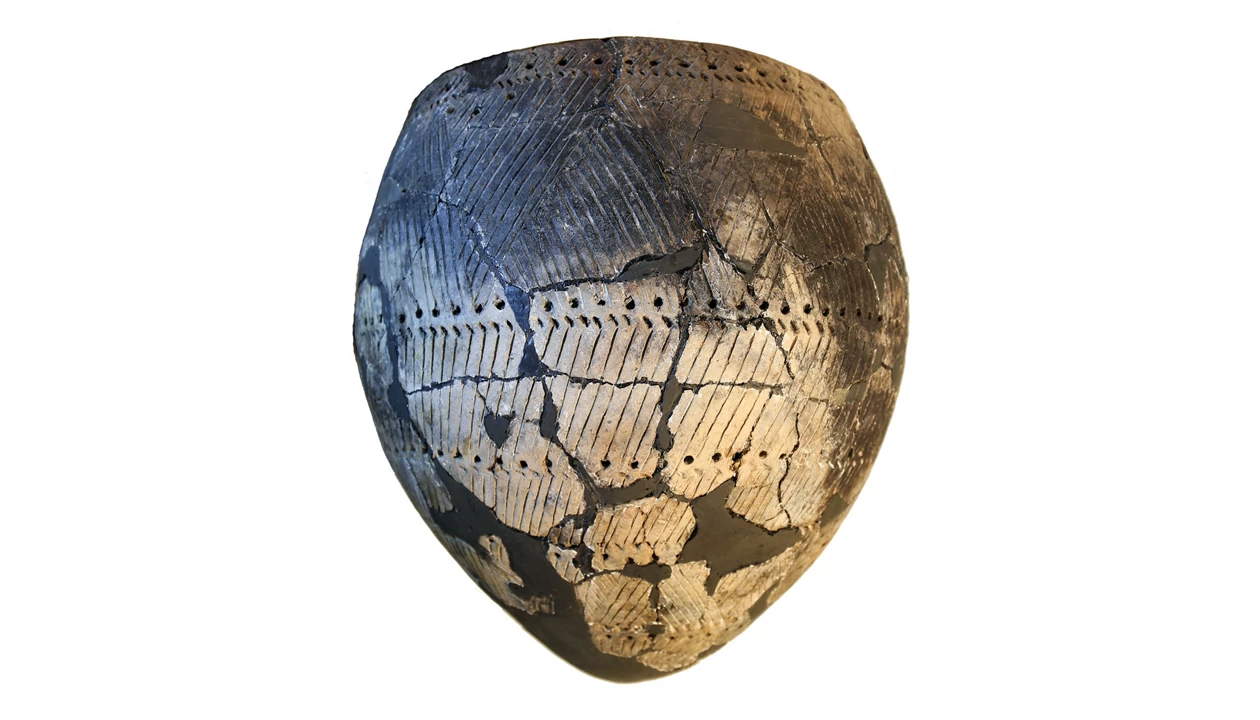
A new analysis of carbonized food deposits on ancient pottery from hunter-gatherer-fisher communities reveals a previously overlooked pattern of diverse and selective plant use by ancient humans across northern and eastern Europe. The results demonstrate that pottery was used for an array of culinary applications and highlight the importance of combining analytical techniques capable of identifying both animal and plant ingredients.
While lipid residue analysis—which favors the discovery of animal products—has been extensively used on ancient pottery, techniques that can identify plant species have only recently come into use. Organic-residue analysis can’t target the food crusts attached to the pottery, but it does look at the absorbed lipid residues preserved inside the ceramic matrix, explains Simon Hammann, who researches archaeological chemistry at the University of Hohenheim and was not involved with the study. Since lipids mobilized during cooking are absorbed into pottery, that’s where research has focused, says Hammann. Plants, however, contain low lipid levels.
An abundant evidence of fishing in the study areas has reinforced the association of pottery technology with fish processing and cooking. “Archaeologists had an understanding of culinary habits of these hunter-gatherer-fisher communities in Northeastern Europe. However, this was biased to lake and river fishing, and therefore freshwater fish consumption,” says Lara González Carretero, an archaeobotanist from the University of York who led the new research, which was published this month in PLOS One (DOI: 10.1371/journal.pone.0342740).
Working with 85 pottery sherds featuring food crusts from archaeological sites spanning the Baltic Sea to the Volga from the sixth to third millennium BCE, an international team of researchers used microscopy and isotopic analysis to identify not only plants and animals consumed by stone age humans but also ingredients that were commonly combined.
The team made use of reference materials to identify microscopic, preserved cell tissues and food remnants accurately, explains González Carretero. Not everything was microscopic, however. Some of the food crusts contained whole preserved berries from the guelder rose (Viburnum opulus).
When suitable reference materials didn’t exist, the researchers made their own. González Carretero picked guelder rose berries and goosefoot (Chenopodium species) and sourced fish, which were combined and cooked in replica pots over an open fire. “The idea was to recreate the conditions these communities would have had while cooking,” she says. The team later gathered near the fire to cook pizza and spend time together, says González Carretero.
The team also used lipid residue and bulk isotopic analyses to help identify the materials found in food crusts. Carbon-isotope measurements showed that nearly all food crusts contained fatty acids and distinctive lipid biomarkers that originated from freshwater fish or shellfish. Plant lipid components were also identified in 52 of the 85 analyzed food crusts.
The plant species the team identified include wild grasses, legumes, roots, leafy greens, fleshy berries, and tubers. The research also shows that ancient humans were selective not only in species but in plant parts, with some samples containing only goosefoot seeds, and others stems and leaves as well. Additionally, the presence of both ripe and unripe plant parts indicates that some plants were gathered year-round.
An overwhelming 92% of the food crusts that contained fish particles, like scales, also contained lipid products that indicated heating, as opposed to 69% of food crusts without visible fish fragments.
Certain ingredient combinations, such as guelder rose and amaranth (Amaranthaceae species), kept reappearing across archaeological sites, says González Carretero. “These would always be mixed in with freshwater [animal] resources.”
“It was interesting to see that the microscopic data and lipid data do not necessarily correspond too well, and one technique might actually not be enough in many cases,” comments Hammann.
Combining chemical and microscopy-based methods helps enhance our understanding of ancient people’s diets and cooking methods by allowing researchers to spot previously undetected biomarkers and plant components, says González Carretero.
For Hammann, the key remaining issue is resolving the differences found in the analysis of food crusts and absorbed residues. He says both categories have “inherent biases in terms of formation or accumulation, so it’s quite intriguing to think about how to bring that together in an interpretation. What’s more representative or diagnostic of the vessel and resource use?” While repeated use of a cooking pot develops a “mixed signal of absorbed liquids,” he notes, a food crust results from just one meal.
Chemical & Engineering News
ISSN 0009-2347
Copyright ©
2026 American Chemical Society
Dining and Cooking