
Introduction
The India Residential Kitchen Hob Market is witnessing notable growth as modern cooking appliances gain popularity among urban households. With the increasing adoption of modular kitchens, changing lifestyles, and rising disposable incomes, Indian consumers are gradually moving toward aesthetically pleasing and technologically advanced cooking solutions.
Kitchen hobs, which are built-in cooking appliances integrated into kitchen countertops, are replacing traditional gas stoves in many urban homes. These appliances provide convenience, improved safety features, better heat control, and a sleek modern design that aligns with contemporary kitchen interiors.
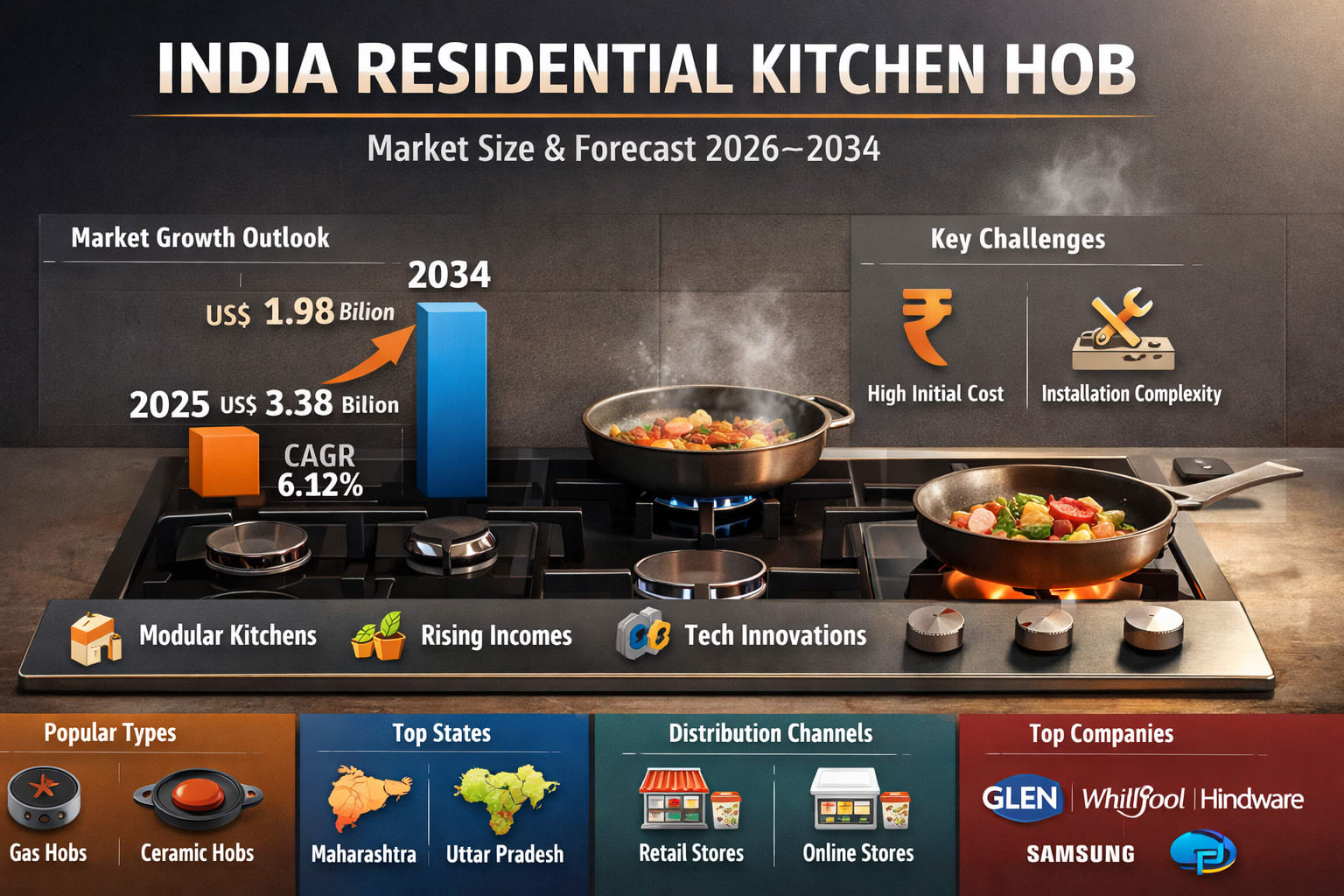
According to Renub Research, the India residential kitchen hob market is expected to expand from US$ 1.98 Billion in 2025 to US$ 3.38 Billion by 2034, growing at a compound annual growth rate (CAGR) of 6.12% between 2026 and 2034. This growth reflects the rapid transformation of Indian kitchens as consumers increasingly invest in modern appliances that combine functionality with design.
Download Sample Report
Several factors such as urban housing expansion, modular kitchen trends, technological innovations, and evolving consumer preferences are driving the market forward. However, certain challenges including price sensitivity and installation complexity remain areas that manufacturers and retailers must address.
Understanding Residential Kitchen Hobs
A kitchen hob is a cooking appliance commonly installed within a kitchen countertop to provide a clean and seamless cooking experience. Unlike traditional stoves that sit on the countertop, kitchen hobs are built into the kitchen surface, creating a more organized and visually appealing setup.
These appliances typically feature burners powered by gas, electricity, or induction technology. Depending on the design and cooking requirements, kitchen hobs are available in various burner configurations such as two-burner, three-burner, or four-burner models.
Modern kitchen hobs are often made using toughened glass, ceramic surfaces, or stainless steel, offering durability and ease of cleaning. Many models also incorporate advanced features including auto-ignition systems, flame failure safety devices, precise flame control, and energy-efficient burners.
As Indian households increasingly prioritize convenience and modern aesthetics, kitchen hobs are becoming an essential component of contemporary kitchen design.
Growing Popularity of Modular Kitchens
One of the strongest drivers of the residential kitchen hob market in India is the rapid growth of modular kitchen installations. Modular kitchens have become highly desirable among homeowners due to their efficient layout, space optimization, and stylish appearance.
In metropolitan cities and emerging urban centers, homeowners are investing more in interior design, particularly in kitchens, which are considered a central part of modern homes. Kitchen hobs perfectly complement modular kitchen setups, offering a streamlined and integrated cooking environment.
For example, in April 2023, Dona Modular Systems received the Kitchen Retailer Award at the India Kitchen Congress for its innovative modular kitchen solutions. The company’s designs blend European aesthetics with Indian cooking requirements, highlighting how global design influences are shaping kitchen trends in India.
As more residential projects incorporate modular kitchens as a standard feature, the demand for built-in appliances such as kitchen hobs is expected to rise significantly.
Rising Disposable Income and Changing Consumer Lifestyle
Another major factor supporting the growth of the residential kitchen hob market is the increase in disposable income among Indian households. As purchasing power improves, consumers are more willing to invest in premium kitchen appliances that enhance convenience and efficiency.
India’s per capita disposable income increased from approximately US$ 2.11 thousand in 2019 to about US$ 2.54 thousand in 2023, and it is projected to reach US$ 4.34 thousand by 2029. This steady growth in income levels is encouraging consumers to upgrade their homes with modern appliances.
Additionally, the rise of dual-income households and busy urban lifestyles has created demand for appliances that simplify cooking tasks. Kitchen hobs offer several advantages including:
Easy flame control
Quick ignition systems
Faster cooking performance
Improved safety features
Simple cleaning and maintenance
Exposure to global home design trends through social media, interior design shows, and retail showrooms is also influencing consumer preferences. As a result, kitchen upgrades are increasingly becoming a lifestyle choice rather than merely a functional necessity.
Technological Innovations Enhancing Product Appeal
Technological advancements have played a crucial role in improving the functionality and safety of kitchen hobs. Manufacturers are continuously introducing innovative features that enhance cooking performance and user convenience.
Modern kitchen hobs often incorporate flame failure protection systems, which automatically shut off gas supply if the flame is accidentally extinguished. This feature significantly improves safety, particularly in households with children or elderly family members.
Many appliances also feature heat-resistant tempered glass surfaces, high-efficiency burners, and energy-saving technologies. These advancements not only improve durability but also make cleaning and maintenance easier.
In April 2025, the introduction of Bora hobs marked a significant innovation in kitchen appliance technology. These advanced systems integrate downdraft extraction technology with cooking surfaces, eliminating the need for traditional overhead exhaust hoods. Such innovations provide improved air quality, enhanced aesthetics, and a seamless cooking experience that aligns with modern kitchen design.
As manufacturers continue to invest in research and development, the technological capabilities of kitchen hobs are expected to improve further, driving market expansion.
Key Challenges Facing the Market
Despite strong growth prospects, the India residential kitchen hob market faces certain challenges that could limit adoption in some segments.
High Initial Cost
Kitchen hobs are generally more expensive than conventional gas stoves due to their advanced features, premium materials, and integrated design. In addition to the appliance cost, installation expenses and countertop modifications may also be required.
India remains a price-sensitive market, particularly in tier-2, tier-3, and rural regions, where affordability plays a crucial role in purchase decisions. As a result, traditional gas stoves continue to dominate in many households.
Installation Complexity and Service Availability
Another challenge is the complex installation process associated with kitchen hobs. Proper installation requires accurate countertop measurements and professional expertise. In existing kitchens, retrofitting a hob may require additional renovation work.
Furthermore, after-sales service and maintenance support may not be readily available in smaller towns. Limited access to trained technicians and spare parts can discourage potential buyers from adopting built-in appliances.
Addressing these issues through better installation services, extended warranties, and consumer education will be essential for long-term market growth.
Ceramic Kitchen Hob Market in India
The ceramic kitchen hob segment is gaining momentum in India as consumers seek sleek and stylish cooking solutions. Ceramic hobs offer a smooth surface that distributes heat evenly, ensuring efficient cooking.
These appliances are often used in electric and induction cooking systems, which align with the growing demand for energy-efficient appliances. The smooth surface also makes cleaning easier compared to traditional gas stoves.
As premium kitchen designs become more popular in urban households, ceramic hobs are expected to see increasing adoption.
Electric Plate Kitchen Hob Market
The electric plate hob segment caters to households seeking alternatives to gas cooking systems. These appliances are valued for their simplicity, durability, and ease of operation.
Electric plate hobs are particularly suitable for apartments and rental properties, where installation of gas pipelines may be limited or inconvenient. They are also appreciated for their clean cooking environment and minimal maintenance requirements.
Although gas hobs remain dominant in India, electric plate hobs are gradually gaining traction in urban regions with reliable electricity supply.
3–4 Burner Kitchen Hob Segment
The 3-4 burner kitchen hob segment is especially popular among medium and large Indian families. These appliances allow users to cook multiple dishes simultaneously, improving cooking efficiency during busy meal preparation times.
Many modern models include features such as auto-ignition, toughened glass surfaces, and advanced flame control systems, making them attractive to consumers seeking both convenience and style.
As household sizes and cooking requirements increase, the demand for multi-burner kitchen hobs is expected to grow steadily.
Distribution Channels: Retail and E-Commerce Growth
Distribution channels play a critical role in expanding the reach of residential kitchen hobs in India.
Multi-Brand Retail Stores
Multi-brand appliance stores allow customers to compare multiple brands, features, and price points in one location. In-store demonstrations and installation services also help build consumer confidence in purchasing built-in appliances.
The expansion of organized retail showrooms in urban areas has significantly supported market growth.
Online Stores
E-commerce platforms have emerged as an important sales channel for kitchen hobs. Online stores provide consumers with access to a wide range of brands, competitive pricing, and convenient home delivery.
Customer reviews, product comparisons, and installation assistance further enhance trust in online purchases, making digital platforms an increasingly popular option for appliance shopping.
Regional Market Insights
West Bengal
The West Bengal residential kitchen hob market is gradually expanding due to increasing urbanization and modular kitchen adoption in cities such as Kolkata, Howrah, and Siliguri. Growing middle-class populations and rising home renovation activities are contributing to market growth in the region.
Maharashtra
Maharashtra represents one of the largest markets for residential kitchen hobs in India, driven by high urbanization in Mumbai and Pune. Modern housing developments and compact urban living spaces are encouraging the adoption of built-in appliances.
Uttar Pradesh
Cities such as Noida, Ghaziabad, and Lucknow are witnessing increasing demand for modern kitchen appliances as living standards improve. In February 2024, Hindware Home Innovation partnered with Migsun Real Estate to provide modular kitchens and built-in appliances for residential projects in Ghaziabad and Greater Noida.
Andhra Pradesh
The residential kitchen hob market in Visakhapatnam and Vijayawada is expanding as new housing developments and rising incomes encourage consumers to invest in modern kitchen designs.
Competitive Landscape
The India residential kitchen hob market includes several well-established domestic and international manufacturers competing through product innovation, pricing strategies, and expanded distribution networks.
Key players include:
Glen Appliances Pvt. Ltd.
iBELL
Whirlpool
Prestige
Hindware Appliances
Samsung
Panasonic Corporation
AB Electrolux
Midea Group Co. Ltd.
These companies focus on product innovation, safety enhancements, and stylish designs to attract modern consumers.
Final Thoughts
The India Residential Kitchen Hob Market is evolving rapidly as Indian kitchens undergo a transformation driven by urbanization, rising incomes, and modern interior design trends. Built-in appliances are no longer limited to luxury homes; they are gradually becoming mainstream as modular kitchens become more accessible.
Technological advancements, expanding retail channels, and the growing influence of global kitchen design trends will continue to shape the market’s future. While challenges such as price sensitivity and installation complexity remain, increasing consumer awareness and product innovation are likely to overcome these barriers.
With strong demand from urban households and rising interest in modern kitchen solutions, the India residential kitchen hob market is set to experience steady and sustainable growth through 2034.
Dining and Cooking