
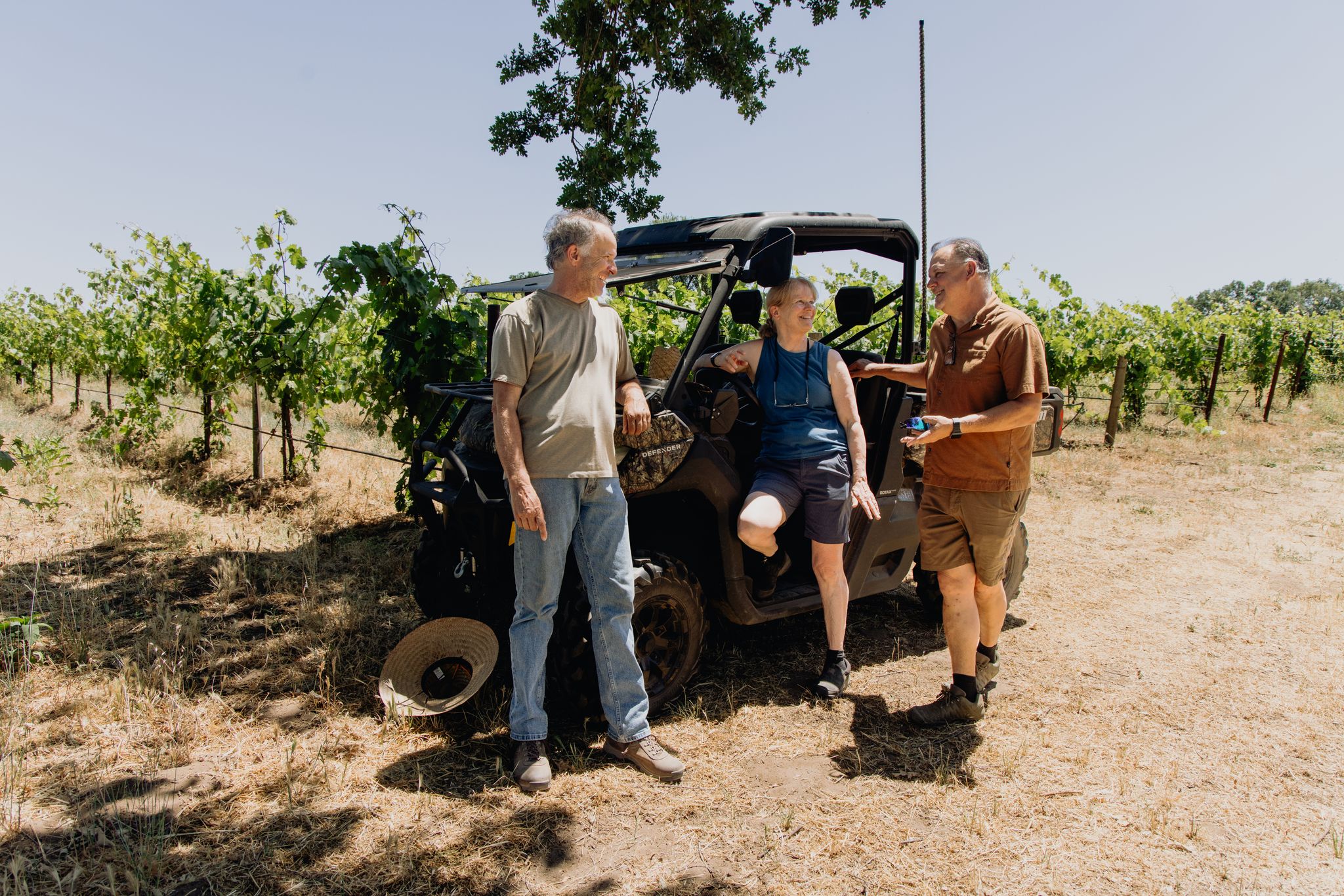
Grape growers Brett Koth, Anne-Marie Koth, and Phil Silver at Mokelumne Glen Vineyards in Lodi, which features an unusual collection of 52 German and Austrian grape varieties.
Rozette Halvorson/For the S.F. Chronicle
An underrated California wine region has a surprising claim to fame: It’s the most diverse grape growing region in the country.
Lodi (San Joaquin County) is typically overlooked in favor of Napa or Sonoma, and it’s long associated with Zinfandel and commodity wines. But the region features more than 130 grape varieties — compared to roughly 60 in both Napa and Sonoma — largely thanks to one highly unusual acre of land.
A single block of wines at Mokelumne Glen Vineyards is home to 52 German and Austrian grape varieties rarely found in the U.S. Many are grapes that most wine drinkers have never heard of, much less tasted, like Ehrenfelser, Albalonga, Rotgipfler and Sirius.
Article continues below this ad
Historically grown in cooler regions, these grapes are an unlikely choice for Lodi’s warm, Mediterranean climate. But a handful of small and experimental winemakers are working with the vineyard to debunk that stereotype, simultaneously challenging Lodi’s long-held reputation as Zin country.
Mary Lou and Bob Koth, founders of Mokelumne Glen Vineyards, passed away within months of each other in 2020 and 2021. Now, their children manage the vineyard.
Courtesy Randy Caparoso
In 1962, Mokelumne Glen founders Bob and Mary Lou Koth purchased the property, located on the east side of Lodi along a bend in the Mokelumne River, and built a family home. The land was planted with a pear orchard, as well as some vines of Zinfandel and table grape Flame Tokay, once Lodi’s most widely planted variety.
San Francisco Chronicle Logo
Make us a Preferred Source to get more of our news when you search.
Add Preferred Source
Bob was an army veteran and the Koths were both teachers. They didn’t initially intend to become grape growers, for in Lodi, most growers are at the mercy of conglomerates, like Gallo, and struggle to make a profit. Bob had grown up in Lodi, and his father, who worked in farming, managed the existing vines, selling the Tokay to Gallo; both the grape and the company played a major role in Lodi’s notoriety for mass-produced grocery store wines.
Article continues below this ad
Bob experimented with some home winemaking, but not much changed for nearly 30 years until he visited his daughter, Ann-Marie Koth, while she was studying abroad in Germany. During that trip, he tried his first German Riesling. He was shocked that it wasn’t sickly-sweet like the Rieslings that dominate the U.S. market. That one bottle led to a newfound fascination with German wine.
In the late ’90s, he set about grafting over his existing vines to German grapes, starting with Riesling, Kerner and Blaufränkisch.
“Everyone thought he was crazy,” said Bob’s son Brett Koth. “There were admittedly times I thought, ‘I don’t know if this is a good idea.’”
California’s most peculiar grape collection
Lodi is the most diverse grape growing region in the country, largely thanks to one acre of land at Mokelumne Glen Vineyards.
Rozette Halvorson/For the S.F. Chronicle
But Bob “wasn’t someone that could be swayed,” said Ann-Marie, who teaches German and English at Lodi High School.
Article continues below this ad
The experimental block, which the Koths named the German Collection, is the only place in California where many of these varieties are grown. For each grape, there are just a handful of vines planted, with the exception of Riesling, for which there are eight different clones.
Outside of the German Collection, the vineyard, totaling 15 acres of vines, is planted with nine main varieties — mostly Kerner and Dornfelder — that Bob discovered grew the best. The vineyard’s proximity to the river results in slightly cooler temperatures than most of Lodi, but the greatest factor in the vineyard’s ability to grow these unconventional grapes is its deep, sandy soils, known to produce concentrated fruit with high levels of acidity and intense aromatics — both defining qualities of many German and Austrian white wines.
As Bob was building his collection, the family started a small wine label. They eventually opened a tasting room, but it was a struggle to sell their wines in a local market dominated by Zinfandel. In 2010, the Koths closed the tasting room, shut down the brand and decided to sell their grapes. “My dad was really concerned about what we were going to do,” Ann-Marie recalled. “We planted all these German varieties and didn’t know how to sell them.”
The greatest factor in the Mokelumne Glen’s ability to grow these unconventional grapes is its deep, sandy soils, known to produce concentrated fruit with high levels of acidity and intense aromatics — both defining qualities of many German and Austrian white wines.
Rozette Halvorson/For the S.F. Chronicle
Their first customer was Swiss native Markus Niggli of Markus Wine Co., who’s known for making eclectic, rule-bending blends. Niggli first sourced Kerner, Gewurztraminer and Rieslaner from Mokelumne Glen for what he called a Swiss blend, now named Nimmo ($25), which consisted of German varieties fermented together and then unconventionally aged in oak. In 2021, Niggli also made the world’s only sparkling Bacchus, a rare hybrid grape, with grapes from Mokelumne Glen.
Article continues below this ad
Niggli’s wines caught the attention of other winemakers, and it trickled down to the vineyard. “Suddenly, people were starting to come to us,” said Brett.” Winemakers were especially interested in Kerner, the base of Nimmo, so the Koths — the only people growing Kerner commercially in California at the time — have since increased their Kerner acreage by more than 30%.
Embracing the unexpected
Anne-Marie Koth, Brett Koth, and Phil Silver at Mokelumne Glen Vineyards in Lodi, where farming is a scrappy, family affair.
Rozette Halvorson/For the S.F. Chronicle
The family also credits Lodi sommelier, wine writer and photographer Randy Caparoso for saving the vineyard. When he first visited Mokelumne Glen around 2002, Caparoso said he “thought it was very unusual and weird” and “wasn’t that impressed with the wines.”
He now chalks that first impression up to “immaturity” for trying to compare the wines to the traditional styles of Germany and Austria. When Caparoso moved to Lodi in 2010, he developed a newfound appreciation for the Koth family’s venture. He realized that some of these stereotypical cool-climate grapes can actually thrive in Lodi, like Kerner, an aromatic, white grape that’s a cross between Riesling and Trollinger. Dorfelder, typically produced as a light, easy-drinking style of red wine in Germany, “all of a sudden turns into a Cabernet-type wine in Lodi,” he said.
Article continues below this ad
“That is something that one would never expect.”
So when the Koths asked Caparoso to introduce them to some winemakers, he did. One was Matthew Rorick of Forlorn Hope Wines, who often works with esoteric varieties like Picpoul and Mondeuse. Rorick took one look at the German Collection, Ann-Marie recalled, and said, “‘I’ll take it all.’”
For about five years, Rorick produced a rare field blend from the block’s white grapes, and it made an impression on Chenin Blanc legend Craig Haarmeyer of Haarmeyer Wine Cellars. After Rorick moved on from Mokelumne Glen, Haarmeyer couldn’t stop thinking about the field blend. One day, Caparoso received a call from Brett while he was with Haarmeyer. “He turned to me and said, ‘Would you be interested in some Blaufränkisch?’”
Historically grown in cooler regions, Mokelumne Glen’s grapes are an unlikely choice for Lodi’s warm, Mediterranean climate.
Rozette Halvorson/For the S.F. Chronicle
“My reflex was to say, ‘Absolutely, I’ll take it,’” Haarmeyer said, “but truth be told, my motivation was to get my foot in the door and one day broach the subject of making the nursery block wine.”
Haarmeyer never had to ask. In 2023, the Koths approached him about taking the German Collection grapes. Unlike Rorick, he planned to use all 52 grape varieties in his blend, making it one of the most unusual wines produced in all of California.
“To rip out old vine Zinfandel and plant nothing but alpine varieties in the heat of the Central Valley seems kind of foolhardy to me,” he said. “But I’m glad it piqued their interest.”
Haarmeyer calls the wine Victor Weisser ($28) and labels it as a Gemischter Satz, a nod to the traditional field blend of Austria, which includes up to 20 different grapes interplanted in the same vineyard. But it doesn’t necessarily taste anything like a true Gemischter Satz. “We’re not trying to emulate or recreate what’s going on traditionally in Austria,” Haarmeyer said. “The wine is very lush, very giving. It’s definitely California sun-kissed.”
Ahead of the curve
Anne-Marie Koth drives a side-by-side vehicle around Mokelumne Glen Vineyards in Lodi.
Rozette Halvorson/For the S.F. Chronicle
Bob and Mary Lou Koth died within months of each other in 2020 and 2021, and their children now manage the vineyard.
It’s a scrappy, family affair. Ann-Marie can be found on the tractor over the summer preparing for harvest when she’s on break from teaching. Brett, who worked alongside his father for decades, has more time to tend to the vines in the winter, as he has four months off from his job at the San Joaquin County Agricultural Commissioner. Ann-Marie’s husband, Phil Silver, pitches in, too; recently, he fashioned a trimmer to the front of an ATV to ease the process of clipping the vine shoots, which they’d historically done by hand. It cost him $1,000, he said, while purchasing a tractor attachment would have cost $50,000.
Mokelumne Glen now consistently sells its grapes to a handful of geeky, small-production winemakers from regions across California, including Napa Valley, where a Mokelumne Vineyard Kerner from Localism previously made it on the French Laundry wine list. The Koths have even had to turn people away.
“There was a wait list for three years at the vineyard to get these grapes,” said Farrah Felten-Jolley, VP of marketing and sales at Lodi’s Klinker Brick Winery. Klinker Brick produces a semi-sweet white blend ($25) of Gewurztraminer, Rieslaner and Weissburgunder (also known as Pinot Blanc) from Mokelumne Glen. It always sells out.
A sign marks the site of Mokelumne Glen Vineyards in Lodi.
Rozette Halvorson/For the S.F. Chronicle
Now with three decades of hindsight, Bob Koth’s vision doesn’t seem so crazy. White wines are trending while Zinfandel sales have been in a steep slump. Lodi also has cheaper land prices and lower farming costs than more famous California regions, which have sparked an era of experimentation. Suddenly, Lodi has become a hot spot for esoteric white grapes — and Mokelumne Glen led the way.
“A lot of people are pretty envious now,” said Brett. “They say, ‘You’re really lucky your dad did this.’”
Dining and Cooking