
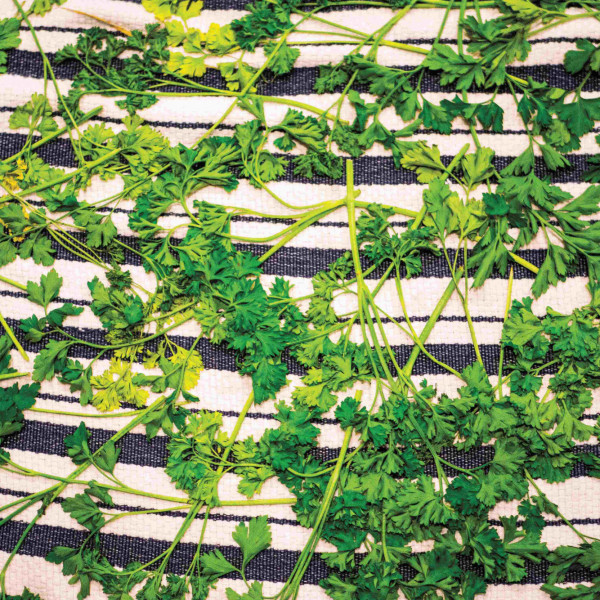
Preparation starts by rinsing armfuls of flat-leaf parsley and leaving it to dry overnight. We aren’t planning to serve twenty people, so my mom and I only bought seven bunches from the store the day before. My partner, Campbell, and I are on plucking duty, along with my sister Ali, Joseph’s wife. We pick leaves off the stems, tossing the debris into a discard pile. Joseph then gathers the leaves into a mound and chops and chops and chops, staining my mom’s cutting board a vibrant green.
At one point, Ali tries to step in and dice some tomatoes to expedite the process while Joseph is finishing up the parsley. Joseph pauses to shake out his hands for a moment, until he notices that Ali is producing the most uneven of tomato chunks. He playfully shoos her away, and Campbell and I welcome her back to the plucking station.
After Joseph transfers the ultra-fine parsley and diced tomato and onion to the large mixing bowl, I add in the mixture of mint, bulgur wheat, and allspice that his mom had prepared for us. I’m not too sure how much of each was included in the mixture—not that it’s a family secret, only that measurements are rarely formalized in Joseph’s family. It was always “a couple of this, a couple of that or some of this, some of that,” he explains.
Ali pours in a couple tablespoons of olive oil and the juice from a lemon as Campbell stirs. Joseph tastes for seasoning, adding the juice from another lemon and a final pinch of salt and one of pepper, careful not to add too much. “My aunt used to put a lot of salt, so hers was always saltier and more lemony compared to my mom’s and mine.” Once the tabouleh is up to Joseph’s standards—which dictate that each bite contains the earthy notes of bulgur wheat, the fresh tang of lemon, the brightness of mint, and the sweetness of ripe tomatoes, all massaged together with olive oil—he covers the bowl in plastic wrap and sets it in the fridge to chill for a few hours.
“Tabouleh’s not something that’s tossed together quickly,” Joseph says. “It’s a very intentional thing to plan out—you have to get the parsley, wash the parsley, and let the parsley dry. Any time you make tabouleh, you’re probably making hummus too, and if you’re making it from scratch, you’re soaking the beans and all of that. It’s all very laborious. It’s a labor of love.”
It was only after moving out of Texas in 2019 that Joseph began making Lebanese and Syrian food on his own, recreating family recipes that had always been his favorite foods. “I was surprised at how much I already knew from the years of sitting there and observing, even though I wasn’t actively trying to learn how to make it,” he tells me. “The first time I picked up the knife to cut the parsley, I knew exactly what to do, even though I’d never done it before.”
For Joseph, it’s more than making dishes he loves—keeping the recipes in use is a means of preservation. “It’s an act of survival in that it is actual sustenance, but also survival of culture,” he says. “When I tell my mom I’m making something that she made for my sister and me when we were younger—whether that’s tabouleh or another Lebanese or Syrian dish—I’m hoping that she sees how the dishes are living beyond the home that she and my dad left and don’t get to return to.” Each time Joseph makes tabouleh—whether by himself, with his mom, or with me—he says he feels closer to those who made it for him while growing up in Sherman. “I really value having a concerted time to think about them, like the thought of them knowing I’m making it now. Or if they ever imagined a little ten-year-old Joseph eventually making tabouleh.” As he continues to make more of his family’s recipes, Joseph’s pockets of home and belonging expand, and his distance from Lebanon and Syria gets smaller. Through food, Joseph returns to his jedo’s backyard, retracing his steps around the garden.
Dining and Cooking