
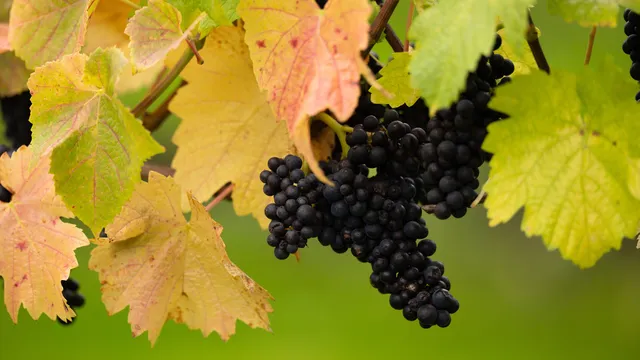
The findings establish a link between modern France — one of the world’s leading producers and consumers of wine — and its distant wine-loving past.
A grape seed dating back around 600 years, discovered in a toilet at a medieval hospital in France, has been found to be genetically identical to modern varieties used to produce Pinot Noir wine, scientists said.
The discovery shows that this highly popular grape variety has been cultivated in France since at least the 15th century, according to a new study.
“It cannot be determined whether the fruit was consumed as table grapes or used to make wine at the time,” said study co-author Laurent Bouby in a statement to AFP.
The findings, however, establish a link between modern France — one of the world’s leading producers and consumers of wine — and its distant wine-loving past.
The other co-author, Ludovic Orlando, noted that the Hundred Years’ War between England and France ended in the 15th century, and that the national heroine Joan of Arc lived during that time. “She may have eaten the same grapes as we do,” said the paleogeneticist from the University of Toulouse.
The seed was found in a toilet at a 15th-century hospital in Valenciennes, in northern France. At the time, such facilities often also served as waste disposal sites.
The study, published in the journal Nature Communications, includes genome sequencing of 54 grape seeds dating from the Bronze Age (around 2300 BC) to the Middle Ages.
It confirms that vine growers used so-called clonal propagation — preserving cuttings from specific varieties — for centuries.
“Ancient texts suggest this practice, but outside of paleogenomics it is very difficult to prove,” explained Bouby of the Institute of Evolutionary Sciences in Montpellier.
The new research shows that this technique was already being used as early as the Iron Age, around 625–500 BC.
The oldest analyzed seeds come from wild vines in the Nîmes region and date back to around 2000 BC. Cultivated vines appeared later in the Var region in southern France, when Greek colonists likely introduced viticulture after founding Marseille.
DNA analysis also reveals long-term exchange of grape varieties between different regions, including Spain, the Balkans, the Caucasus, and the Middle East, especially during the Roman period.
Pinot Noir, most commonly associated with France’s Burgundy region, is today the fourth most widely planted grape variety in the world, the study notes. | BGNES
Dining and Cooking