
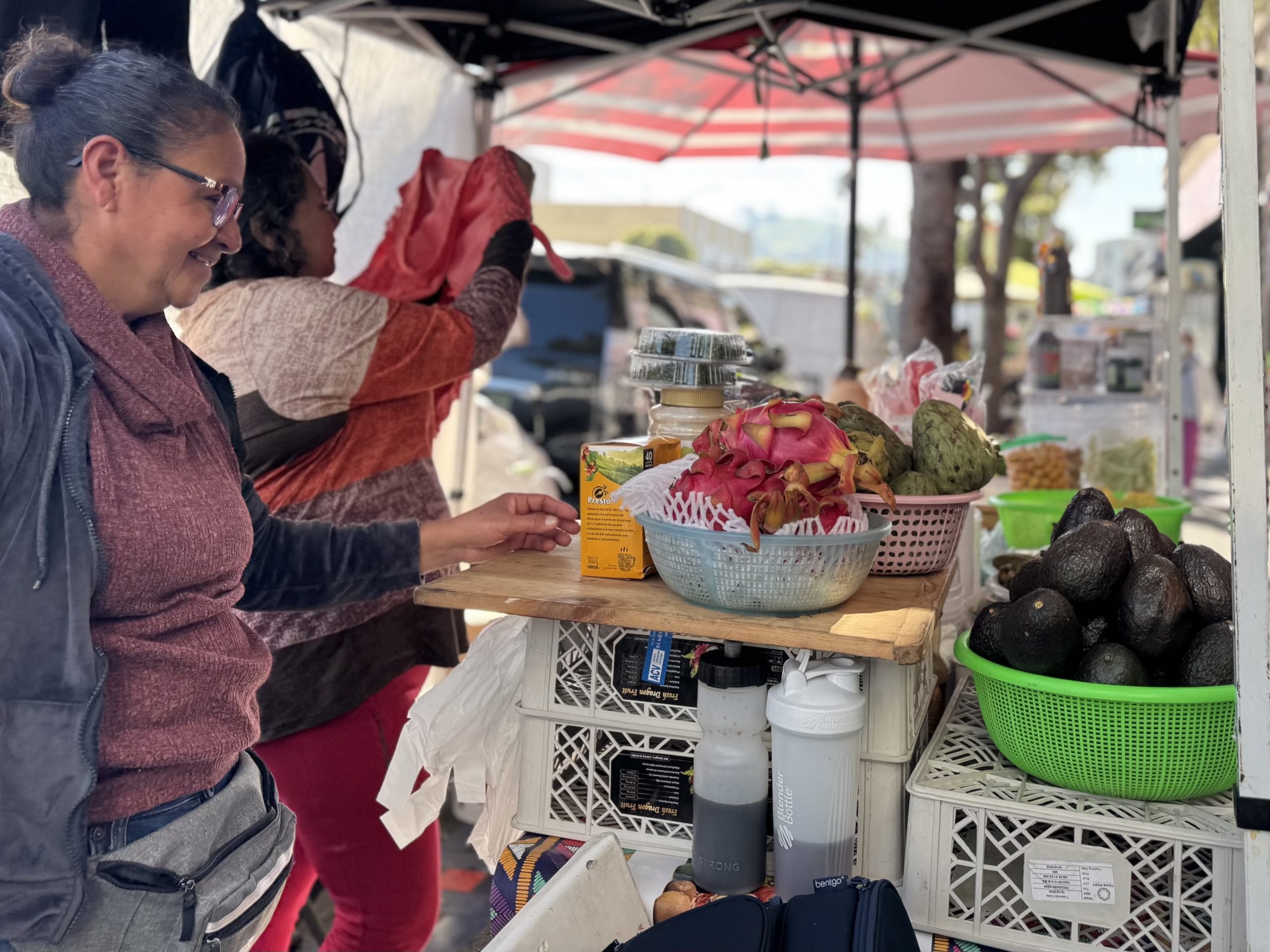
The board of supervisors voted today to approve a new ordinance to regulate food street vendors, despite concerns raised by street vendors — many of whom work in the Mission — that the ordinance’s requirements are too expensive for small-time vendors, and will force them to either go out of business, or operate outside of the law.
The ordinance brings the city in compliance with 2022’s SB 972, a state law that went into effect three years ago.
It passed without any objection from the 10 supervisors who were present. District 9 Supervisor Jackie Fielder, who helped negotiate a waiver of permitting fees for most vendors, was not in attendance.
Fielder’s office did not reply to a request for comment.
“Honestly, we’re really scared. This affects all of us. We’re small vendors just trying to survive and take care of our families, and now we’re being asked to come up with money we don’t have,” said Andrea Guirola, who sells fruit and aguas frescas at 24th and Mission and 16th and Mission.
“The stress is overwhelming. How are we supposed to come up with almost $20,000 for a cart? How are we supposed to do that?.”
Under 2022’s SB 972, the state started to recognize compact mobile food operations — a mobile food facility operated by an individual, such a pushcart; wagon; pedal-driven cart; stand; showcase; rack or any other nonmotorized conveyance — as its own separate food facility category. The law essentially decriminalized street food vending in California, giving small-time food vendors who had operated outside the law the opportunity to go legit.
SB 972 aimed to ease the permitting process for street food vendors, many of whom are immigrants, as well as reduce unpermitted vending and protect public health. But it also required municipalities to draft their own ordinances detailing permitting, regulation and enforcement.
Some counties adopted something called Microenterprise Home Kitchen Operations (MEHKO) — a set of rules that allow street vendors using a home kitchen to comply with state law without significant new expenses. Santa Cruz, Monterrey, Santa Clara, Sonoma, Alameda, San Mateo and Contra Costa are among the counties that adopted MEHKO.
San Francisco county was not among them. It wrote its own regulations, and did not include the MEHKO category. That means that, in order to operate with a permit, most street vendors selling fresh or hot food must, at minimum, have a pushcart with a washing station, and do the majority of their food prep at a licensed commissary kitchen.
Representatives from the Food Vendor Committee, a group representing more than 60 vendors in the Mission District like Guirola said the new rules will hurt them.
“We’re disappointed the City moved forward without ensuring real pathways for vendors to comply. We support legalization, but it has to work in practice,” wrote Carina Rodriguez, an organizer with Nuestra Causa, a Mission District nonprofit that works on political education and civic engagement, in a statement
“Our collective focus now is on implementation, making sure this policy protects long-time vendors, creates opportunities for new ones, and lifts people up rather than pushing them out.”
Rosi Villanueva, who sells pupusas and warm drinks at 24th and Mission streets, had hoped the city would adopt MEHKO before the ordinance came before the full board of supervisors. It could still happen, but will require multi-agency cooperation between agencies like the Department of Building Inspection, the Department of Public Health and the Fire Department.
Until that happens, they still have to come into compliance. “Our economic future is uncertain. We don’t know how we’re going to cover these costs or how we’re going to survive. But we will keep fighting to make sure we are not simply pushed out,” said Villanueva.
Vendors also pointed at what the city of Los Angeles did after adopting its own ordinance to support their vendors. Los Angeles launched a $2.8 million vending cart program designed to help 280 street vendors to obtain carts that comply with the new code.
Los Angeles also started adopting MEHKO in November 2024.
The ordinance will go before the full board for a second reading on April 7th. The Mayor will then have 10 days to sign it.
Dining and Cooking