
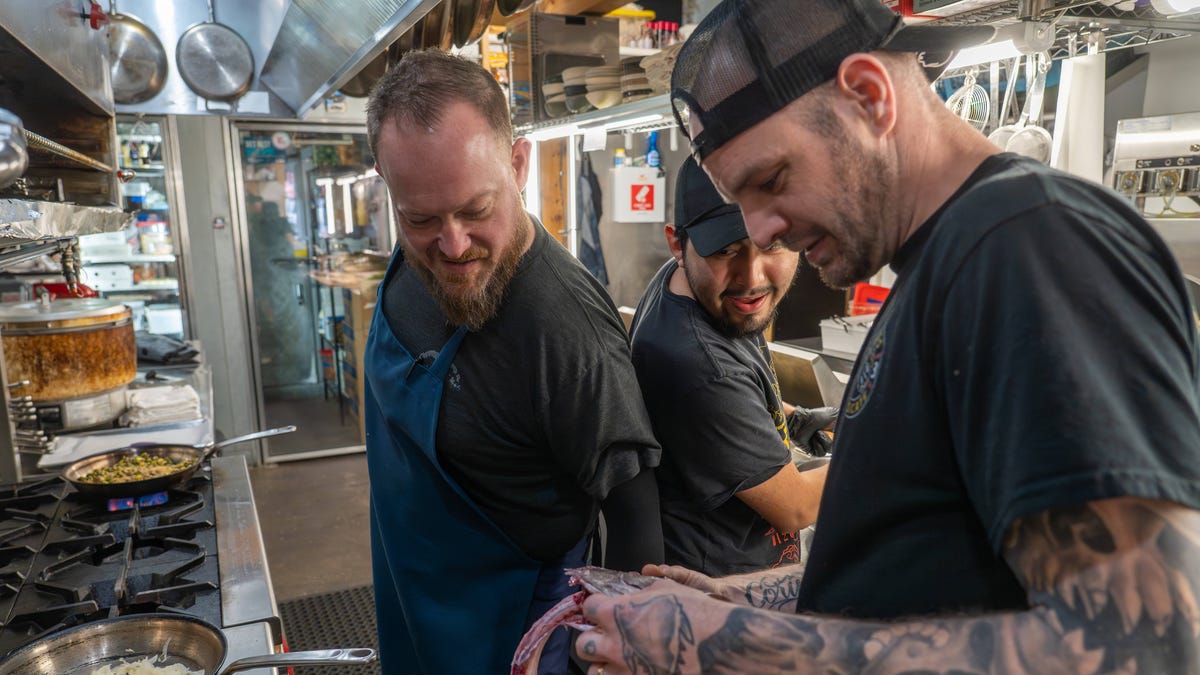
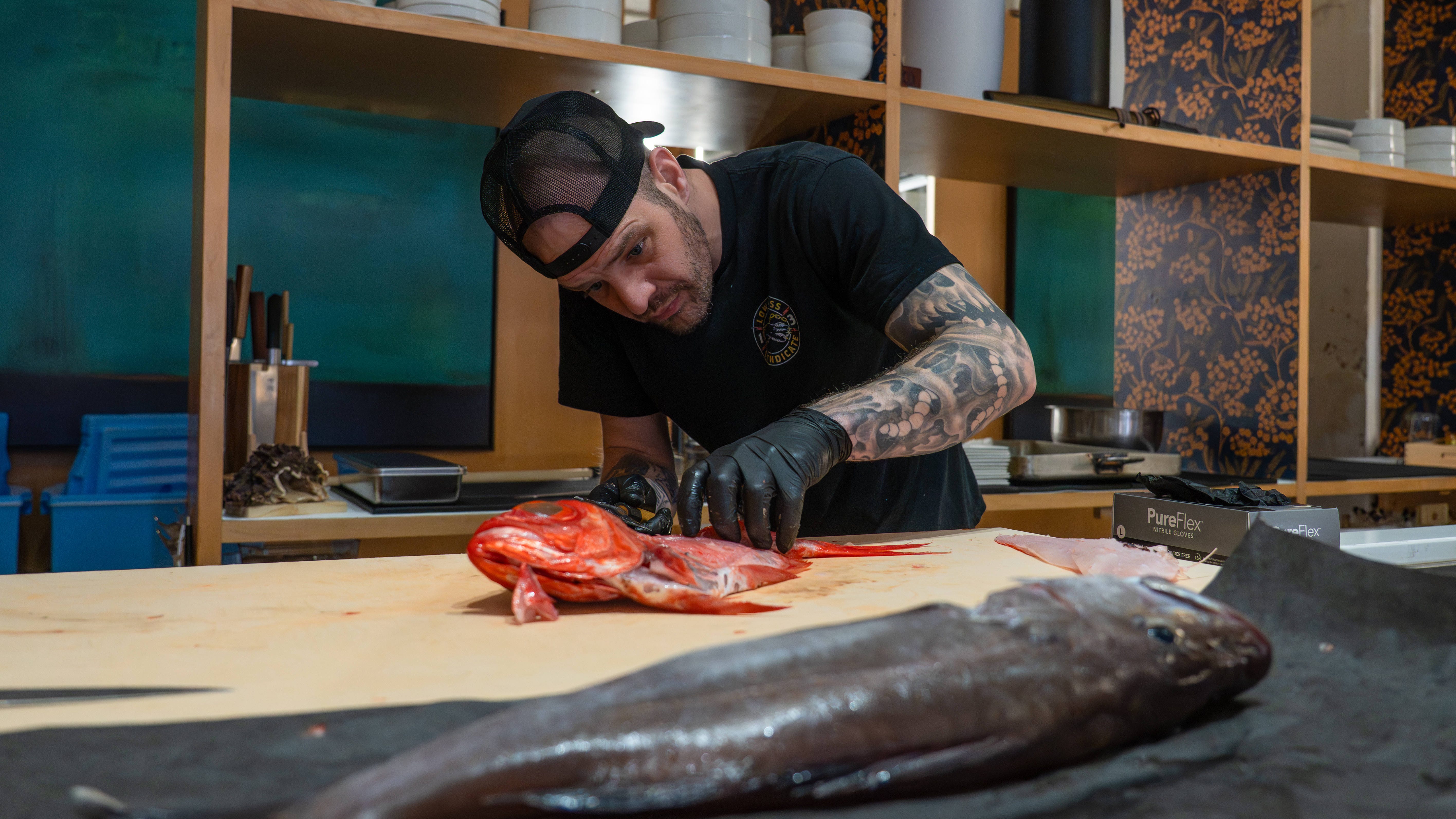

See Masao chef Nick Hanke prepare fresh sushi
Masao chef Nick Hanke believes respect and deliberate care makes for higher quality sushi. See him in action in his kitchen.
For the Register
Chefs Nick Hanke and Phil Shires opened the Des Moines restaurant Masao in May 2025.The restaurant features an ever-changing menu of French and Japanese dishes using unique, seasonal ingredients.Hanke and Shires were named 2026 James Beard semifinalists for Best Chef Midwest.Masao honors Hanke’s mentor, master sushi chef Mike “Masao” Miyabi, by continuing his traditional techniques.
Lionfish. Rabbit. Saw-edged perch. Himalayan morels. Those are among the ingredients the restaurant Masao has showcased in Des Moines since opening in May 2025.
“Those mushrooms have barely been out for five minutes, and people are already stopping to look at them,” said Chef Phil Shires.
He had just plated a bunch of the morels and placed them in a nice patch of sunlight by the window. Someone walking outside paused for a second, taking a closer look, before scurrying on their way.
Shires was happy to see his ingredients catching people’s eyes. It’s a callback to the restaurant’s early days: people stopping in because they saw a curious dish through the window.
It’s been about two months since Shires, 45, and Hanke, 39, were announced as semifinalists by the James Beard Foundation for Best Chef Midwest on Jan. 21. And it’s nearing the first anniversary of their partnership.
Masao honors Hanke’s mentor of 20 years, Mike “Masao” Miyabi, a master sushi chef who associated with legendary chefs in Hollywood. The pair worked together at Miyabi 9. The former space now houses Masao.
The Des Moines dining scene didn’t know what it had before Miyabi retired, Hanke said. The careful, meticulous techniques Miyabi used were becoming obsolete — replaced by quickly prepared takeout sushi — something that pushed him out of the food scene in Los Angeles. “Now I’m in freaking Des Moines, bringing back his Edo-style traditional and fighting the very new age sushi that took over what he was doing in the first place,” Hanke said.
The restaurant, pronounced mah-SAOW, is their love project for Des Moines. Known for unique, ever-changing menu of Japanese and French dishes, the chefs want to make sure the flavor of their ingredients shines through.
“We’re bringing New York Michelin-star-level ingredients to Des Moines,” Hanke said. “Why should people have to go that far away to get that?”
What is Masao?
Fast forward 10 months, and the pair has kept its flair for experimenting on the fly. “A trial by fire,” Shires said.
“It’s been riding on faith this entire time,” Hanke said.
The Masao menu is a collection of dishes, somewhere between the size of a small plate and an entrée. The list changes daily, depending on which ingredients are in season and what the chefs are able to procure.
Masao is not quite a test kitchen, as chefs know it in the industry, but Hanke and Shires are testing out recipes live with customers who come in. As people are dining, they’ll sometimes hand out amuse-bouches, small tastes, or have waiters offer off-menu options at the table.
“We have blinders on to the peanut gallery of what other people think,” Shires said. “We want to have our personalities as who we are as humans, as well as the food.”
He said five people have cried when they’ve tasted his lavender eggs, a dish that’s won Midwest Living’s Best Dish in the Midwest award. Diners told him the dish reminds them of going to the south of France in the summer.
Masao is a true partnership, with Hanke staffing the front-facing sushi bar, and Shares in the back with the stove. The James Beard nomination reflects that partnership — both chefs were named semifinalists.
“It was pretty dope that both of us got it together. It wasn’t just like, he got one or I got one. It was, we both did,” Shires said.
Nick Hanke is continuing master sushi chef Mike Miyabi’s legacy
Most of Hanke’s life has revolved around fish. His family has owned Waterfront Seafood Market, which now has locations in West Des Moines and Ankeny, since 1984.
But Masao is more than just a place where he can show off his skills as “the fish guy.” It’s also a testament to Miyabi’s legacy.
Miyabi’s family was part of a large produce company in Japan, Hanke said. He became a master chef in order to teach people how to properly use its ingredients, eventually owning his own restaurant on Sunset Boulevard in Los Angeles. Miyabi is among the legendary names in sushi like Nobu and Katsuya.
Hanke’s family met Miyabi at Seafood Expo, the largest seafood trade exhibition in North America. When Miyabi saw then 20-year-old Hanke working in the store — only two weeks into training — he asked Hanke if he wanted to train weekly in his home kitchen.
“He was that first person, other than my parents, who really saw something in me,” Hanke said. “I wouldn’t be in food if it weren’t for him. … He grabbed me up and was like, ‘I’ll teach you real sushi.’”
After 20 years of working together, Miyabi called Hanke his No. 1 student. At first, Hanke thought Miyabi was just stroking his ego. But he later discovered that Miyabi had been letting him in on the deeply coveted secrets of his trade.
When Miyabi retired, Hanke didn’t have the funding to take over the restaurant, and the space went to another owner. But the landlord contacted Hanke when that business closed. He had a second chance to continue Miyabi’s legacy.
“I had no money whatsoever. I had no plan. But I was like, ‘I’m not losing this space. We’re doing it,’” Hanke said. “Statistically, we should’ve been closed at six months and owing people money.”
To him, being the owner of Masao still doesn’t feel real. He’s just doing what he’s always done with Miyabi.
“I don’t know what it would feel like to not be able to walk in here and have it be somewhat of his legacy,” Hanke said.
Specialty Japanese fish on rotation at Masao
Part of what Miyabi taught Hanke was about respecting the fish.
Hanke can tell you exactly which docks his fish came from, how much it was handled by different workers, how it got to Masao and more.
He’s willing to pay top-dollar to be able to bring specialty fish to Des Moines.
Places like Waterfront are able to keep costs down for ingredients because they can buy large quantities, “or you’re going to be a crazy person like me, who’s willing to do the footwork and definitely pay more” to buy just a few fish at a time, Hanke said.
“There’s a reason why it’s not common,” he said.
But he said dinners can taste the difference when a fish has been carefully handled.
“This is when I know Miyabi had definitely Miyabi’d me,” he said. Hanke now pays attention to every tiny detail, from the way the fish is laid out in the tray to the way salt is sprinkled on it, thanks to Miyabi’s insistence that the final product be more than the sum of its parts.
Sometimes, he’s able to bring in live fish, the ultimate way to eat seafood. By butchering the fish in the restaurant, Hanke reduces the amount of time in which the quality of the fish could deteriorate. Through a fish broker, he orders live king crab, eel, sea urchins, scallops, ingredients few other restaurants in Des Moines chose to use.
Masao wouldn’t exist without both Nick Hanke and Phil Shires
Shires has experience timing recipes and ingredients to the seasons. He riffs on traditional French recipes to create dishes like braised rabbit with apple cider and potatoes.
“I let him do whatever he wants, really. Why would I stop that?” Hanke said. “He’ll say, ‘Thank you for letting me do my thing and what I want to do.’ And I’m like, ‘Nah, man, thank you.'”
But most of all, Hanke appreciates the person Shires is. Hanke said Shires has the “same want for things to be done well, for people to be happy, for people to be taken care of.”
“He just brought a whole ‘nother light that I didn’t realize existed. It wouldn’t be the same if I would have started this with anybody else,” Hanke said.
Masao is ‘one last go’ for two-time James Beard nominee Phil Shires
“The universe aligned with Nick,” Shires said. “Nick has his faith and his trust in me because we’ve known each other for so long. He knows what I’ve been doing. He loved the food that I had always made.”
Shires has been nominated before for James Beard’s Best Chef Midwest, back in 2014, when he was working at Cafe di Scala (now the restaurant Aposto). That was also before two carpal tunnel surgeries and multiple epidurals in his shoulder.
Early in his career at Des Moines’ La Mie Bakery, he didn’t have a sous chef to help him with prep. He was alone in the kitchen, working and kneading around 200 pounds of dough a week for more than 10 years. He was also opening, taking orders, making orders, closing, cleaning alongside other staff.
His body gave out. In 2017, he stepped down as a chef, but wanted to remain in the industry. Other chefs have asked him to join their kitchens, but he had to turn them down to avoid stressing his injuries.
But things were different when Hanke approached him in April 2025. Shires said Hanke emphasized the “we” in working together.
“It was just like, ‘you know what? I got you. I can help you,’” Shires said. “At first, it was, ‘I can help you wherever I can.’ And then it was, ‘you know what, I’m in.’ This seems like it’d be the best place to give it one last go.”
Shires is not looking to create, say, a regimented steakhouse experience where shirts are all buttoned up. Masao’s got more of a backward hat on, wearing some Vans or Chuck Taylors, Shires said.
And he doesn’t have to do it alone.
“We’re going to fall together. We’re going to win together. We’re going to lose together. We’re going to pick each other back up,” Shires said.
What’s next for Masao?
Both Hanke and Shires are thrilled that their efforts have been recognized by the James Beard Foundation.
Since the nomination, the restaurant’s website traffic jumped by almost 1,000%. They’ve got at least one table booked until mid-April.
As the weather begins to warm up, Shires said they’ve thought about sprucing up their patio space. They’re throwing around ideas for a patio-specific menu.
For Hanke, things have never fallen into place like this before. Every time an obstacle comes up, Hanke said, a solution would pop up out of nowhere.
“I’m telling you, we’ve even talked to people like, ‘Will you do another one?'” Hanke said. “You couldn’t do this again. We couldn’t do another one. This wouldn’t work without all the things that just came together the way they did.”
Lucia Cheng is a service and trending reporter at the Des Moines Register. Contact her at lcheng@gannett.com or 515-284-8132.
Dining and Cooking