
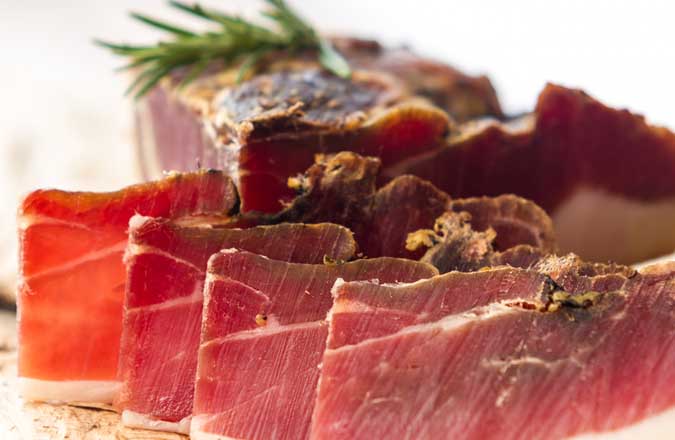
Lo Speck Alto Adige PGI It stands out in the European cured meats panorama for its biochemical profile characterized by a high density of micronutrients, with significant contributions of noble proteins, minerals, and B vitamins. This nutritional identity reflects a production method that blends traditional Germanic cold smoking with the natural curing typical of the Mediterranean area, offering a sensory and analytical balance unique in the global processed meat market.
Alpine excellence in the global market: the numbers behind its success
Il XXIII ISMEA-Qualivita Report on the DOP Economy (2025) places Speck Alto Adige PGI at the thirteenth place among Made in Italy foods with Geographical Indication in 2024, with a certified production of 12.669 tonnes, a production value of 114 million euros, a consumer value of 279 million euros and a value at export of 45 million euros, + 12,8 % compared to 2023.
In 2025 they were certified 2.551.323 whiskers of Speck Alto Adige PGI, equal to 39,2% of the total production of the companies belonging to the Consortium. On the promotional front, the Consortium – which in 2026 celebrates 30 years since the PGI recognition – has invested in the ‘UneSpeckted’ television campaign and in the partnership with the Milan Cortina 2026 Winter Olympic and Paralympic Games, which offers an international showcase for the brand.
A medieval legacy of smoke and salt: the roots of Speck
The first documentary evidence of speck dates back to the beginning of the Two hundred, when in South Tyrol it was already practiced meat preservation through smoking and air drying. During the Middle Ages, in the Alpine valleys, preservation techniques based on dry salting and smoking light: Alto Adige, a crossroads between the Latin and Germanic worlds, was able to integrate the Mediterranean-style curing process with the Nordic use of smoking. Speck thus became an essential food for rural mountain communities, appreciated for its shelf life and high energy content. IGP denomination It was recognized in 1996 by Commission Regulation (EC) No. 1107/96, officially establishing the link between the product and the territory.
The specification: technical parameters and certified quality criteria
Il disciplinary The current regulation – approved for non-minor amendments by Regulation (EU) 2017/119 and last updated on 20 October 2025 (MASAF, 2025) – defines each production phase with technical and legal precision.
La name ‘Speck dell’Alto Adige’ (Italian), ‘Südtiroler Markenspeck’ or ‘Südtiroler Speck’ (German) is reserved for the product that meets the requirements of the specification (specification, article 1 – Denomination).
La processing area includes the entire territory of the Autonomous Province of Bolzano – Alto Adige (Südtirol. Article 2 – Area of production).
Raw material
Alto Adige PGI speck is produced with boneless pork legs, trimmed with or without topside (art. 3 – Raw material). The legs must come from pigs born and raised in the European Union, be delivered fresh and have a minimum weight of:
10,5 kg before boning, in the case of whole legs delivered with bone;
5,2 kg, in the case of boneless and trimmed legs (also called ‘whiskers’).
The fat portion should not be ‘greasy, or soft in consistency, or yellow/orange in colour’. The lean portion must be ‘free of stretch marks or tears between the
muscle bundles’ (art. 4 – Processing method).
Method of production
‘«Speck Alto Adige PGI» is obtained from the boneless pork leg, moderately salted and flavoured, «cold» smoked in special rooms
special, at a maximum temperature of 20°C and well seasoned according to local customs and traditions’.
The boneless pork leg must be subjected to the following treatments:
trimming according to the traditional method;
salting and flavoring dry, within
six days from the start of processing, with an express prohibition on subjecting the legs to any type of churning or syringe;
smoking in special rooms, using non-resinous wood and natural aromatic herbs (with the use of synthetic products prohibited), at a temperature not exceeding 20°C;
aging, through the use of specific
wrapping and protective films intended for food use, after reaching the minimum prescribed weight loss;
seasoned at an ambient temperature between 10 and 16°C and a humidity between 55 and 90%. The minimum maturation and aging periods vary depending on the final weight of the matured forms (never less than 3,4 kg at the end of processing) from 15 + 20 weeks to 24 + 32 weeks (art. 5 – Aging).
‘The manufacturer is required to adopt recording systems documented which allow the unique identification of the date of receipt of the meat in the establishment, to be understood as the start date of processing for each individual piece, also with reference to the
corresponding homogeneous batch, until the end of the production process’ (art. 4 – Processing method).
Product features
Le organoleptic properties of Speck Alto Adige PGI, at the time of release for consumption, are defined and evaluated on the basis of a series of descriptors, specific requirements and weighting coefficients:
the external appearance of the surface crust and rind of the whole speck, brown in colour;
the internal aspect of the visible muscle section when cut, red in colour with white-pink parts;
the consistency and composition of the muscle portion (evaluated after resting at room temperature for at least two hours);
the smell and taste related to the lean part, deprived of the external crust, for the evaluation of the smell ‘aromatic and pleasant’ and taste ‘characteristic, intense and tasty’;
The whiskers must reach a score of 80/100 evaluation units, which rises to 85/100 for products labelled and presented with the term «Reserve».
Le chemical-physical characteristicsand respect the following composition:
total proteins: equal to or greater than 20%;
water/protein ratio: < 2,0;
fat/protein ratio: < 1,5;
potassium nitrate: < 150 mg/kg;
sodium nitrite: < 50 mg/kg (art. 6 – Features).
Marketing, labelling and controls
‘”Speck Alto Adige PGI” can be sold loose or vacuum-packed or packaged in a modified atmosphere, whole, sliced or diced..
Whole speck that meets the requirements set out in the specification is identified with a mark indelible on the rind, at the end of the maturing process, which bears the central part of the PGI logo – a “bib” with a stylised drawing of mountains in the centre, surmounted by the writing “SÜDTIROL” – and an alphanumeric identification code of the producer.
Le Labels must always report:
la designation of the protected geographical indication «Speck Alto Adige PGI» (Italian) or «Südtiroler Markenspeck ggA» or «Südtiroler Speck ggA» (German), which cannot be translated into other languages. It must be affixed to thelabel in clear characters, ‘clearly distinguishable from any other writing’, and followed by the words “Protected Geographical Indication” and/or the acronym “PGI” to be translated into the language in which the product is marketed;
il logo. of the PGI of «Speck Alto Adige», «Südtiroler Markenspeck ggA» or «Südtiroler Speck ggA»;
il symbol of the Union of the protected geographical indication, pursuant to Regulation (EU) 2024/1143 and subsequent amendments.
Le additional indications permitted on the label, to be reported outside the logo, are:
«bauernspeck», for speck produced with the legs of pigs raised and slaughtered in Alto Adige;
«Speck ham», «Schinkenspeck», «Schinken»;
«with topside», «mit Kaiserteil», «mit Oberschale»;
«handcrafted production», «handwerkliche Herstellung»;
«mountain product», if production takes place in territories located at least 600 m above sea level (art. 7 – Designation and presentation).
The Ministry of Agriculture, Food Sovereignty and Forestry has entrusted the Checks to the independent body IFCQ Certificazioni Srl, starting in 2024.
Beyond taste: nutritional profile and micronutrients
According to the official CREA tables, 100 g of ‘Speck dell’Alto Adige PGI’ provide on average:
Fat: 19,1 g, of which: saturated fatty acids 6,6 g; monounsaturated fatty acids 8,4 g; polyunsaturated fatty acids 3,3 g;
As regards the minerals, Speck Alto Adige PGI is characterised by:
rich in phosphorus: 272 mg per 100 g of product, equal to 38,9% of the Nutritional Reference Value (700 mg) indicated in Annex XIII to Regulation (EU) No. 1169/11;
rich in potassium: 658 mg, equal to 32,9% of the VNR (2000 mg);
source selenium: 15 µg, equal to 27,7% of the VNR (55 µg);
source Zinc: 2,5 mg, equal to 25% of the VNR (10 mg).
The contents of vitamins Also worthy of attention are:
wealth in Thiamin (vitamin B1): 0,41 mg, equal to 37,3% of the NRV (1,1 mg);
wealth in Vitamin B6: 0,47 mg, equal to 33,6% of the VNR (1,4 mg);
presence of niacin (B3): 4,10 mg, equal to 25,6 of the VNR (16 mg).
2030 Goals: Animal Welfare and Energy Transition
Speck Alto Adige PGI is distinguished by a sustainability strategy launched by the Consortium for the Protection of Speck Alto Adige in 2019, which integrates animal welfare, greening of production processes, and contribution to the United Nations Sustainable Development Goals (SDGs). Since 2020, a dedicated working group has defined concrete measures such as the introduction of verifiable standards for animal welfare starting from 2024, the gradual transition torenewable energy (photovoltaic, biomass, biogas) with monitoring of electricity consumption to reach significant shares by 2025, and the use of Eco-friendly packaging and optimized transport. Furthermore, the Consortium promotes theThe circular economy regional through the valorization of local resources, collaborations with typical South Tyrolean products such as wines and cheeses, and initiatives to attract young talent to the sector, confirming a consolidated commitment in 2025 with production growth and new monitoring parameters for an increasingly transparent and innovative supply chain.
Signature cuisine and pairings
Speck Alto Adige PGI is extremely versatile, both in Alpine cuisine and in contemporary catering.
Among the most popular combinations: the cutting board with bread rye and cheese, speck dumplings (Speckknödel), Alpine appetizers. In modern cuisine, speck lends itself to gourmet pairings with fresh fruit (figs, pears, melosine), as a seasoning for risottos and stuffed pastas, as a topping for premium pizzas and in fusion preparations.
Advice for international buyers and buyers
For consumers and professionals, selecting speck requires attention to several factors:
verify the authenticity of the product (IGP logo and brand);
favor products with organic certification, which represents the highest standard of animal welfare;
consider products with the lowest salt content.
For international buyers, the team of GIFT – Great Italian Food Trade offers expert support in identifying certified producers, verifying regulatory compliance, and developing solid and transparent business relationships.
Conclusions
The value of Speck Alto Adige PGI lies in the consistency of its analytical parameters and the ability to integrate intrinsic nutritional quality with new ethical production requirements. The adoption of rigorous animal welfare standards and a commitment to energy transition consolidate this cured meat’s role as a benchmark for international retail. For industry professionals, the PGI mark is a guarantee of origin and confirmation of a technically superior product, capable of meeting modern health and sustainability demands.
Bibliography
Commission Regulation (EC) No 1107/96 of 12 June 1996 on the registration of geographical indications and designations of origin under the procedure laid down in Article 17 of Council Regulation (EEC) No 2081/92. Consolidated text: 20/11/2008 http://data.europa.eu/eli/reg/1996/1107/2008-11-20
Commission Implementing Regulation (EU) 2017/119 of 13 January 2017 approving non-minor amendments to the specification for a name entered in the register of protected designations of origin and protected geographical indications [Speck Alto Adige/Südtiroler Markenspeck/Südtiroler Speck PGI]. http://data.europa.eu/eli/reg_impl/2017/119/oj
MASAF – Ministry of Agriculture, Food Sovereignty and Forestry. (2025, October 20). Ordinary amendments to the production specifications for the protected geographical indication (PGI) «Speck Alto Adige» (25A05800). Official Journal of the Italian Republic, General Series no. 253 of 30/10/2025. https://www.gazzettaufficiale.it/eli/id/2025/10/30/25A05800/SG
Regulation (EU) 2024/1143 of the European Parliament and of the Council of 11 April 2024 on geographical indications for wine, spirit drinks and agricultural products, as well as traditional specialties guaranteed and optional quality terms for agricultural products. http://data.europa.eu/eli/reg/2024/1143/oj

Dario Dongo, lawyer and journalist, PhD in international food law, founder of WIISE (FARE – GIFT – Food Times) and Égalité.
Dining and Cooking