
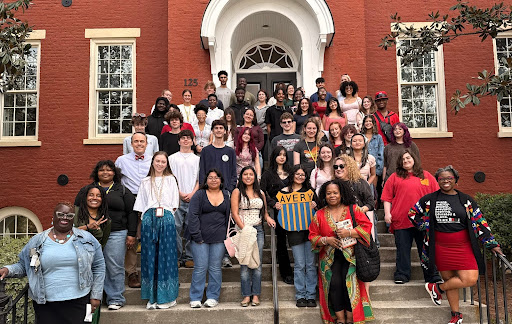
At an archives in Charleston, South Carolina, one day last month, a group of high school students sat around a table, newspaper clippings scattered before them. The articles, some decades old, described what a legendary community of formerly enslaved Black people and their descendants ate — and how they cooked it.
As Erin Polite, one of the students from the nearby Charleston County School of the Arts, scanned the clippings for her project, one caught her eye: a photo of bags filled with lima beans.
The image reminded her of time spent with her parents, soaking the beans before cooking them in a crockpot. But it also brought to mind what her ancestors might have eaten — pig tails and turkey necks that the white people who owned them tossed aside.
“I just thought, ‘I don’t know anyone else who makes lima beans other than people down here,’” she says.
RELATED: The Best Things to Happen to Black People in 2025
How Can Zines Keep the Gullah Geechee History?
The “down here” Polite referred to is South Carolina’s famed Lowcountry, the oceanfront home of the Gullah Geechee people. And her project, funded by a grant from an organization that supports English and language arts, is to use modern storytelling techniques — zines, do-it-yourself collages, and artwork — to document Gullah food and recipes before time steals them away and the loss of their ancestral homes.
“I think that it’s definitely a communal memory practice as students are thinking about what they’ve seen, but also memories that they’re also trying to like hold on to and or create for themselves,” Tamara Butler, the executive director of the Avery Research Center says. The students were using materials from the center to build their zines.
Patrick Martin, an English literature teacher at Cheslton County School of the Arts, who secured the Anne Frank Award for Teaching Memoir, said his goal was to bring students into a space where stories are kept. The grant made it possible to create an immersive, place-based experience rooted in real voices.
“My hope was that they would leave not only with knowledge, but with a sense of responsibility and desire to document, preserve, and contribute to the ongoing story of their own communities,” he wrote in an email to Word In Black.
RELATED: Scholars Turn Black Studies From Resistance to Renaissance Amid Scrutiny
This project comes at a time when literary skills for Black students are in decline, and when the Trump administration is erasing Black history.
At the same time, the center was working on a project funded by a $2 million grant it had secured from the Mellon Foundation. For the grant, the center was in the midst of republishing the fifth edition of “Treasure Recipes,” a cookbook featuring Gullah Geechee recipes.
‘Losing Recipes’: How Gullah Cuisines Are Lost
Often known as just Gullah, those from the Gullah Geechee community are descendants of enslaved Africans from West and Central Africa. White settlers brought them to the southeastern coast — the Carolinas, Florida, and Georgia — to labor on rice, cotton, and indigo plantations, according to the U.S. National Park Service.
Unlike other populations of the formerly enslaved, who were forced to more completely assimilate, the Gullah people have retained much of their African culture and language. That includes food: rice and seafood, including shrimp, oysters, crab, and fish, are staples.
RELATED: Bringing Black Studies to Black People
But Butler, the Avery Center executive center director, says the cherished recipes are gradually being lost to history as elders pass away. Exacerbating the problem: the Gullah are losing access to their land to urban sprawl and unscrupulous developers and realtors.
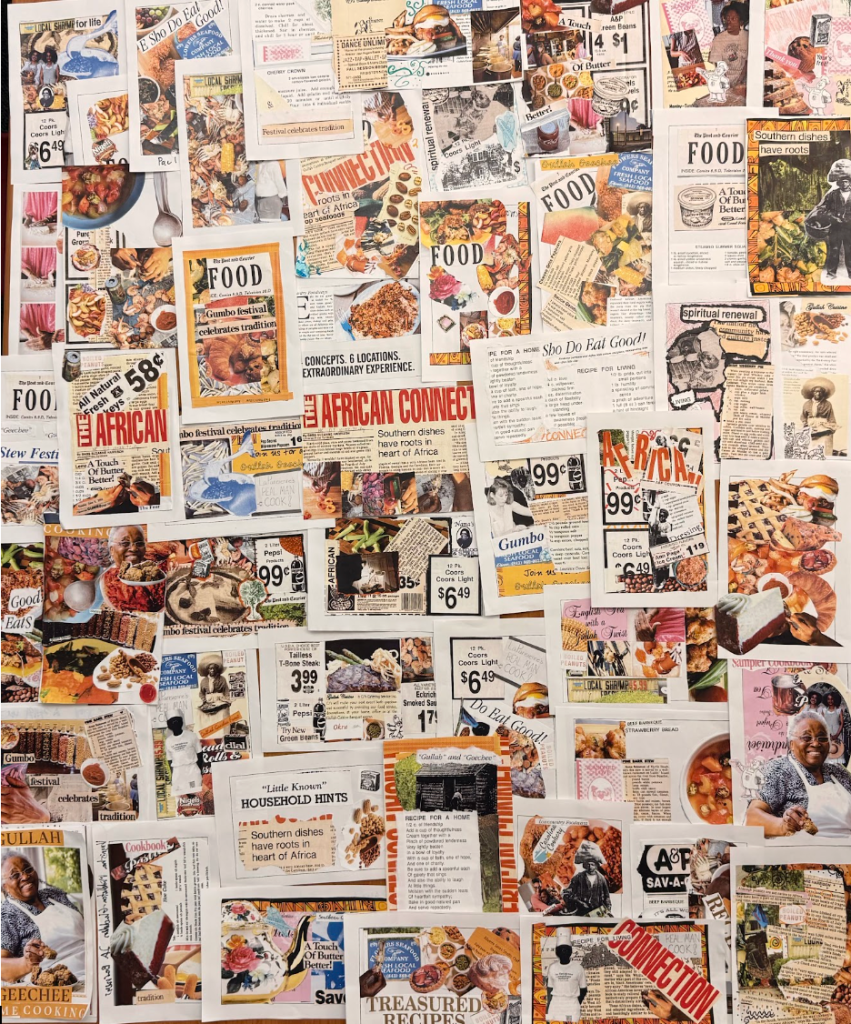 Student-created zines made from collage materials and archival images reflect what students learned about Gullah Geechee foodways and cultural memory (Courtesy of the College of Charleston).
That’s where the students come in. They are using the resources of the archives to make zines. The Black feminist practice of making pamphlets with common household items is a way to preserve the communal memory of Gullah recipes for future generations.
“Food is a big part of our community, and I feel like that’s something that brings us together in our culture,” Cameron Hazel, a senior at Charleston County School of the Arts, says. “It’s very sacred in a way. Food recipes [are] something that has been carried on from generations, too. It kind of explains why it’s really good because it’s been kept on for so long.”
The zines, made from collage materials and archival images, illustrate how the Gullah shared understandings of history, passed down from generation to generation. The zines feature brightly colored foods — chicken, croissants, blueberry pies, and vegetables — sprawled across pages next to texts advertising their existence. In bold, the words “RECIPES,” “THE AFRICAN CONNECT,” “FOOD,” GULLAH,” AND “GOOD EATS” pop out.
RELATED: School Districts Push for Black Studies
Some images of people, an elderly Black woman with gray in her hair, smiling, stand out. Another black-and-white image of an old farmer wearing a large hat to block the sun is placed next to images of green, luscious vegetables.
Donte Foxworth focused his zine on recipes he’s never heard of before, such as tomato fritters, whole cake, strawberry cake, and barbecue beef. Meanwhile, Hazel’s zine featured spices used in Gullah Geechee dishes.
Butler said she was excited that the students had the chance to understand the role of Gullah Geechee foodways in African American history and how these cuisines made the students feel at home.
“History is not all of these major change makers writ large somewhere else, but it’s actually that this is a place where you can be a part of the history, a part of the storytelling,” she says.
Dining and Cooking