
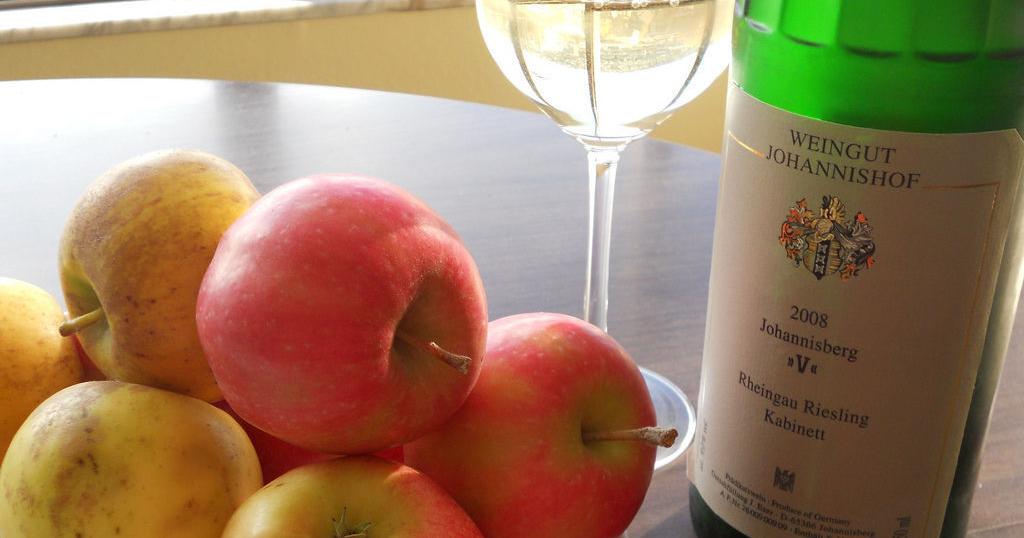
Apples and riesling, riesling and apples. As a pairing, they’re one of my favorites.
Autumn is an excellent time to be drinking Germany’s most famous white wine, the best of which have bracing acidity to balance out a touch of sugar.
Last weekend, my wine group tried a half dozen rieslings as part of a loosely inspired, Oktoberfest-themed wine tasting. It reminded me how good both riesling and fall fruit can be.
My friend David, hosting with his girlfriend Lauren, donned lederhosen and dubbed our tasting OktoberWINEfest. (Why should beer drinkers have all the fun?) We decided to taste both wines from Germany and German varieties made elsewhere in the world.
The food was Germanic too: warm potato salad; a sweet and sour purple cabbage; a riff on spaetzle (noodles) with caramelized onions; a simplified beef rouladen with bacon, onion and pickles.
Though riesling carried the day, we didn’t start there, instead beginning with a spätburgunder brut rosé. Spätburgunder (SHPAYT-bur-GUHN-der) is what pinot noir goes by in Germany, and this pretty pink bottle of 2010 Messmer spätburgunder ($33 at Square Wine Company) had classic aromas of strawberry. It was surprisingly ripe, almost like a California rosé.
A 2014 gewürztraminer from Carlson Vineyards in Colorado ($17 at Brennan’s) was, we were told, made in a German style. But I found it unlike any gewürz I’d ever had, with a steely quality and little of the expected flower garden perfume. Some tasters said they got petrol or acetone on the nose, others got nectarine, or stone fruit, at the very end.

Red wines from Germany are a bit harder to find in Madison but we tried several, including a pinot meunier and a pinot noir.
PHOTO BY LINDSAY CHRISTIANS
I adore riesling from the Finger Lakes, and the 2014 Ravines dry riesling ($16.99 at Riley’s Wines of the World) presented a perfect example of why. A refreshingly tart white, this wine had very little residual sugar and flavors of sour apple, with a higher alcohol level than some at 12.5 percent ABV.
Give this bottle to someone who thinks riesling is sweet and only sweet and watch what happens.
“This tastes like Rosh Hashanah — apples and honey,” said my friend Leah, tasting the 2013 Michel Fonné riesling from Alsace, in France. A friend dug this one out of his cellar, but Alsatian riesling is fairly easy to find in Madison and often very good, dry, delicious and food-friendly.
One of our newer tasters said she got “beeswax” in this one. Another said rye bread, or caraway.
The notes for the next wine got a little weird. To some, the 2011 Dr. Pauly Bergweiler riesling kabinett from Wehlener Sonnenuhr (mid-$20s) had a smell some described as “new plastic” and others thought was more like crayons or (seriously) “fresh bike grease.” Also: sugar.
Kabinett is technically the least sweet of the German classifications, below spatlese and auslese, but this one packed a sugary punch. Worth noting, too, is that the petrol aromas often blow off after a wine has been open for awhile.
I’m consistently a fan of Selbach-Oster’s rieslings, which are fairly easy to find in town. The 2007 Selbach-Oster Zeltinger Schlossberg riesling spatlese ($33 at Steve’s) was so pretty, a golden-well-aged riesling with flavors of honey and golden raisins. One taster called it, approvingly, “adult apple juice.”
David Sanborn hosted a tasting of wines from Germany and German varieties grown elsewhere. He discovered this riesling from 1980 in his parents’ basement. It was still delicious.
PHOTO BY LINDSAY CHRISTIANS
Finding a great red wine from Germany isn’t the easiest thing to do in Madison, but we rounded up a couple for this tasting on principle. The woman who brought the 2014 Darting pinot meunier ($17.99 at Steve’s on McKee) went to three wine shops before finding her bottle, made from one of the three primary grapes in Champagne. It was a light red, with high acid and mild tannins, a good pairing with much of the savory food.
Two people brought the 2012 Messmer pinot noir ($17 at Square Wine Company and Steve’s), a screwcap wine that had some off flavors many tasters didn’t care for. Both bottles were thin, funky and almost effervescent. One woman leaned over to me as I was taking notes and whispered, “dirty socks.”
After tasting a white wine that had aged for a full 36 years (!) in David’s basement, a 1980 Buena Vista riesling that had gone brown, plummy and sherry-like, we ended the tasting with dessert in a bottle.
A teensy tiny bottle of 2006 Dr. Loosen Beerenauslese ($21 at Steve’s for 187 mL) smelled like honeycomb and pear. It tasted like golden raisins, with the barest edge of acidity.
And the final wine came from Canada, a 2006 bottle of Mission Hill Five Vineyards ice wine riesling that tasted, despite relatively low alcohol (9 percent), like fortified wine. With a blush-brown color and a viscous, sticky texture, it went beautifully with the apple tart I brought.
Riesling and apples, apples and riesling. I’m so glad it’s fall.
Dining and Cooking