
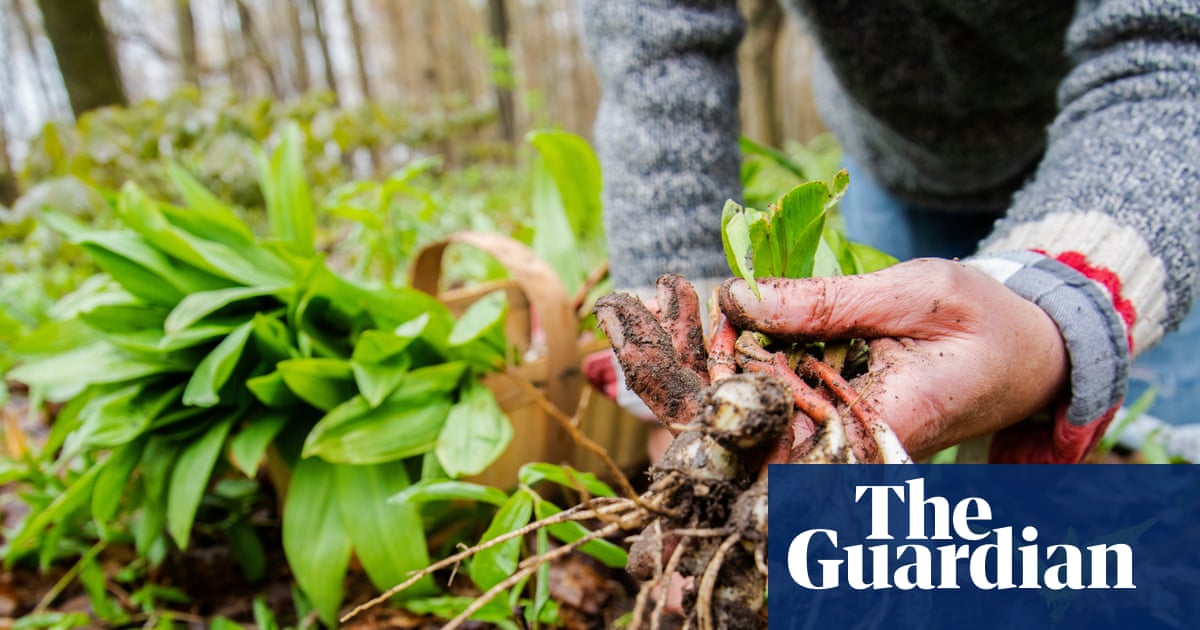
When I called Robin Greenfield, an environmental activist and author, his assistant answered. “We’re stopped really quick,” Marielle said, adding “he is harvesting a ton of wild onions right now. He’ll be on in just a minute.”
I waited, curious to see his haul and bemused by his willingness to delay an interview for wild vegetables. I had called Greenfield, who wrote Food Freedom about the year he grew and foraged 100% of his food, to talk about how possible, or hard, it is to do just that.
Foraging is not entirely new for me. I’ve done it for about a decade, long enough to know which patches of woods near my house will give me ramps in April and to harvest delicate mulberries during the two weeks they’re around in June. This year, as I’ve been watching grocery store recalls pile up and food prices climb, I keep wondering how much longer I can rely on the system from which I feed myself. Could I actually step away from all of it? Not just supplement with a few foraged greens here and there, but really solely feed myself this way?
Greenfield’s been living the answer to my question since October, with no garden, seven years of experience behind him, and traveling a route that follows the seasons: Maine in fall, Florida in winter, Georgia in early spring, foraging as he goes.
He spent three months preparing. He moved back to his homeland in northern Wisconsin, set up a base he calls the Hermitage and started calculating how many pounds of each food he’d need for each season. He harvested 75 pounds of wild rice, 200 pounds of mushrooms and 42 quarts of applesauce. His preparation still had gaps: barely any fish, fewer stored vegetables than he’d planned and not a lot of berries due to a poor season.
When Greenfield got on the video call, he lifted the blanket in the back seat. There it was, a row of mason jars wedged between his bags, a traveling pantry of wild rice and venison, wild yams and ocean salt, moving down a Georgia highway. “The only way to live off of a fully foraged diet,” he said, “is to harvest the abundance when you find it and then preserve that abundance”.
Time is everything here. When to harvest, how long you have before it goes bad, and how many hours you can give to the work of preserving it.
‘Time is everything here. When to harvest, how long you have before it goes bad, and how many hours you can give to the work of preserving it.’ Photograph: RoxiRosita/Getty Images
“I would say it’s in the realm of a full-time job to harvest all of my food and medicine,” Greenfield shared. Some weeks, that’s 20 hours, and that includes eating; some weeks, 60 to 80. Right now, he’s out of fruit and won’t have any until he gets back to his Wisconsin pantry in April. He has people who help him process and preserve what he harvests, participants in the workshops he gives, and volunteers who are part of his teaching work. The system works, but it doesn’t run on its own.
Most of us don’t have a system or helpers – and wouldn’t know where to start. I still live inside the food system. I supplement ground beef from a local butcher with a rotating cast of seasonal greens, mushrooms and wild alliums. I stretch what I find past its peak with preserves, infusions and pickles. Even cooking for one is a constant dance of procurement, preparation and preservation, while working for myself is its own balance. One missed day, and that plant goes from possibility to mush.
It’s now “false spring” in New York. A few warmish days, and you see green patches pushing through gray soil. That greenery could one day be a plant you can name and eat, but you have to know what’s what. It took almost 10 years of looking to recognize crow garlic’s specific shade of green or how to harvest stinging nettles with my bare hands.
When I called Linda Black Elk and her husband, Luke, they were just pulling out of the Hmongtown community food market in Minneapolis. Linda is an ethnobotanist and food sovereignty activist who serves as education director at the North American Traditional Indigenous Food Systems (Natifs) non-profit. Luke is a Lakota chef and food sovereignty activist. They both have nine-to-five jobs, and a large share of their family’s diet still comes from what they’ve hunted, fished, gathered and traded.
Linda told me: “I do not believe that whole idea of every man for himself homesteading out in the middle of the woods. I do believe it’s possible, but I believe it requires community, especially now, when we have to increase land access and we have to increase knowledge.”
One year, when the family couldn’t go wild ricing, they turned to Jack, an elder from the Red Lake Reservation who harvests every year. They traded prairie turnips for some of his wild rice. They also bought some. “He also needed money,” Linda said. “You kind of have to be OK with those types of things these days because people have bills to pay.”
Linda didn’t always see it that way. As someone whose career has been rooted in public health, she spent years taking what she’d describe as a militant stance, “almost mean”, she said. Her position then was: “Down with whatever processed food, that’s the food of the oppressor, and no one should be eating that. We need to eliminate this and eliminate that from our diets.”
As she got older and became a mother, she softened that hard line. “I love me some cheese, and I love brownies,” she said. “Sometimes when I’m having tacos at a restaurant, I will do anything for a Coke in a bottle. Saying that other people can’t have that comes from a place of privilege.” She realized it was less about eliminating things from their diet and more about what they could add. Sometimes you have to be gentle with yourself and with others.”
Even with that gentleness, the work is constant. Every harvest has a window, and for the Black Elks, catching it means using whatever free time they have. “That’s our vacation time, that’s our PTO time,” Luke said. “But it’s a necessity for our family food system, and so we make time for it.” In June, they harvest prairie turnips, also known as timpsila, in South Dakota. In July, North Dakota for chokecherries. August, wild plums. October, southern Minnesota for wapato (wild potatoes). The family spends one hour a day, all five of them, forwarding food sovereignty in their community, even if that means helping someone else with theirs.
What foraging requires, Linda says, is a relationship with the land itself that most people have never been taught to build. “You can’t take and take and take and expect things to be healthy. It has to be reciprocal, and it has to be sustainable.”
Black Elk was talking about sustainability as it relates to the land, but there’s also the question of whether a foraging-only diet can sustain the body.
Jessica Brantley-Lopez, a registered dietitian, said that while a foraged diet can be nutrient-dense, it’s not realistically viable for the average person in the long term. “It requires a high level of knowledge to safely identify foods and significant time and effort to meet basic calorie, protein and fat needs, especially without consistent access to specific plants, wild game or fish. Seasonal availability and environmental limitations also make it difficult to obtain a complete range of essential nutrients like B12, vitamin D, iodine and iron.”
Brantley-Lopez’s assessment is clinical, but Greenfield has a different perspective. “All of my needs are met. You got your calories, your fat, your protein, but also the herbs and spices and the herbal teas and the oil and the salt. I don’t always have everything that I want at every moment, but that’s the life that I want to live.”
The Black Elks make it work by planning what they need to feed themselves. “My family eats about 50% wild food at least,” Luke said. “When we go out to get timpsila, we know the number we need to hit for our family. When we’re putting away bison meat, we know we go through about a pound and a half of ground bison per meal. Just being able to budget those things out and make a list of what you need and working towards that.”
I still couldn’t tell you with confidence that I could feed myself this way. Not on my own, not without a network of nearby people who do this, and with whom I could trade what I forage, and buy or barter what they’ve sourced.
It’s a way of life that gets built slowly. The Black Elks have spent 15 years doing this. What’s missing for most of us isn’t access to the woods. It’s time, knowledge and community.
I know my limitations, but this spring I am starting where Linda says to start: with what I can add. I am mapping out what I eat in a day, looking at what I can replace with wild-harvested food, and checking it against a seasonal calendar. Some of that means trading with my nephew for enough venison for a household of one. Well-stocked foraging pantries do not come into being overnight; like a community, they grow over time. At this scale, incremental is the only honest place to begin.
Dining and Cooking