
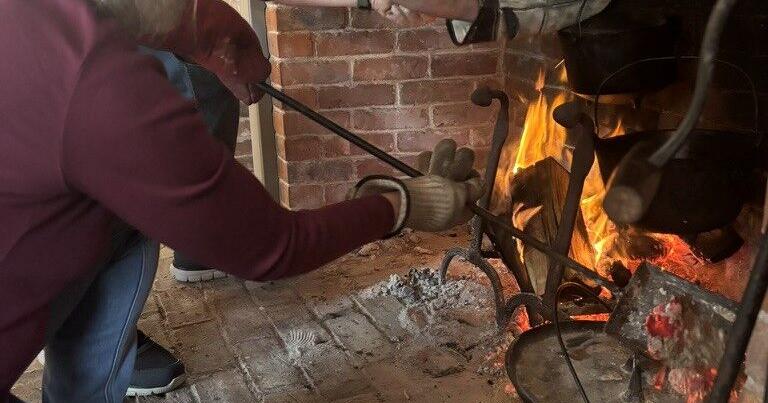
WESTERLY — The last course of the cooking class was done and served around 8 p.m., after five hours of a journey from the 21st century to the 18th.
The cooks had to work without the bare necessities: a stove, fridge and even counter space.
As everyone began to eat their dessert, they toasted all their hard work, and Ellen L. Madison for welcoming them into her home. They joked about the hardships of Colonial-era cooking, and the many steps it took them to get to this moment.
“When you taste the gingerbread, you can taste the history,” said Arlene Piacquadio, one of the participants, filling the room with laughter.
The Colonial fires continue to burn inside the house of Madison, where she committed to hosting a hearth cooking class March 14 following the Colonial Kitchen lecture by Maureen J. Bjorkland at the Babcock-Smith House Museum on March 8.
Madison has a room built to replicate the Colonial era, with her own hearth, beehive oven and authentic Colonial kettles and cast-iron pots. Her home used to be Woody Hill Bed and Breakfast until 2024, and has been in her family for four generations.
Teaching a group of adults with limited prior knowledge to cook like Joshua Babcock is no easy feat. Madison, in only six hours, achieved just that. Laying out a packet of instructions for each participant and a table full of every ingredient they’d need, Madison was just there to teach.
“You guys will be doing all the cooking, not me,” Madison said to participants when they first arrived.
The meal consisted of three courses; the first including Abigail Adams’ rum-tea punch, squash soup and skillet corn bread; the second including roast pork, cranberry relish, herbed rice, pear chutney and cornmeal biscuits, and the third Thomas Jefferson’s bread pudding and Mary Washington’s spiced gingerbread, all made from scratch and in a hearth or beehive oven.
One of the first dishes, the skillet corn bread, had to be adjusted due to the heavier, more moist white cornmeal in the Colonial era. Instead, JIFFY mix made up the batter that was then poured into a spider skillet, greased “heavily heavily,” as Madison emphasized in all capital letters in the instructions.
It was then cooked uncovered over hot coals in the hearth until the edges pulled away from the side of the spider. Once that happened, it was covered with a lid and hot coals placed on top of the lid. It was turned a quarter way every 15 or so minutes until completely baked.
With Madison’s instructions, participants divided and conquered the dishes mostly in pairs. Though many of the participants didn’t know each other beforehand, most of them had attended Bjorkland’s presentation, and now they all worked together fluidly to create the three-course meal laid out for them.
As if it were a classroom and Madison the professor, she instructed participants to search in their packets for the answers as she quizzed them on certain tasks, like how to bake the desserts.
Though all the recipes were from the Colonial era, Madison made sure to include every detail of the instructions in the packet, down to what kind of antique pan a participant should use for the dish.
Other events on Revolutionary history are planned at the museum in celebration of the nation’s semiquincentennial. For more information, visit www.babcocksmithhouse.org.
The Community News Lab is a project of the University of Rhode Island’s Harrington School of Communication and Media (email newslabeditor@uri.edu).
Dining and Cooking