
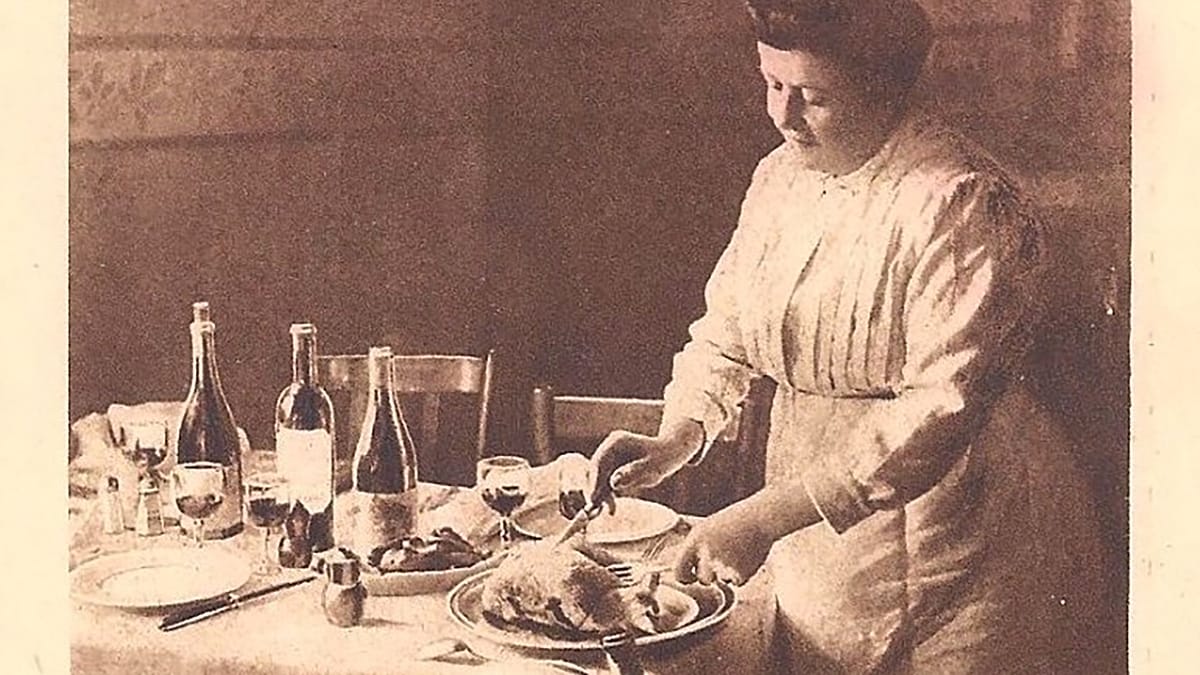
Long before celebrity chefs became media figures, women in Lyon built restaurants, reputations, and culinary standards that helped define French gastronomy.

ADVERTISEMENT
ADVERTISEMENT
Although, legendary males names like Paul Bocuse and Joël Robuchon are widely touted as the forefathers of haute cuisine, in Lyon, however, one of the strongest foundations was laid by women known as the Mères Lyonnaises.
They were cooks, many of them from modest backgrounds, who had worked for bourgeois households before opening their own establishments in the 19th and early 20th centuries.
Their food was rooted in the region and, in time, that cooking became part of Lyon’s identity as a food capital and the beating heart of French gastronomy.
Their influence still runs through French kitchens today.
For many chefs like Nina Métayer, one of France’s most prominent pastry chefs, their story is not just part of culinary history but a constant reminder that women had a fundamental role in developing French cuisine.
One of the most influential mothers was Eugenie Brazier also called “La Mère Brazier” (The mother of modern french cooking).
Having been one of them most well documented mothers, she grew under guidance of older female mentors like Françoise Fayolle, also known as “Mere Fillioux”, and together with other mothers at the time, held the title of Mères Lyonnaises.
A lineage before Brazier
Many people across the 19th and 20th century held the title of Mère like Mère Bourgeois, Mère Fillioux, Mère Bizolon, La Mélie, MèreBrazier, Mère Léa and more.
However in recent history, there are a few who stood out.
Mère Fillioux, is often described as the “empress” of the Mères Lyonnaises.
She helped establish the reputation of the tradition and became closely associated with dishes that are now a part of Lyon’s gastronomical history, especially quenelles and poularde demi-deuil, the truffle-studded chicken that would later become central to Brazier’s repertoire.
In the same era as Brazier, Mère Léa, or Léa Bidaut, opened La Voûte chez Léa in 1943 and became known for rich Lyonnais staples including choucroute au champagne.
Beyond Lyon itself, Élisa Blanc in nearby Vonnas showed that women were also winning Michelin recognition on the strength of regional cooking.
She got Michelin recognition in 1929 and again in 1931, while her reputation later led directly into the Georges Blanc dynasty.
Eugénie Brazier’s early life
Brazier came from a humble background. She was born on 12 June 1895 in La Tranclière, in the Ain department, and after her mother died she worked on farms from a young age.
At 19, pregnant and under social pressure, she left for Lyon and began rebuilding her life there.
In the city, she first worked in a bourgeois household and when the family cook fell ill, Brazier moved into the kitchen.
From there she entered the orbit of Mère Fillioux, where she learned the dishes and rigour of the mères tradition. She applied lessons learned at the Brasserie du Dragon, where she strengthened her reputation before striking out on her own.
Rue Royale: the first restaurant
On 2 April 1921, Brazier opened her first restaurant at 12 Rue Royale in Lyon.
Although small in size, her menu drew on what she had mastered under Fillioux: artichoke hearts with foie gras, quenelles au gratin, sole meunière, chilled caviar, and the now legendary poularde demi-deuil; dishes which put her restaurant firmly in the culinary spotlight.
With Mayor Édouard Herriot a regular and critics like Curnonsky visiting in 1925, La Mère Brazier became one of Lyon’s essential addresses.
The second restaurant & 6 Michelin Stars
By 1928, Brazier had begun spending time at a simple chalet at Col de la Luère near Pollionnay, just outside of Lyon. A year later she opened a second restaurant there, which operated as a rural counterpart to the Rue Royale address.
Michelin awarded both restaurants two stars in 1932 and three stars in 1933. That gave Brazier six Michelin stars at the same time, making her the first chef to achieve that total across two establishments and the first woman to reach that level.
There is no understating the size of this achievement. For a woman from a poor rural background, with no elite institutional path behind her to own not one but two restaurants of France’s highest recognised standard was simply extraordinary.
Brazier thus became one of the first icons of French gastronomy. Her simple flavours grounded in regional produce and ingredients made her a culinary legend in the region.
Her impact on French gastronomy
Brazier’s influence extended beyond her own kitchens.
Paul Bocuse, one of France’s most famous chefs in the 21st century, began his career under her apprenticeship. He emerged from a world the mères had already built.
As Taste France puts it, the Mères’ food was a blend of comfort and refinement, built from slow-cooked meats, rich sauces, seasonal vegetables, and intelligent use of modest ingredients.
Brazier took that base and proved it belonged at the highest level of restaurant cooking. Those dishes like poularde demi-deuil are now considered as authentic French food.
Michelin calls it “the mythical dish of Lyonnaise and French cuisine.”
The dish was passed from Mère Fillioux to Brazier, and then from Brazier to Paul Bocuse and Bernard Pacaud, moving from generation to generation, changing with modern culinary twists.
The Brazier legacy
Brazier passed the business to her son Gaston in 1968 who died in 1974. However, her granddaughter Jacotte Brazier helped maintain the legacy.
In 2008 chef Mathieu Viannay revived the Rue Royale institution. Brazier’s legacy survives as the current menu at La Mère Brazier includes “Artichaut et foie gras ‘hommage à la Mère Brazier’” and “Poularde de Bresse en demi-deuil.”
These dishes are an ode to Brazier and her culinary legacy.
Lyon and the greater region of the Rhone-Alpes continue to treat her as a central figure in the history of Lyonnaise cuisine.
As the number of female French chefs and culinary students increase, the roles of Meres Lyonnaise are important to remember.
Métayer says Eugénie Brazier and the Mères Lyonnaises represent “courage, independence, and transmission,” describing them as pioneers who created their own restaurants and defined their own standards of excellence at a time when women rarely had access to recognition or authority in gastronomy.
Anne-Sophie Pic, one of four female chefs to hold three Michelin Stars, paid tribute to the Méres in an interview with Le Point saying they helped create a greater openness in professional kitchens than in the past and that Eugénie Brazier “has a lot to do with it”.
Dining and Cooking