
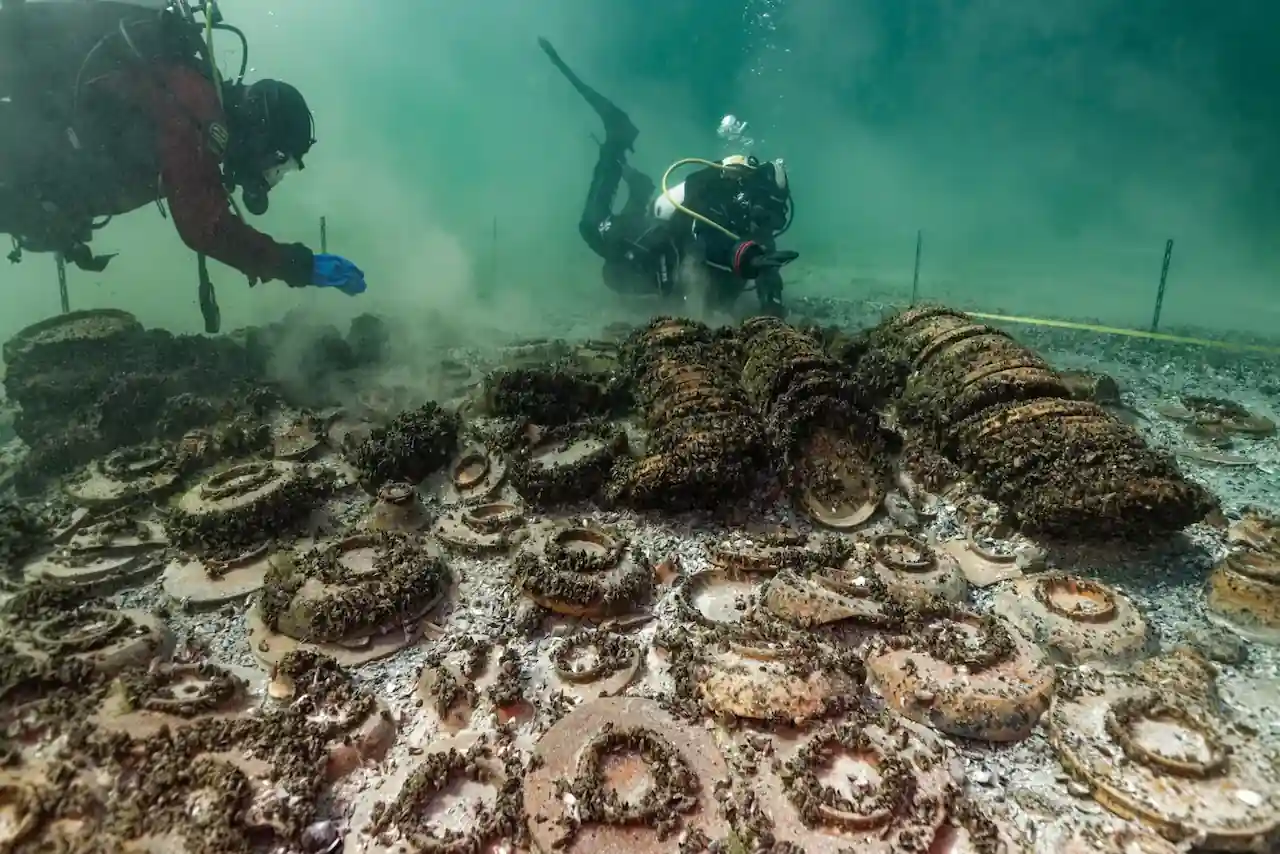
An underwater archaeology operation in Switzerland has brought to light, at the bottom of Lake Neuchâtel, the remains of a Roman cargo from a vessel that sank nearly two millennia ago. The Cantonal Office of Archaeology of Neuchâtel (OARC), in collaboration with the Octopus Foundation and the Archaeological Service of the State of Fribourg (SAEF), has carried out an excavation campaign since March 2025 that has made it possible to identify, document, and recover several hundreds of objects that lay submerged, constituting a unique assemblage in Switzerland and in inland waters north of the Alps.
The discovery dates back to November 2024, when an aerial photograph, taken as part of the sanitary monitoring of lakebeds and submerged heritage carried out by the OARC, revealed the anomalous presence of materials on the lake floor. Subsequent underwater surveys confirmed the scale of the discovery: these were the final remains of a shipwreck that occurred at some point between the years 20 and 50 of our era, from a vessel of which no structural trace remains, but whose cargo has remained at the bottom of the lake in an exceptional state of preservation.
The richness and diversity of the recovered goods have led archaeologists to classify this assemblage as extraordinary. The need to act urgently prompted the first excavation campaign in March 2025, aimed at evaluating the site’s potential and, above all, safeguarding the objects against multiple threats.
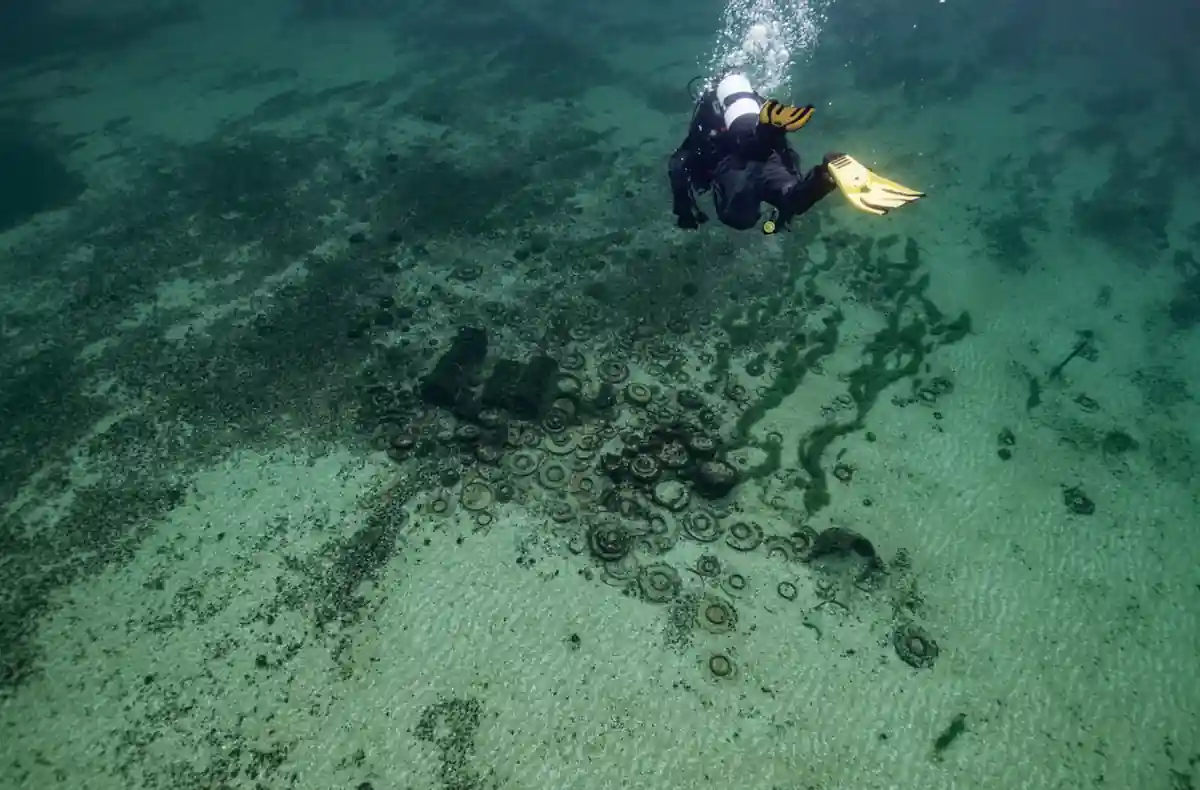 General view of the Roman cargo uncovered. Credit: Octopus Foundation
Despite the apparently good state of preservation, the fragility of the context is extreme. Lakebeds are subject to continuous erosion processes, recreational boats anchoring in the area pose a constant risk of disturbance, and, more seriously, there is the latent threat of looting and malicious acts. In order to mitigate these risks preventively, the most vulnerable objects have been systematically recovered after completing their corresponding in situ documentation.
The contents of the cargo reveal an amalgam of products of regional and long-distance origin. The most voluminous part of the assemblage is composed of several hundred ceramic vessels that, almost miraculously, have survived intact to the present day. These consist mainly of tableware—plates, platters, cups, and bowls—whose production has been linked to regional workshops within the Swiss Plateau.
Alongside this local tableware, the presence of a significant number of amphorae intended for the transport of olive oil, imported from the Iberian Peninsula, attests to the integration of this territory into the long-distance trade networks characteristic of the Roman Empire.
However, the archaeological interest of the assemblage is not limited to ceramics. Among the recovered objects are also utensils and tools linked to the daily life of those who sailed on board. Archaeologists have also identified harness and cart elements, among which wheels in perfect condition stand out, constituting the only Roman examples of this type found in Switzerland.
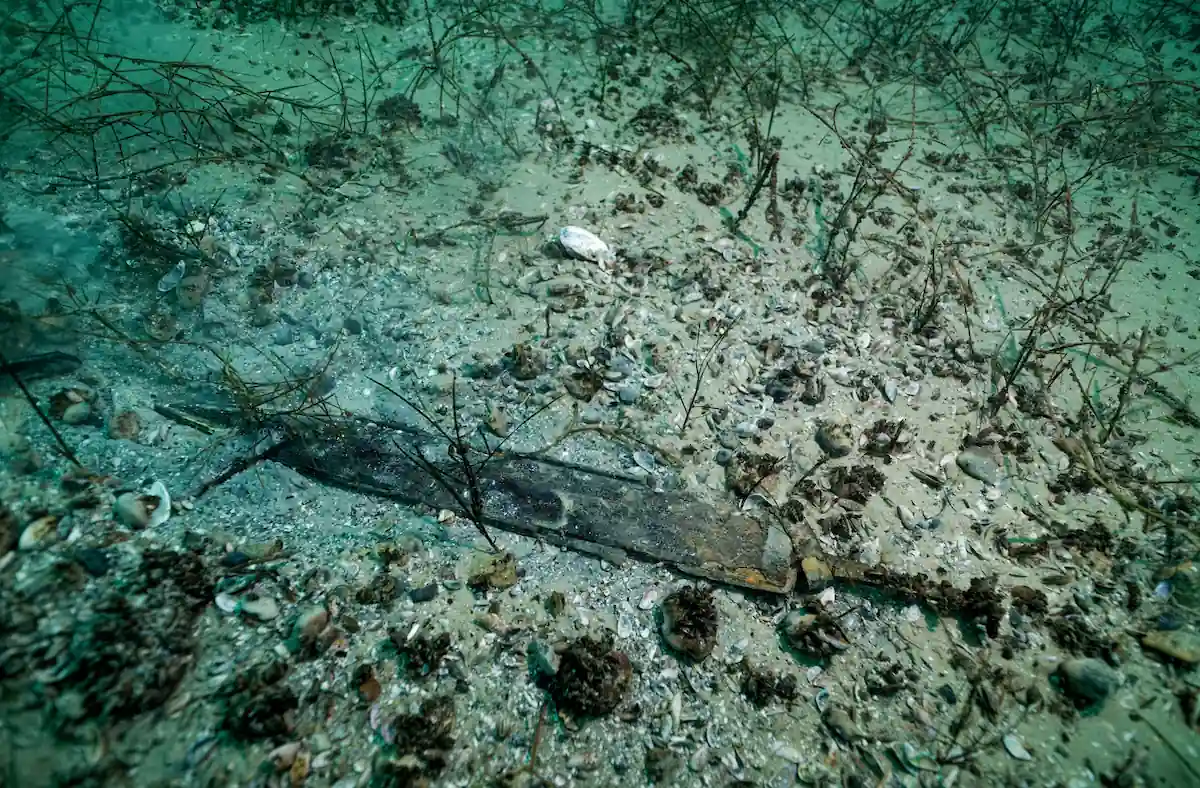 One of the roman gladius found. Credit: Octopus Foundation
The presence of these components points toward a dual transport system, in which goods were transferred between land and lake routes, using a combined logistical infrastructure.

Subscribe to our newsletter
Receive our news and articles in your email for free. You can also support us with a monthly subscription and receive exclusive content.
The discovery of weapons, specifically several gladii or short swords, has introduced an element of particular interest for the historical interpretation of the shipwreck. The combination of a cargo of a civilian nature with the presence of these weapons suggests that the vessel that sank between AD 20 and 50 was not a strictly military ship, but rather a merchant vessel sailing under armed escort, providing a new perspective on security along regional trade routes during the first half of the 1st century.
The research prospects opened by this discovery are considerable. The directors of the excavation emphasize that the cargo, due to its excellent state of preservation and having been recovered in a clearly defined archaeological context, constitutes a source of information of invaluable value.
Future studies are expected to advance knowledge of commercial exchange networks in antiquity, the technical knowledge of the time, and the precise identification of the pottery workshops that produced the recovered tableware. The assemblage of objects also offers a unique opportunity to analyze the distribution circuits of manufactured products within the context of the Roman Empire.
Parallel to the scientific research, the institutions involved have established a roadmap for the public dissemination of the results. Once the initial phases of specialized study have been completed, the objective is to share the findings with society through a museum presentation at the Laténium, the archaeology park and museum of Neuchâtel, which houses one of the most significant collections of the period in Switzerland.
Before this process of public presentation can be carried out, conservation-restoration teams face meticulous and unavoidable work. All recovered objects, despite their apparently good condition, require stabilization and conservation treatment to guarantee their future accessibility and ensure optimal sanitary conditions that will allow their long-term preservation.
This meticulous work, which has already begun, is presented as an essential intervention so that a heritage that has remained underwater for two millennia can be studied and admired by future generations. The underwater operation, led by the OARC with the support of the Octopus Foundation and the SAEF, thus consolidates the importance of preventive archaeology and interinstitutional collaboration in the protection of submerged cultural heritage in Switzerland.
Dining and Cooking