
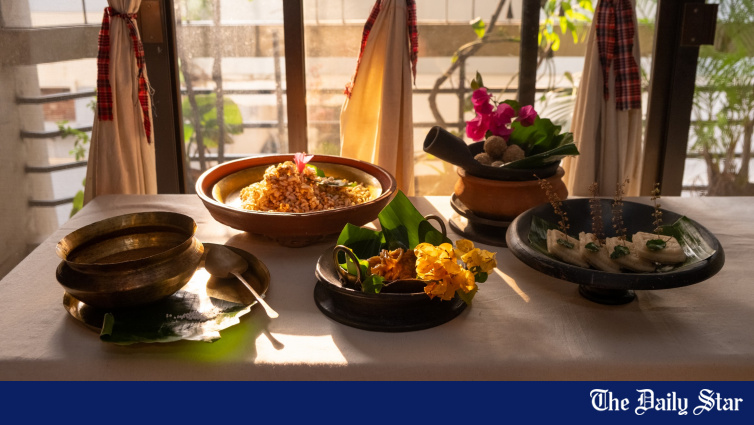
On a quiet table sits a moulded piece of semolina (suji) halwa. It looks simple enough, almost austere. There is no heavy gloss of ghee, no syrup pooling around the edges, no elaborate garnish. Instead, it carries the faint scent of coconut oil and the subtle green of a tulsi leaf placed carefully on top. For Faiza Ahmed, this modest plate tells a larger story.
Photo: Silvia Mahjabin
“Sujir halwa feels like childhood to me,” she says. “The way we usually eat it today – with ghee and milk – is not the only way it existed. I make mine only with coconut oil. I do not add milk because I’m vegan. And I fry the semolina very lightly so it remains soft.”
The result is not a reinvention. It is a recovery.
Faiza Ahmed, a fashion designer, visual artist, and culinary thinker, has spent the past decade quietly questioning what Bangladesh chooses to remember and what it chooses to forget. Her plant-based culinary venture, Sanchayita, first launched in 2015, grew out of a simple idea: heritage food should not survive only as nostalgia.
Photo: Silvia Mahjabin
“The idea for Sanchayita was specifically to work on reviving local heritage food,” she says.
“Fusion is positive, but entering fusion does not mean sending our heritage food to the departure lounge.”
Ahmed often compares this attitude toward food with how people sometimes treat traditional clothing. Just as the saree is dismissed as inconvenient in modern life, simple local foods are often overlooked in favour of new trends.
To her, abandoning these traditions risks weakening cultural identity. “If we discard our own things,” she explains, “Then we are living in a borrowed place.”
Sanchayita responds to this concern by bringing familiar but often neglected dishes back into contemporary dining spaces. Many of Ahmed’s recipes are rooted in research into older cooking practices.
Photo: Silvia Mahjabin
While exploring heritage sweets, she discovered that halwa was historically made with oils such as mustard oil rather than butter or ghee. This insight allowed her to reinterpret such recipes within a completely plant-based framework.
Ahmed’s kitchen is entirely vegan. No dairy, honey, or animal products are used. Instead, ingredients such as coconut milk, jaggery, nuts, and natural oils form the foundation of her dishes. Initially, some questioned whether traditional sweets could retain their richness without ghee or milk. Over time, however, diners have embraced the approach.
“People who are not vegan also enjoy the food,” she says. “They don’t feel something is missing.”
Photo: Silvia Mahjabin
One of Sanchayita’s most popular desserts is sabudana kheer, made with coconut milk and jaggery rather than refined sugar. Tapioca pearls are soaked until translucent and simmered until thick, producing a rich yet balanced dessert often garnished with peanut dust.
Ahmed notes that while tapioca is celebrated globally, the Bengali name “sabudanar kheer” is sometimes dismissed as outdated. Yet, visitors, including foreigners, often respond enthusiastically to its simplicity and depth of flavour.
Alongside desserts, Ahmed revives everyday snacks such as mishti khoi, puffed rice coated in “nolen gur”. She describes it as a healthier alternative to imported breakfast cereals. At home, it even serves as morning cereal for her son. “If we store it in a jar, it becomes something you can eat anytime,” she says.
Presentation also plays an important role in Ahmed’s work. Drawing from her background in visual arts, she plates food carefully, often using traditional moulds and vessels. This visual attention helps younger diners engage with dishes they might otherwise overlook.
Photo: Silvia Mahjabin
“If we plate our simple foods properly,” she says, “People realise how beautiful they are.”
At its core, Sanchayita is less about reinventing Bengali cuisine than about restoring its confidence. Ahmed believes heritage foods should not survive only during festivals like Pahela Baishakh. Instead, they should remain part of everyday life, evolving gently while retaining their roots.
Through Sanchayita, Faiza Ahmed demonstrates that cultural preservation does not require grand gestures. Sometimes it begins with something as simple as cooking an old recipe carefully, plating it thoughtfully, and placing it back on the table.
Dining and Cooking