
As of 2026, there are two Michelin-starred gastropubs in London. For the better part of fifteen years, The Harwood Arms has been all alone in holding the fort for Michelin-starred pub dining in the English capital. That changed earlier in the year when, 10 months after opening, The Kerfield Arms in Camberwell was awarded a star. The sister restaurant to The Baring over in Islington (another fine gastropub, and one I'd also recommend), The Kerfield Arms is led by head chef Jay Styler, whose pared-back, ingredient-led and unfussy approach has won over the Michelin inspectors. Prior to moving across to the newly-opened The Kerfield Arms in 2025, Styler had stints at several restaurants up and down the country, before holding the head chef position at The Baring for three years.
More so than at The Harwood Arms (which I'd contest is a restaurant masquerading as a pub, and should be judged as such), at The Kerfield Arms you are hit with that chattery buzz endemic to lively pubs up and down the country, as soon as you walk through the door. Bar to the left, tables (candlelit on an evening, as the lights are turned down low) to the right (and pretty much everywhere), it takes a moment to find the front of house receiving dining guests through the sapien horde.
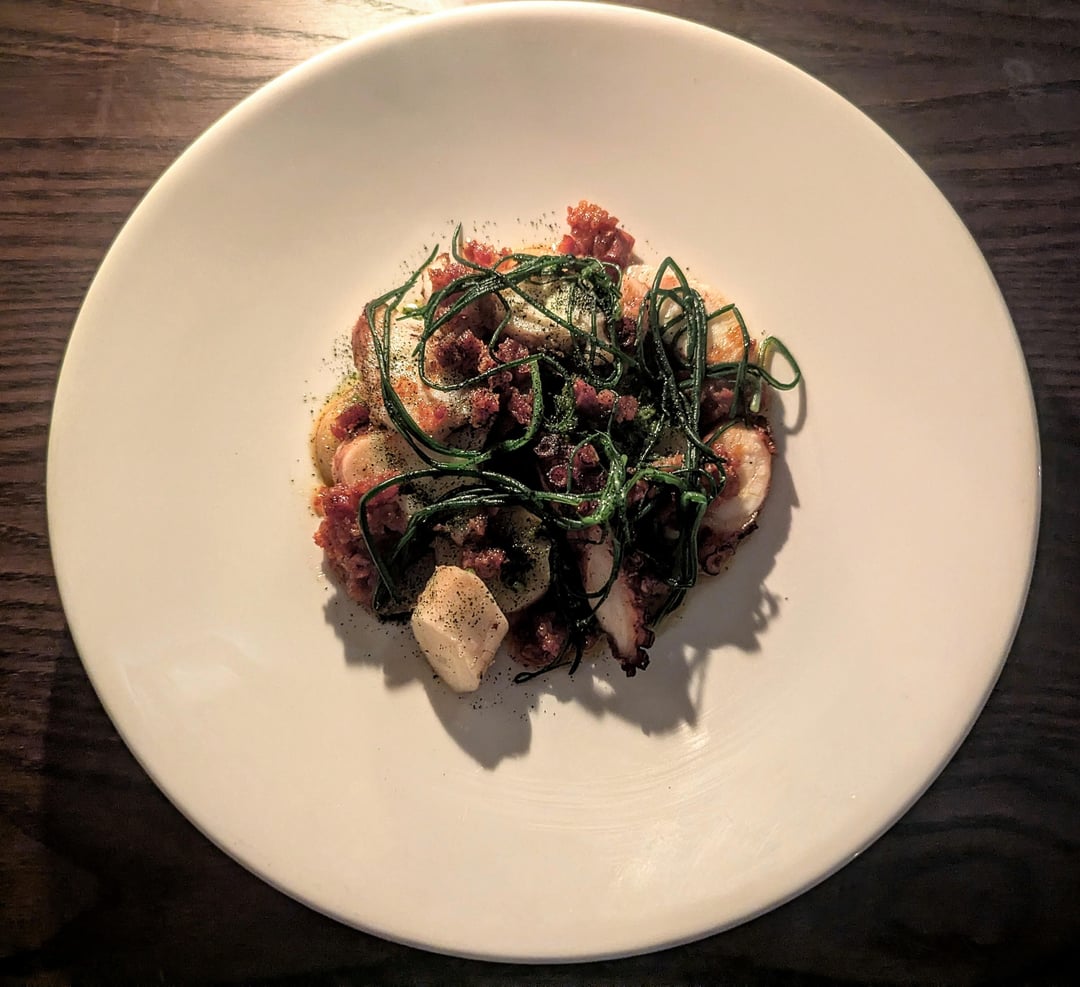
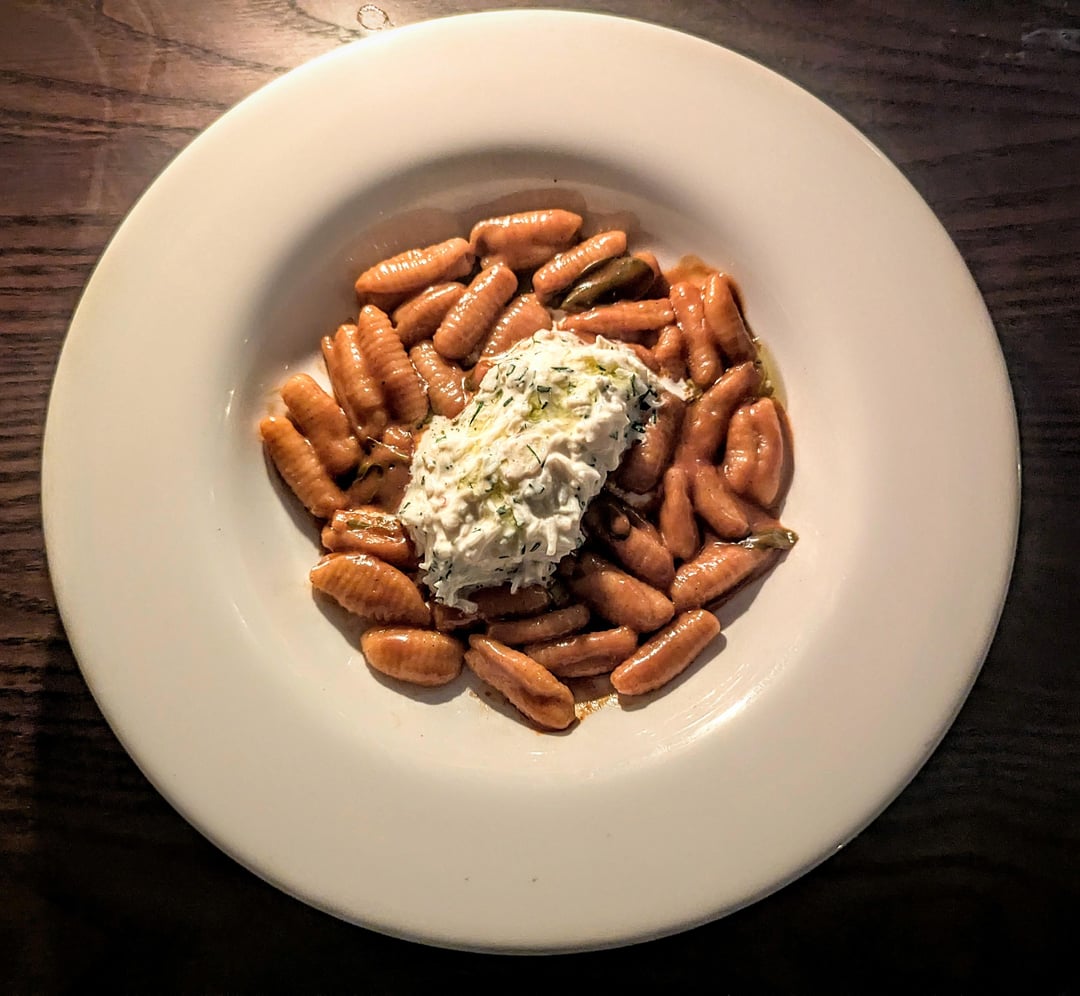
This being a gastropub, à la carte was and likely forever will be the order of the day, and we went for two starters, two mains and two desserts to share. The octopus and chorizo starter was excellent, all of the flavours very clear on the plate, with the crumbled chorizo and its inherent saltiness attenuating the flavours of the other ingredients. The garlic and herbaceous quality of the mojo verde worked well with the potatoes, and the octopus was cooked to a welcome tenderness. Sadly the crab cavatelli didn't meet the high quality of the other starter; the crab itself had a fresh taste, but it was not built upon in any meaningful way by the bisque that coated the pasta. While the pasta was nicely cooked, there just wasn't much to go at with this dish.
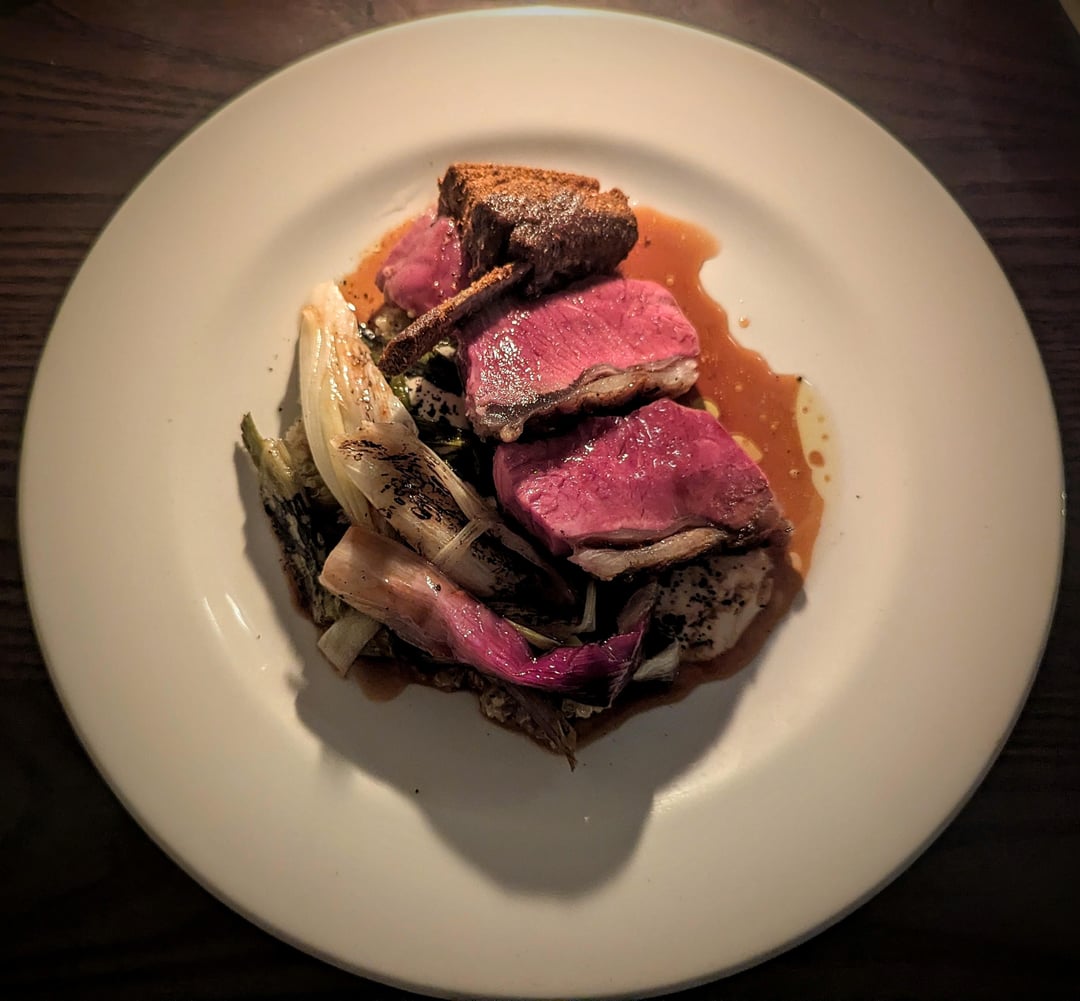
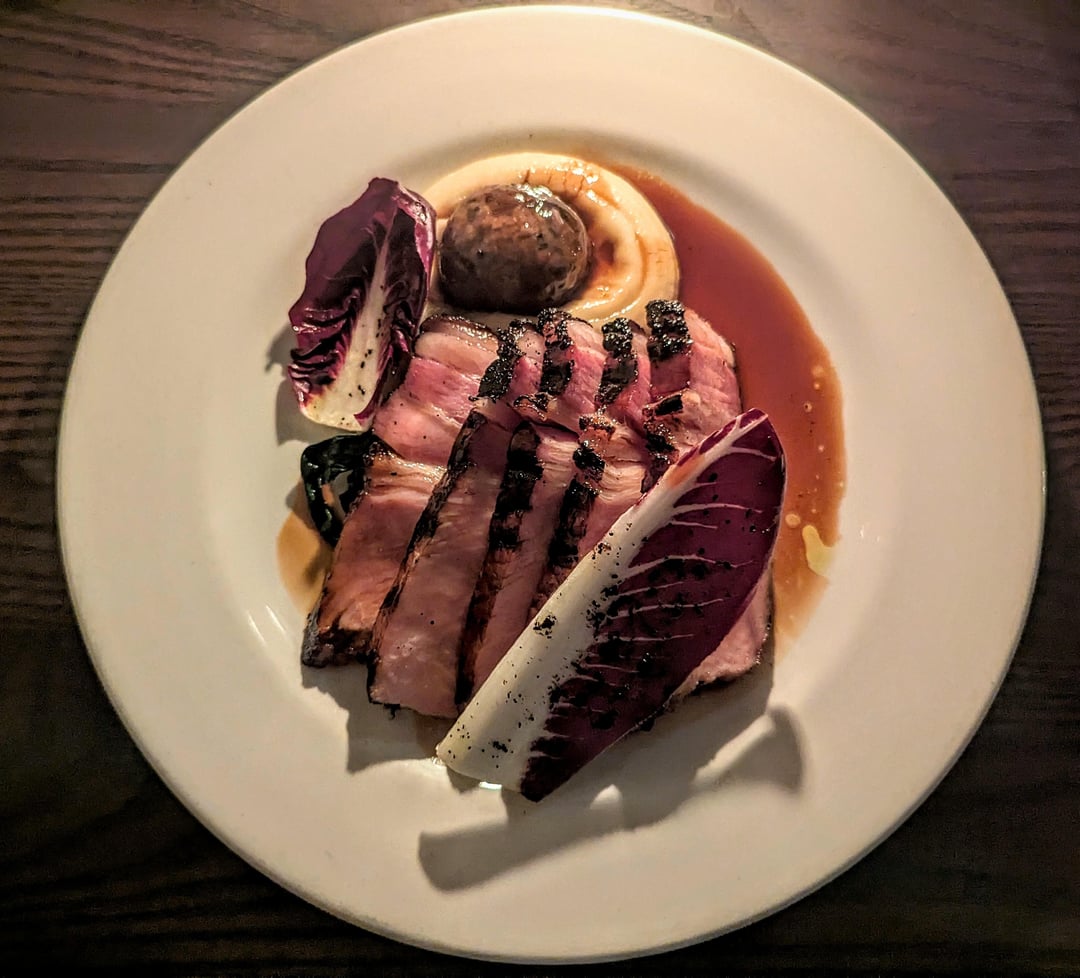
Onto the mains, one being good and one being excellent. First the good: grilled bacon chop with smoked mash and prune. This is what was written on the menu, but a quick eyeball will tell you that that is not a prune on the plate. It is a faggot, a British meatball typically made from Pork off-cuts. The smoked mash (which was not too far from being a pomme purée) and faggot were exemplary accompaniments to the grilled bacon chop, which itself was pink and tender (though I would have preferred a little more fat and caramelization therein). The other main we had, the swaledale lamb with quinoa, was truly excellent. The yoghurt coated the quinoa thoroughly and leant every bite sweetness, while the lamb – as should be the case – was the star of the show. Perfectly cooked (achieving that glistening fat that I would have liked to also see on a less lean cut of pork), the lamb rib had seasoning that differed from the other cuts, and was something of a flavour bomb. The rub consisted of cumin, oregano and pul biber chilli flakes, and together with the tenderness of the lamb, made for the clear highlight of the meal.
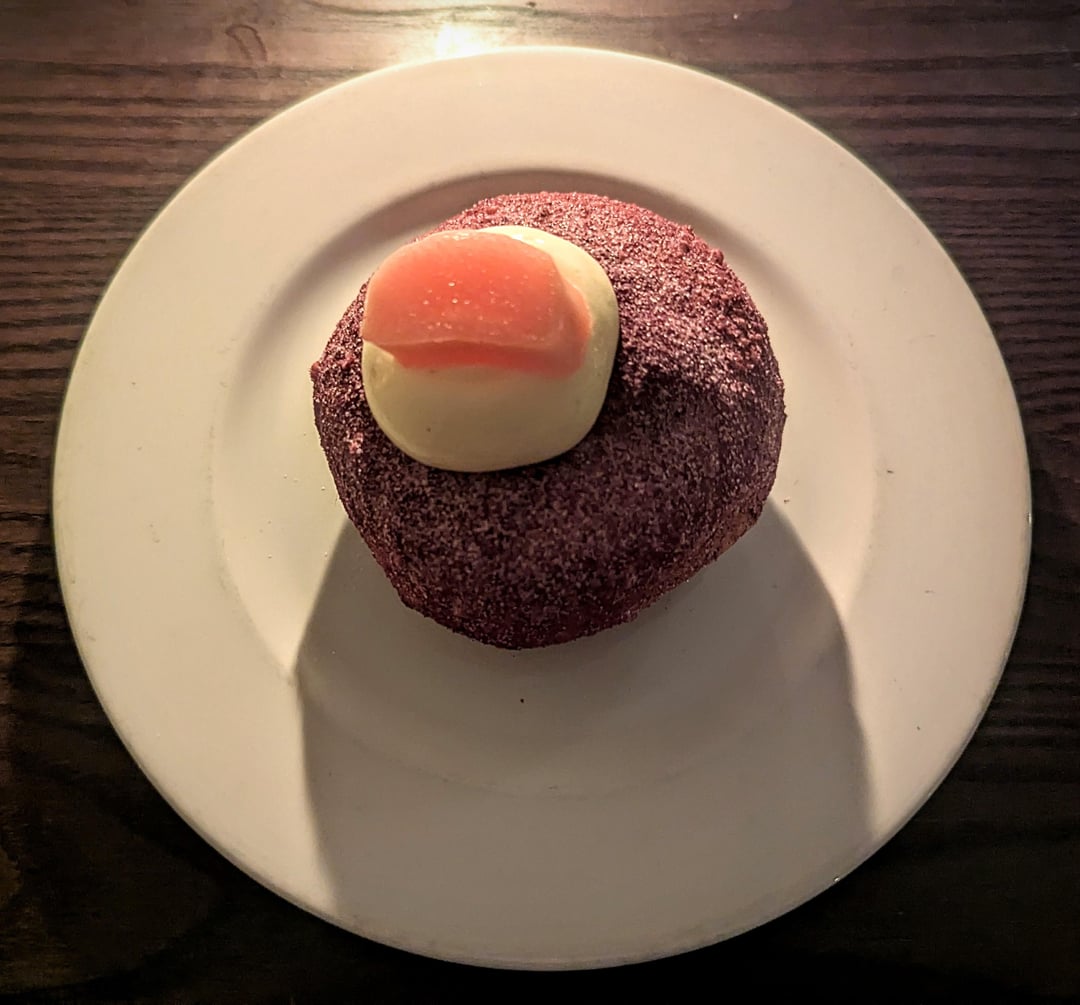
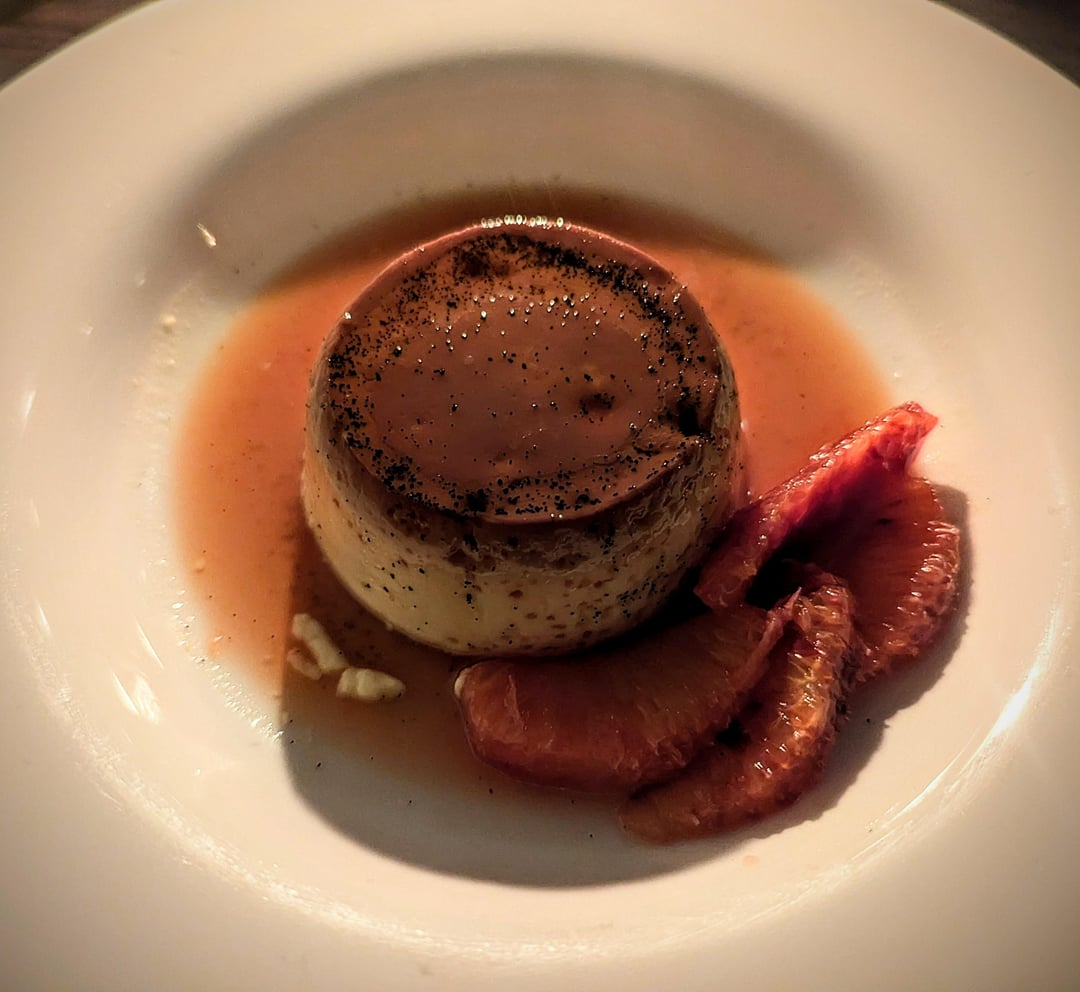
Rounding off the meal with desserts, the crème caramel with blood orange was a fine attempt, though the blood orange didn't really add anything to the crème caramel. Again a tale of two halves, the doughnut, meanwhile, was excellent. The dough was light with a crunchy exterior, and the custard and rhubarb jam (with pieces of rhubarb suspended in this viscous mixture) worked well as a filling; slightly tart, slightly sweet, but not completely drowning out the flavour of the fried dough.
Overall, we had a good meal at The Kerfield Arms, and there is no denying that there is some very capable cooking going on here. While I would happily return, I have waited a couple of days to write this, because there is a wider point here that I think worth considering. The reason for the wait is because I visited Bouchon Racine yesterday evening (a return visit, because I dare anyone to go just the once), and my dining companion and I both consider it one of the finest examples of casual dining in London. The Kerfield Arms is, similarly, casual dining. Sure, it may have a Michelin star, but 'one swallow does not a summer make'. Why have I posted this review in this sub then? One reason because of the star accolade, the other to broach this very subject. The Michelin guide says that 'A Michelin star is awarded to restaurants offering outstanding cooking'. Fair enough, but then if The Kerfield Arms or The Harwood Arms are considered Michelin-worthy, both of which are on the casual end, then there are clear omissions, not least Bouchon Racine and The French House. I feel that, when those gates are thrown open, a whole host of restaurants on the casual end can and should be considered. Perhaps its best to keep those gates closed, as a means not to devalue the star (though I can't see how much more it could be devalued at this point).
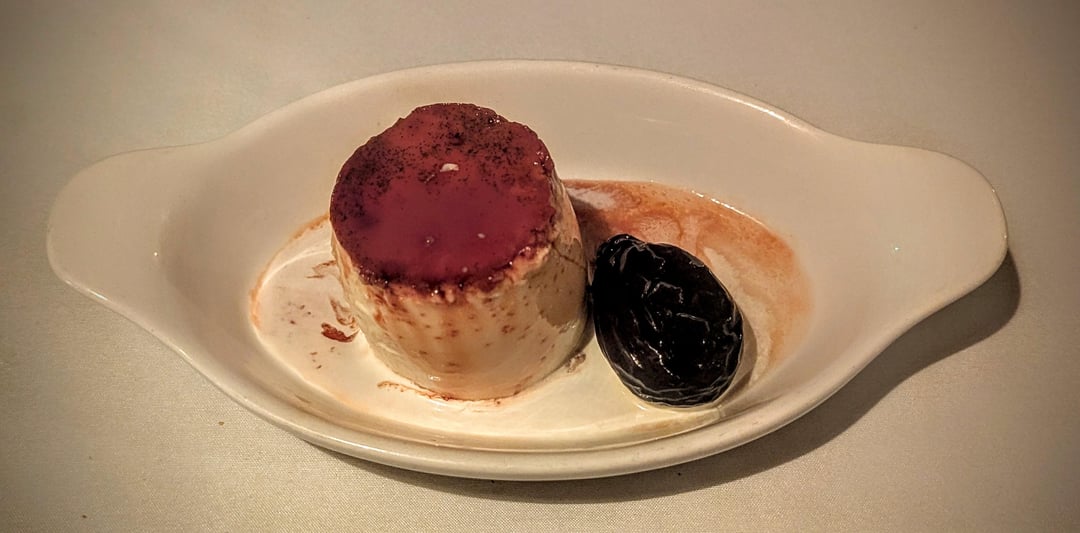
As a final thought, I finish this review with a note and a picture of the crème caramel at Bouchon Racine. Served with a prune soaked in armagnac, this is how the crème caramel should be done. An iconic dessert at a wonderful restaurant that, if casual establishments are to be considered for stars, presents as a glaring omission.
Courses:
Octopus, chorizo, pink firs, mojo verde
Crab cavatelli, bisque and pickled purslane
Swaledale lamb, quinoa, Tropea onions and muscovado yoghurt
Grilled bacon chop, cavolo nero, smoked mash and prune
Yorkshire rhubarb and custard doughnut
Crème caramel and blood orange (pictured sixth; the crème caramel from Bouchon Racine pictured seventh)
by MaaDFoXX
5 Comments
Looks great!
> One reason because of the star accolade, the other to broach this very subject. The Michelin guide says that ‘A Michelin star is awarded to restaurants offering outstanding cooking’. Fair enough, but then if The Kerfield Arms or The Harwood Arms are considered Michelin-worthy, both of which are on the casual end, then there are clear omissions, not least Bouchon Racine and The French House.
Yes I’d agree with your broad point here.
The underlying issue is that the * level has always been a slightly problematic category. Once you are at ** or above you are indisputably in the realm of fine dining, tasting menus, napkin sniffing and all that jazz. The * level however ranges across the whole gamut from wannabe two stars (cf Row on 5 up to this year) to well-crafted neighbourhood restaurant. There is simply a very wide range of styles and formality within this category.
I mean St John and The River Cafe (or say Chez Panisse in the US) are prime examples of the issue. Can’t remember their current status but for years they bounced in and out of the * category. Are they really Michelin one star restaurants? The food is delicious, well crafted and frequently outstanding. But tbh it feels like the adage that if your only tool is a hammer then everything looks like a nail..
PS I’d also agree the Harwood Arms is more a restaurant not a pub, and the Hand & Flowers doubly so.
Obviously photos are subjective, but that all looks disgusting.
You touch on something I have thought about a lot. I have been to several pubs in the guide now, including a few with stars..
I have never had a bad meal at them, in fact I’ve always had a very good one.
But the jump between the starred ones, the recommended ones, and ones that are very good but not in the guide isn’t always super clear.
The Bailiwick’s speciality game options did not feel two whole stars below the offerings at Hand & Flowers, for example. And while I will also say that the oxtail & kidney pudding at Hinds Head (*) is one of my favourite dishes I have ever had at a pub, the quality of the lobster tortellini starter at The Stile Bridge gave it a run for its money.
I also don’t know what Red Lion East Chisenbury did to lose its star because both times I have dined there (tasting and a la carte) it’s been on a par with most starred places I have eaten at.
Where I really scratch my head is a tier lower. Sometimes I have visited a pub that’s in the guide, then been to another one the next village along and it’s just as good. Maybe it’s the consistency?
Another thing I have noticed is that a lot of more village/small town starred places often have a pub nearby that’s in the guide. I do wonder if the inspectors thought “well, if we have to go all the way over here for dinner, might as well try this pub nearby for lunch to see if we can kill two birds with one stone”.
The one star bracket is the absolute Wild West (let’s not get started on Green stars). The gulf in cooking from restaurants that should clearly no longer hold a star, to the restaurants knocking the door down to two stars is enormous.